

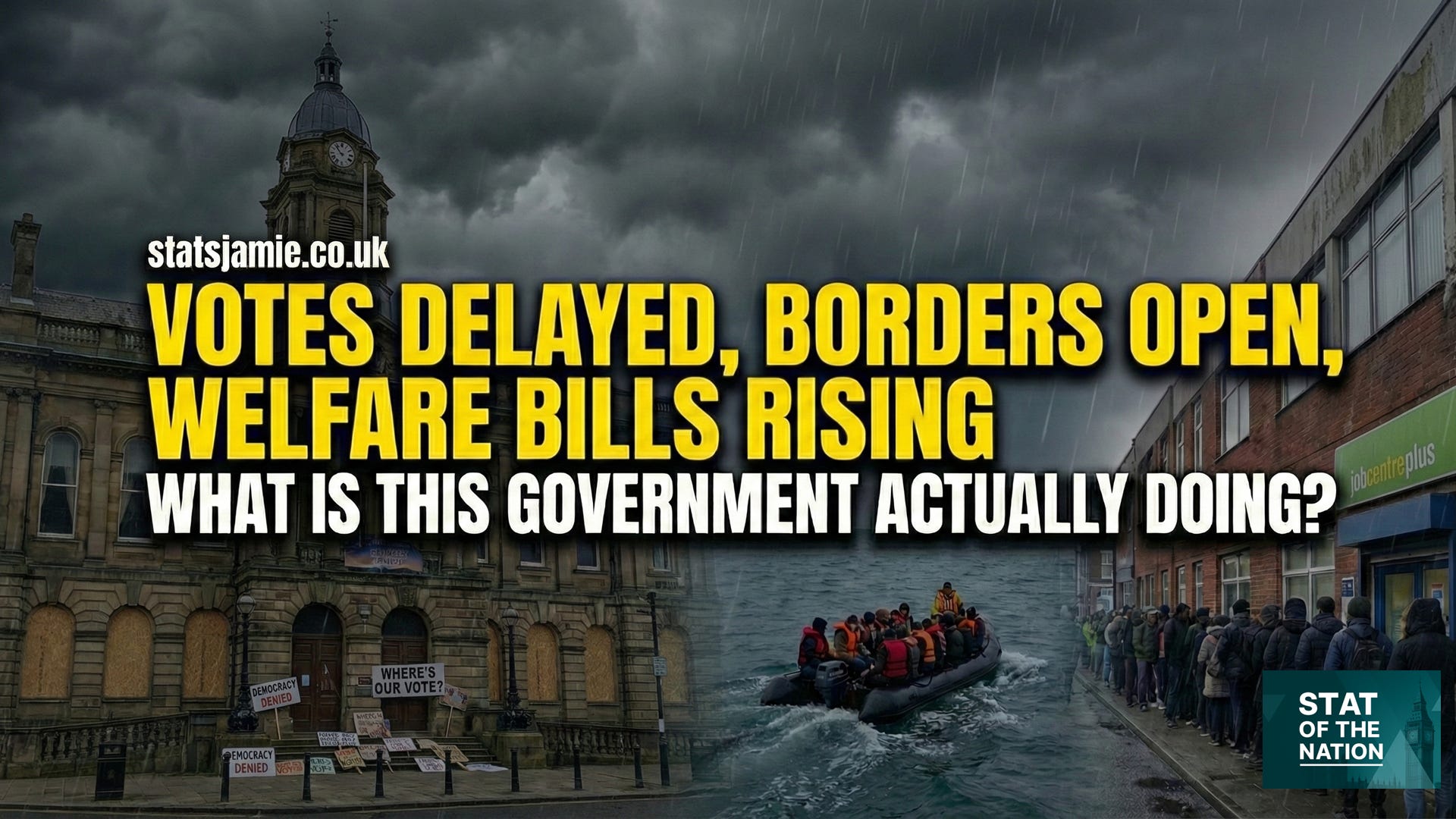
This week’s Stat of the Nation cuts across three very different stories — but they all point in the same direction: a government ducking accountability, failing to deliver, and hoping branding can paper over the cracks.
We looked at:
Why local elections are being postponed just as voters are drifting away from the political mainstream
How Labour’s much-vaunted “one in, one out” migration scheme is already unravelling
And how the “super flu” scare quietly collapsed once the data caught up with the headlines
I also joined Mike Graham for my usual weekly roundup on his show — and later in the week made another appearance on Plank of the Week, where, as ever, nobody held back.
🗳️ Democracy deferred: elections postponed — and now councillors are quitting in protest
Local elections due in May across 29 English councils have been postponed on the grounds of local government reorganisation. The government says it’s about capacity and efficiency. Critics say it’s something else entirely: politicians extending their time in office without asking voters for permission.
And this week we learned something that makes the story even harder for ministers to dismiss as “procedural”: some councillors are now resigning — or threatening to resign — in protest.
What we learned this week
In Norfolk, a county councillor who quit over the delayed elections urged others to do the same — explicitly to force by-elections and give residents a chance to vote.
ITV also reported councillors threatening to resign to force cancelled elections back onto the ballot paper — a sign the revolt isn’t just online outrage, it’s reaching inside the system.
In Welwyn Hatfield, the council leader resigned after the postponement controversy — an unusually public act that underlines how politically toxic these delays are becoming at the local level.
Why this matters
This is no longer just an abstract argument about democratic principles. When elected councillors themselves start walking away — or openly talking about using resignation as a tool to trigger votes — it shows the postponements are being seen as a legitimacy problem, not an admin tweak.
Because once you normalise “we’ll vote later”, you’re only a short step from “we’ll vote when it suits us.”

🚤 One in, one out: policy by slogan, failure by design
Labour’s flagship migration message — “one in, one out” — was supposed to project control, competence, and firmness.
Instead, it’s become a case study in government by slogan.
Yes, the numbers matter — and they already show the scheme isn’t working as advertised. But the deeper failure is political, not mathematical.
This policy was sold as:
Tough
Deterrent
Credible
In practice, it’s:
Small-scale
Easily overwhelmed
Dependent on calm weather rather than state capacity
The uncomfortable truth is that the government knows this scheme doesn’t touch the sides — but keeps talking it up anyway, hoping presentation can substitute for results.
When a single calm day in the Channel can undo weeks of removals, you don’t have a serious policy. You have a press release.

🏥 “Super flu”: when the panic ran ahead of the data
Back in December, the language was apocalyptic: crisis headlines, winter emergency framing, and familiar calls for restrictions.
But once the surveillance data was in, the story quietly changed.
The charts showed:
A clear peak and decline
No exceptional severity
Pressure — yes — but nothing approaching the implied catastrophe
This wasn’t a denial of winter strain. It was a reminder of something more important: panic travels faster than evidence.
And once again, we saw how quickly parts of the media defaulted to the old pandemic script — even as the data refused to cooperate

💷 On Mike Graham: the Great Welfare U-Turn and the “two speeds” problem
I joined Mike Graham for my regular weekly slot on the The Mike Graham Show, and we dug into several topics — one of the biggest being the welfare system, which now looks like a major reform agenda quietly being watered down and pushed back.
The issue isn’t whether we should have a safety net. We should. The issue is what happens when the state starts treating welfare as something closer to a permanent settlement than a temporary support — and then asks the people who are already struggling to keep paying for it.
That’s where the “two speeds” problem comes in.
Because when working people look at their take-home pay, their rent, their bills — and then look at what the system offers to those not working — the question becomes unavoidable:
Does this country still reward effort?
And if the answer starts to look like “not really”, you don’t get a fairer society. You get a more cynical one: lower productivity, weaker incentives, and a growing sense that the people doing the graft are being treated as the automatic pay-pig for everyone else.
We made the point on air that politics is drifting into something dangerous here: reforms postponed, responsibilities blurred, and taxpayers left carrying the load — all because confronting the problem is politically painful.
But delaying it doesn’t remove the cost. It just shifts it onto the very people who already feel squeezed — and that’s how trust in the system breaks.
If you reward idleness and punish industriousness, the outcome isn’t compassion. It’s decline.
🪵 Plank of the Week: the “Prosper” bubble
I also joined Mike Graham for Plank of the Week alongside Kelvin MacKenzie and Donald MacLeod — fast-paced, blunt, and very much not interested in polite Westminster phrasing.
I kicked things off by taking aim at the launch of Prosper UK — the new “centrist” movement. On air, I said it felt like a political boy band reunion: watching Andy Street and Ruth Davidson try to reclaim the “sensible middle” was like watching S Club 7 or Take That attempt a comeback — fewer hits, more white papers. It’s basically 2016 nostalgia being marketed to a 2026 audience that’s already moved on — and it says a lot about how out of sync the political class has become with what people actually want.
From there, the absurdity ramped up. We got into the Forestry Commission’s latest antics — what we joked was basically a tax on fresh air — and it fed straight into the wider point: the growing “two fingers” attitude from parts of government, where the state looks more interested in inventing new ways to fine you than actually serving you. I joked it’s the same instinct behind 20mph zones and all the rest: the bureaucratic worldview where your freedom is an inconvenience.
We wrapped it by tearing into Keir Starmer’s recent China diplomacy — which, frankly, felt less like a serious leader advancing national interests and more like the establishment performing competence for the cameras. Even the week’s unintentional metaphor wrote itself: British Airways literally lost a wheel on the runway in Las Vegas. As we said on the show: what happens in Vegas usually stays in Vegas — but in BA’s case, it stayed right there on the tarmac.
The takeaway
Across every story this week, the pattern is unmistakable:
Delay decisions
Rebrand failure
Avoid accountability
Hope voters forget
But the data doesn’t forget. And neither do people paying the bills.
That’s why Stat of the Nation exists — to cut through the noise, strip out the slogans, and show what’s really going on.
✍️ Jamie Jenkins
Stats Jamie | Stats, Facts & Opinions
📢 Call to Action
If this helped cut through the noise, share it and subscribe free by entering your email in the box below and get the stats before the spin, straight to your inbox (no algorithms).
📚 If you found this useful, you might also want to read:

📲 Follow me here for more daily updates:
https://thebluearmchair.substack.com/p/the-dangers-of-irony?r=5kmhkr
Govt creates money (digital info you can spend) the same way I'm creating this comment (digital info you can read). As money is govt IOUs (say the BoE, March 2014 Quarterly Bulletin PDF), taxation effectively destroys it, preventing inflation. Rinse, repeat. There's your future welfare state taken care of. Since it seems highly unlikely there'll be anything like enough jobs to go round even for those who want them, other than create enough money for people to live on via the welfare state, what else are we going to do?