

I hope you had a lovely Christmas — and that you’re heading into the new year feeling rested, recharged, and ready for whatever 2026 has in store for you.
Before we all get swept up in “fresh starts” and big promises, it’s worth grounding ourselves in what the numbers are actually saying right now. And over the last week on Stat Of The Nation, the picture is pretty clear: the state is getting bigger, more expensive, and less effective — while the underlying economic problems remain unresolved.
From record borrowing to costly tech schemes, to symbolic taxes that raise next to nothing, the gap between political intent and real-world impact keeps widening.
Here’s what the numbers showed this week.
💷 £163bn a Year Borrowed — And Still No Growth
The headline figure alone should stop any serious conversation in its tracks: the UK is now borrowing around £163 billion a year.
• Debt continues to rise despite record tax receipts
• Public spending is growing faster than the economy
• Interest costs alone now absorb around £100bn annually
This isn’t borrowing to build long-term productive capacity. It’s borrowing to stand still.
If this level of debt were delivering stronger growth, rising productivity, or higher real wages, there might at least be a case to defend it. But it isn’t. We’re paying more — and getting less.
That’s not an investment. It’s drift.

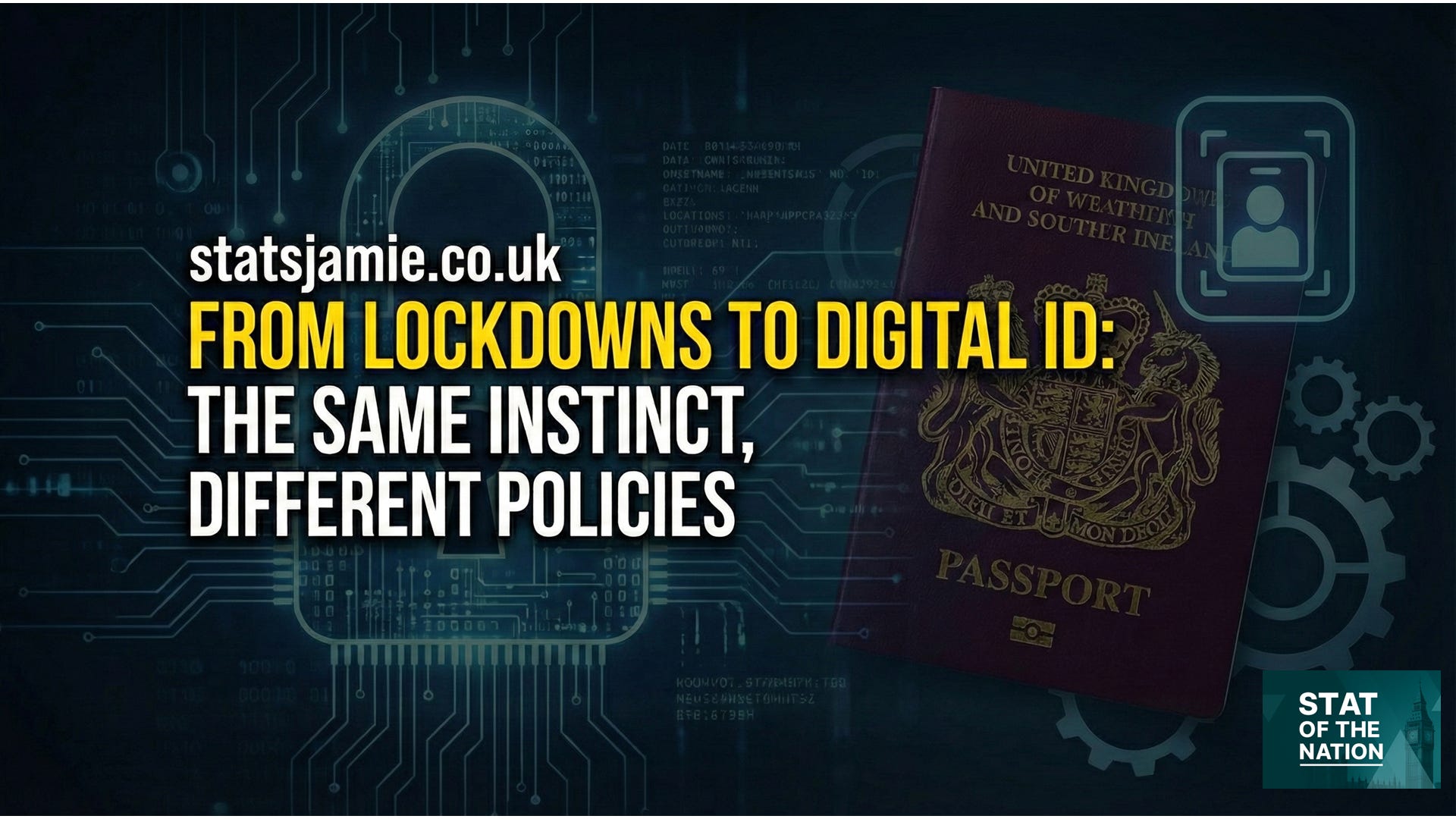
🪪 The £1.8bn Digital ID Scheme — High Cost, Low Confidence
The same problem shows up when you look at how money is being spent.
The government’s digital ID scheme is now expected to cost £1.8 billion — without a manifesto mandate and without public consent.
• Whistleblowers have raised serious security concerns
• There is no clear evidence that it will meaningfully reduce illegal migration or illegal working
• The risks are being downplayed, while the costs keep rising
This is bureaucracy dressed up as reform.
When trust in institutions is already fragile, pushing through large-scale tech projects with unclear benefits and obvious vulnerabilities doesn’t strengthen confidence — it erodes it further.

🚜 The Farming Tax — A Gesture, Not a Solution
The proposed farming inheritance tax has been presented as “necessary” — with Keir Starmer explicitly linking it to funding the NHS. But once again, the numbers tell a very different story.
• Expected annual revenue: around £390 million
• Annual government borrowing: £163 billion
• Equivalent to roughly one day’s worth of public spending
To put that figure in context, the revenue raised by the farming tax is only a fraction of what the government spends each year on the asylum system.
If the goal really is to protect NHS funding, the obvious question is: why target family farms instead of tackling much larger, far less defensible areas of spending?
Even on the government’s own terms, the maths doesn’t work.
This tax was never going to fix the public finances or “save the NHS”. What it risks doing instead is accelerating the decline of domestic food production, undermining family farms, and hollowing out rural economies — all for a fiscal return that barely registers on the balance sheet.

🎄 When Welsh Labour Cancelled Christmas — And Why 2026 Matters
Looking back matters — because it tells you how power is exercised when scrutiny is low. Five years ago, days before Christmas, Welsh Labour cancelled Christmas overnight.
• Non-essential retail was shut
• Supermarkets stayed open — but with aisles literally taped off
• People could shop across the border, but not locally
It was a textbook case of performative control replacing practical sense.
And now, it matters again — because 2026 is when the Welsh public next go to the polls. Since then, support for Welsh Labour has fallen off a cliff. What was once near-total dominance has fractured into voter frustration and genuine competition.
Current polling shows the race for outright victory is extremely tight — with Plaid Cymru and Reform UK both now serious contenders. That collapse didn’t happen in isolation.
Across the UK, the Labour Party is pushing ahead with policies that reflect the same instinct for control — without a clear democratic mandate. That includes plans for a national digital ID system and proposals that would significantly weaken the role of jury trials.
Different policies. Same mindset.
Centralised power, reduced scrutiny, and major constitutional changes are being advanced without explicit public consent. 2026 won’t just be an election in Wales. It will be a reckoning — not just on economic performance, but on how power has been used.

📊 Why Stat of the Nation Exists
All of this is why Stat of the Nation exists. To step back from the noise. To strip away the slogans. And to look calmly at what the numbers actually say.
Whether it’s borrowing, taxation, digital ID, lockdown decision-making, or the quiet expansion of state power, the aim here is always the same: evidence first, spin last.
If you’ve found Stat of the Nation useful this year, the single biggest way you can support it is simple: share it.
Send it to a friend.
Forward it to family.
Drop a link into a group chat.
And a genuine thank you to everyone who’s found their way here from my other social media channels — X, Facebook, Instagram, YouTube, and TikTok. Your support is what makes this possible.
Let’s keep building a community that values facts, context, and clear thinking — not just in 2026, but well beyond it.
The numbers matter. And so does sharing them.
✍️ Jamie Jenkins
Stats Jamie | Stats, Facts & Opinions
📢 Call to Action
If this helped cut through the noise, share it and subscribe for free — get the stats before the spin, straight to your inbox (no algorithms).
📚 If you found this useful, you might also want to read:

📲 Follow me here for more daily updates:
I was born and raised in Cardiff but I've lived most of my adult life in England. My family still live in Wales. I often hear the view that Brexit has been a disaster for Wales because Wales no longer gets money from the EU. I keep pointing out that since the UK was a net contributor that any money received from the EU was our money in the first place but they will not accept it. It suddenly occurred to me that Wales is a little like a family which lives on benefit and will not work. Whining that they are not given enough money. Instead of promoting Wales as a place where businesses can flourish they waste money on projects like tree planting in Uganda. Do you think I've got that right?