

This Christmas Eve, families across Wales will walk freely through supermarkets and sit down to full tables with relatives.
Five years ago, that simple normality didn’t exist. In December 2020, the Welsh Government replaced Christmas with plastic sheeting, “essential” lists, and a legal retreat into isolation — policies that went further than anywhere else in the UK.
🚫 The Return of the “Non-Essential” Ban
On 19 December 2020, the Welsh Government announced Wales would move into Alert Level 4 from midnight — the highest tier of restrictions.
This wasn’t a new experiment. It was a return to a policy already trialled during the October 2020 firebreak — and one that had failed the common-sense test the first time.
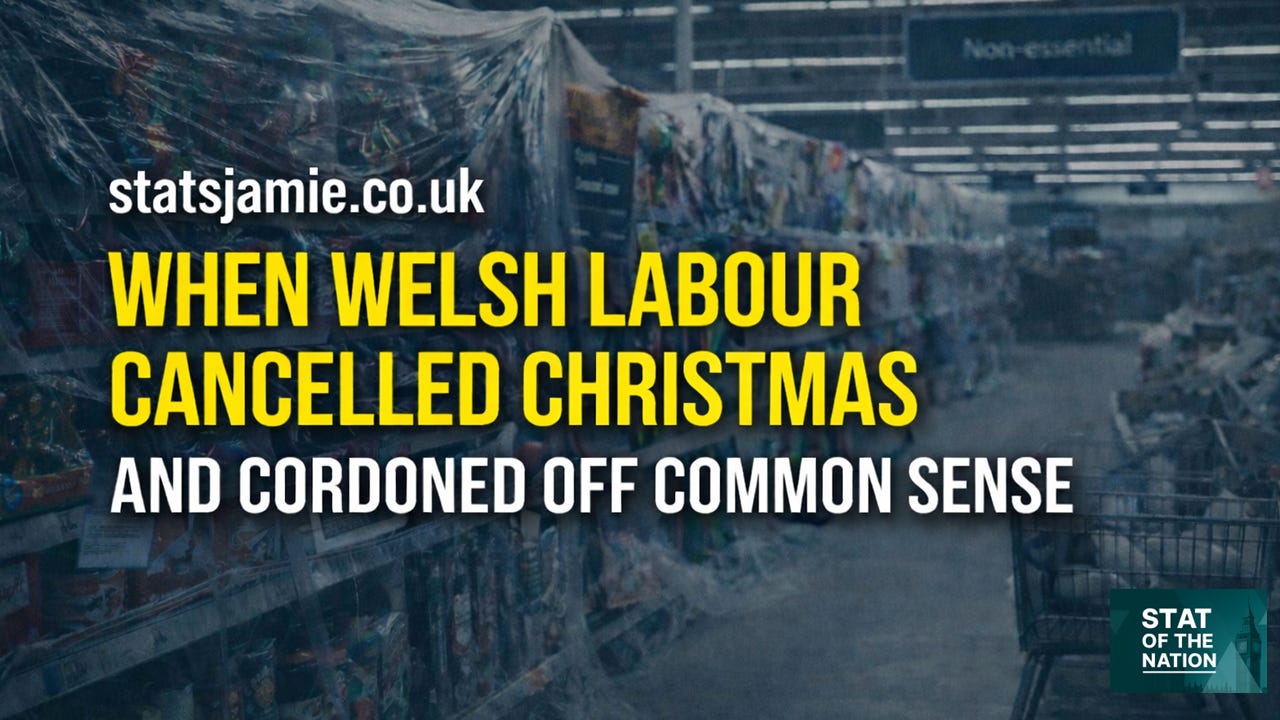
From midnight on Sunday, 20 December, supermarkets in Wales were legally barred from selling wide ranges of “non-essential” goods, despite being allowed to remain open for food, just days before Christmas.
Aisles cordoned off: Non-essential sections were physically blocked or covered.
Banned from the basket: Children’s toys, clothing, household items — and even Christmas decorations — were treated as contraband days before Christmas.
🧾 Seen in Real Time
This wasn’t just something people read about later — it was unfolding in front of shoppers’ eyes.
In the days before Christmas, people across Wales were posting photos on social media from inside supermarkets, showing aisles physically wrapped in plastic, including sections selling wrapping paper itself.
It became a symbol of how detached the rules were from everyday life: families legally allowed to shop for food, but blocked from buying the paper needed to wrap the presents they already owned.
The policy didn’t just restrict behaviour — it actively undermined basic Christmas preparations.
Crucially, England never introduced a Wales-style legal ban on supermarket aisles. Where access restrictions occurred in England, they were largely voluntary or store-led, not mandated in law.
This was a uniquely Welsh policy choice.
📦 The Perverse Incentive
Closing non-essential retail didn’t just shut local shops — it warped competition.
Independent retailers were forced to close entirely. Supermarkets were allowed to stay open for food, but were required to stop selling large categories of “non-essential” goods to avoid undercutting businesses that were legally barred from trading.
But online retail faced no equivalent restriction.
So while a family couldn’t buy wrapping paper or a children’s toy in a supermarket aisle, the same item could still be ordered online and delivered to the doorstep — often within 24 hours.
That’s how you tilt the playing field — and train consumers out of local shopping and into Amazon habits.
🛒 The Snap Lockdown Effect
Ministers were explicit about why these decisions were taken.
On 19 December 2020, the Welsh Government said it was acting on new evidence of a more infectious coronavirus variant, believed to be circulating widely across Wales. The First Minister said the situation was “incredibly serious” and that an immediate response was required following advice from senior medical and scientific advisers.
As a result, alert level four restrictions were brought forward with hours’ notice, non-essential retail was ordered to close at the end of trading that day, and stay-at-home rules came into force from midnight — days earlier than originally planned for the Christmas period.
Christmas household mixing was also cut back, with the five-day window scrapped in favour of Christmas Day only.
This was the rationale offered: speed was necessary, delay was dangerous, and decisive action was required to protect the NHS.
The consequence was predictable. The sudden deadline pushed people into last-minute shopping, queues, and congestion — the opposite of calm, planned risk reduction.
While ministers said the aim was to reduce mixing, the policy design concentrated activity into a shrinking window, rather than spreading it safely over time.
🧠 The Architects of Isolation
It’s worth remembering who was in charge.
The current First Minister, Eluned Morgan, sat at the heart of the cabinet that designed these rules. At the time, she served as Minister for Mental Health and Wellbeing, with responsibility for managing the pandemic’s psychological impact.
Yet evidence that emerged during and after the pandemic paints a stark picture, as Public Health Wales later reported that 42% of adults felt their mental health had deteriorated because of the restrictions.
Last week, Morgan spoke of a “new generation of politics” and a “new Wales on the horizon”. For families who lived through the Red Welsh Way, that rhetoric rings hollow.
The final blow came days before Christmas itself.
On 25 November 2020, all four UK governments agreed on a UK-wide plan: up to three households could mix for five days (23–27 December).
But as concerns grew about a more infectious variant, those plans were scaled back across the UK. In Wales, ministers went further than most.
The Welsh Government had already set a stricter starting point — two households, not three — and then cut the plan down again so the bubble applied on Christmas Day only.
Elsewhere, the retreat was real — but different in character. In England, household mixing was restricted to Christmas Day only in Tiers 1–3, while Tier 4 areas could not form a Christmas bubble at all. In Scotland, the festive bubble was also limited to Christmas Day only, while keeping the “three households” framework in law.
So yes: other UK nations scaled back. But Wales imposed the tightest general legal limit, cutting both the length of the relaxation and keeping the number of households lower than elsewhere.
🧾 The Lesson Five Years On
As we sit down for Christmas dinner this year, it’s worth remembering how far the state once went.
In 2020, the government didn’t just tell people who they could see — it dictated which aisles they were allowed to walk down.
Five years on, the lesson is simple: Emergency powers, once normalised, age badly.
And when evidence is sidelined, it’s families — not ministers — who pay the lasting price.
🧭 A Final Warning
This matters because the pattern didn’t end in 2020.
In 2025, we’re again being asked to accept new forms of control as normal — proposals to remove juries from certain trials, the push for Digital ID, and the quiet expansion of state power in the name of efficiency or safety. Each measure is argued on its own terms. Taken together, they point in one direction.
The lesson from Christmas 2020 is that emergency logic hardens quickly into habit. And it’s worth restating a basic principle before it’s forgotten:
Government is elected by the people, for the people — not the other way around.
✍️ Jamie Jenkins
Stats Jamie | Stats, Facts & Opinions
📢 Call to Action
If this helped cut through the noise, share it and subscribe for free — get the stats before the spin, straight to your inbox (no algorithms).
📚 If you found this useful, you might also want to read:

📲 Follow me here for more daily updates:
I live in Shropshire just across the border from Wales near Welshpool. At that time people were popping across the border to England to do their shopping. I think devolution has been a disaster.
This must never be allowed to happen again! The Governments were drunk on power! The sad (and worrying) thing is, they still are!