

In 1999, Tony Blair’s government launched a controversial bid to strip defendants of the right to choose a jury trial. They argued it was slow, expensive, and antiquated. They were defeated.
Now, the idea is back from the dead.
David Lammy has dusted off the New Labour playbook, claiming that removing juries from “mid-level” cases is the only way to fix the record backlog.
But the data shows he is trying to put out a forest fire with a garden hose.
My analysis of the latest Ministry of Justice data reveals that the backlog hasn’t just grown—it has mutated.
🦠 The Backlog Has Mutated
The Government likes to blame the pandemic or the previous administration for the delays. But the numbers reveal a deeper failure.
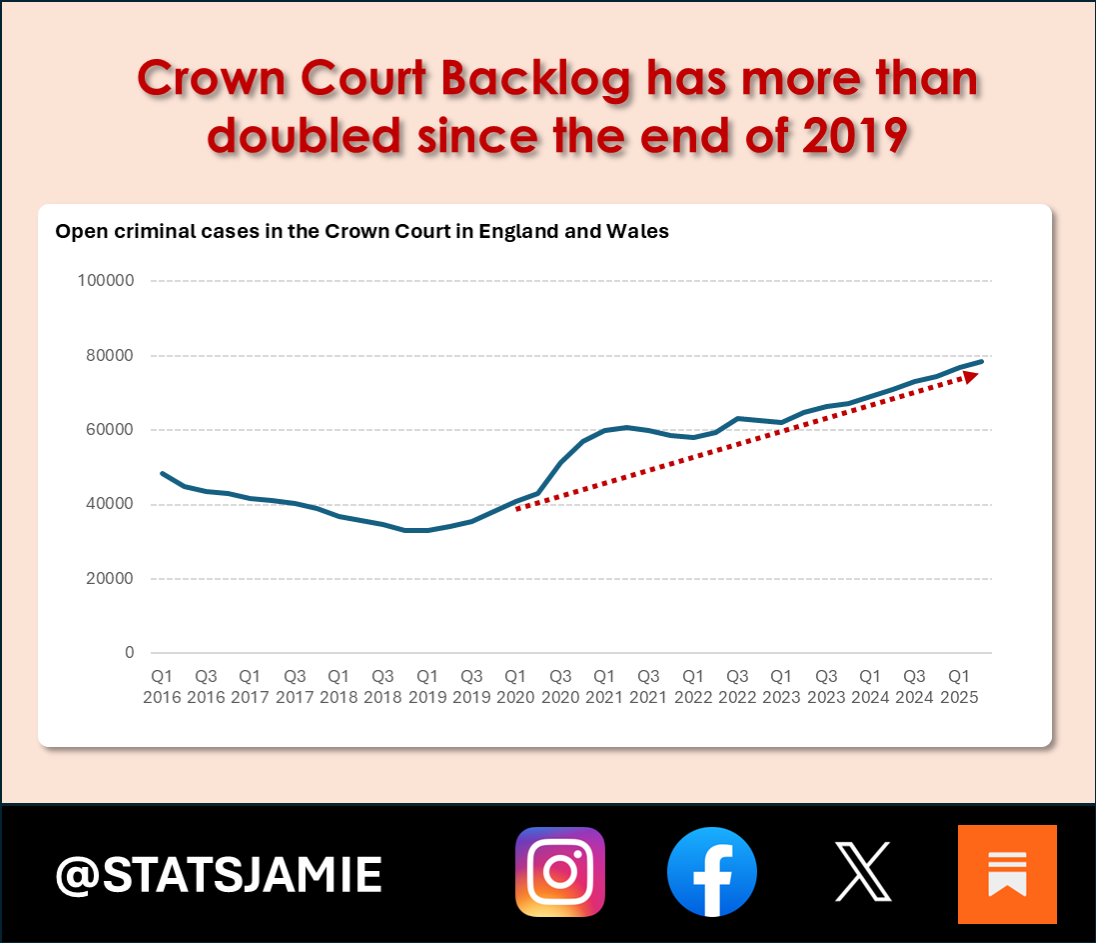
If we compare the situation just before the pandemic (Q4 2019) to today (Q2 2025), the scale of the collapse is shocking.
Since the start of the pandemic:
The Total Backlog has doubled (from 38,070 to 78,329).
But the Sexual Offences Backlog has nearly quadrupled (up 284%).
And Violence Against the Person cases have more than doubled (up 161%).
In 2019, these serious crimes made up a third (33%) of the queue. Today, they account for almost half (48%).
A Crucial Distinction We must be precise here. Not every case in these categories is a Murder or Rape trial. The “Violence” backlog includes mid-level assaults (like ABH), which are candidates for judge-only trials.
But this caveat does not save their argument. The cases that consume the vast majority of court resources—Rape, Murder, Manslaughter, and GBH with Intent—are “Indictable Only.” They are too serious ever to be heard without a jury.
So while Lammy might succeed in removing juries from shorter assault trials, the “heavy lifters”—the multi-week trials that actually clog the court diary—will remain exactly where they are.
🔨 The Sledgehammer Fallacy
To understand how pointless this reform is, you have to look at the “Funnel of Justice.”
There are approximately 1.3 million prosecutions in England and Wales every year.
Only about 10% of these ever reach a Crown Court.
Of that 10%, only three out of ten actually go to a contested jury trial (the rest plead guilty).
Now, look at what happens after Lammy’s reforms.
Because the most serious cases (Rape, Murder, GBH) are mandatory jury trials, more than two out of those ten cases will possibly still go before a jury.
So, what are we actually achieving here?
We are tearing up an 800-year-old constitutional right to stop less than one in ten Crown Court cases from having a jury.
It is a sledgehammer to crack a nut. The “saving” to the overall judiciary system is statistically negligible—a rounding error in the 1.3 million prosecutions.
🛡️ The “Southport Test”: Why Juries Matter
This “marginal efficiency gain” could have serious ramifications for individuals across the country.
If you want to know what we lose by scrapping juries for these “mid-level” offences, look no further than the case of Jamie Michael.
In February 2025, Mr Michael—a former Royal Marine and Manchester United apprentice—stood trial at Merthyr Tydfil Crown Court. His crime? Posting a 12-minute Facebook video in the emotional aftermath of the Southport murders.
In the video, he used strong, angry language. He spoke of “illegal immigrants” and “scumbags,” and warned that the country was “under attack”. The Crown Prosecution Service charged him with stirring up racial hatred.
Under the proposed reforms, a case like this would be a prime candidate for a judge-only trial. The likely sentence for a first-time offender would be under the 3-year threshold.
A judge might have looked at the statute and convicted him. Technically, his words were inflammatory. A judge, applying the letter of the law in a vacuum, could easily have found that they met the definition of hate speech.
The jury looked at the man and acquitted him. They heard that he was a father, “gut-wrenched” by the murder of children, who admitted he had been “clumsy” with his words but denied being a racist. They saw a man expressing raw, unfiltered grief—sentiments shared by his community—rather than a calculated attempt to incite violence.
The jury took less than an hour to clear him.
This is the “Safety Valve” in action. A jury does not just apply the law; it applies community standards. It distinguishes between a dangerous hate preacher and a dad venting on Facebook. If we hand these decisions to a single judge, we lose that nuance.
📉 The Hierarchy of Failure
This is the smoking gun in the data. The backlog has risen across all types of offence, but some are rising much faster than others.
Compare the growth rates since 2019:
Theft & Fraud: Up ~40%
Motoring Offences: Up 45%
Violence Against the Person: Up 161%
Sexual Offences: Up 284%
David Lammy’s proposal targets the bottom of this list. He wants to remove juries from “either-way” cases like theft and fraud—the very areas where the growth has been slowest.
Meanwhile, the areas causing the real paralysis—Violence and Sex—are growing four to seven times faster.
🚜 The Three Practical Fallacies
The Government relies on three practical arguments to justify this change. When scrutinised, all three collapse.
1. The “Blocked Road” Fallacy. Ministers claim that clearing theft trials will free up judges to hear rape trials. This assumes all judges are the same. They aren’t. Theft trials are heard by “Generalist” judges (often part-time Recorders). Rape trials require “Specialist” ticketed judges. Clearing the “Generalist” queue does not create capacity for the “Specialist” queue. It is like firing receptionists to solve a shortage of brain surgeons.
2. The “No Space” Fallacy. We are told there is no physical room for juries. This ignores the millions of square feet of empty public sector space in post-pandemic Britain. If the choice is between using an empty council conference room or abolishing the right to a fair trial, the answer should be obvious. We don’t need to scrap juries; we need to use the buildings we already own.
3. The “Speed” Fallacy. Finally, there is the claim that judge-only trials are faster. But the evidence phase—witness testimony, CCTV, cross-examination—takes the same amount of time regardless of who is watching it. Saving half a day on jury selection in a three-week trial is a rounding error, not a solution.
⚖️ The Mathematics of Justice: Why 12 Is Better Than 1
Beyond the logistics, there is a mathematical danger. Relying on a single judge creates a “single point of failure.” If that one judge is tired, distracted, or holds a subconscious bias, the entire verdict is skewed. There is no counter-balance.
A jury of 12 operates on the principle of “Signal Smoothing.”
Every human being has blind spots. But when you have 12 independent observers, their individual blind spots tend to cancel each other out, while the “signal” (the truth of the evidence) is amplified.
Statistically, if individual jurors have even a slightly better than 50% chance of getting the right answer, adding more people to the group drastically increases the probability of a correct verdict.
By cutting the group size from 12 down to 1, you are statistically guaranteeing a higher rate of error. We are trading the collective wisdom of 12 focused citizens for the opinion of one overworked employee.
💷 The Price of Justice
Finally, we need to ask the question the Government is dodging: Why are we really doing this?
They talk about “modernisation” and “swift justice.” But let’s be honest: this is about money. Jury trials are expensive. The Government has decided that the fundamental right to a fair trial—a right that has stood since Magna Carta—is a luxury item we can no longer afford.
But look at what we can afford.
In the recent Budget, the Chancellor signed off billions in benefit increases. We are currently pouring billions more into a spiralling asylum system, paying for hotels and processing costs that are wildly out of control.
Compared to these numbers, the savings from scrapping juries are a drop in the ocean. This reform won’t dent the deficit. It won’t fix the public finances.
We do not have jury trials because they are cheap. We have them because they are fair. They are the one place in our democracy where the state cannot simply impose its will on the citizen.
To trade that away for the sake of a spreadsheet efficiency saving—while waving through billions in other spending—is not an economic necessity. It is a political choice. And it is a betrayal of who we are.
✍️ Jamie Jenkins
Stats Jamie | Stats, Facts & Opinions
📢 Call to Action
If this helped cut through the noise, share it and subscribe for free — get the stats before the spin, straight to your inbox (no algorithms).
📚 If you found this useful, you might also want to read:

📲 Follow me here for more daily updates: