

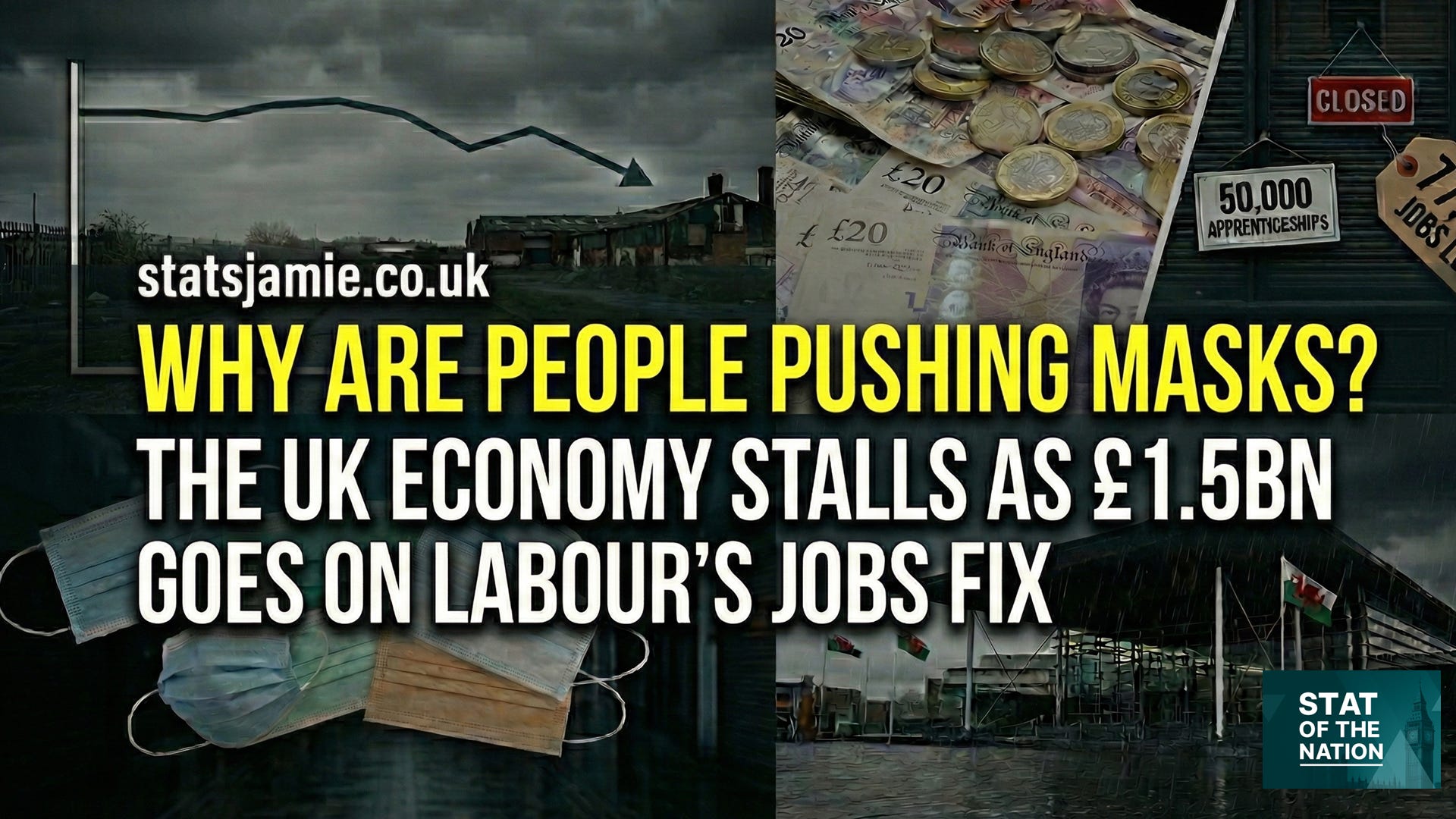
This week on Stat of the Nation, we focus on the return of mask politics, four months of weak growth dragging down GDP per head, a jobs plan that doesn’t match the scale of losses since the election, and a worrying signal from Welsh politics ahead of next year’s Senedd election.
No spin. Just the numbers — and what they actually mean.
📉 The UK Economy: Four Months of Flatlining
Monthly GDP figures will always bounce around — but trends matter far more than one data point. And the trend here is clear.
We’ve now had around four months of flat or negative growth. That’s not a blip — it’s an economy that’s lost momentum.
Crucially, the UK population is still growing. So when total GDP is flat (or shrinking) while the population expands, GDP per head falls — which is another way of saying living standards are quietly going backwards.
🎥 My interview with Martin Daubney (GB News)
I joined Martin Daubney on GB News to spell this out:
Four months of zero or negative growth is the real story — not a single monthly wobble
Flat GDP + rising population = falling GDP per capita
The pain is concentrated in the private sector, especially retail and hospitality
Headline numbers are increasingly propped up by public sector expansion and borrowing
That’s not a sustainable model. You can’t have a permanently expanding public sector without a thriving private economy underneath it.

👷 Jobs: £1.5bn for 50,000 Apprenticeships — After 77,000 Jobs Lost
The government is touting a £1.5bn scheme to create 50,000 apprenticeships.
But since the election, we’ve already lost 77,000 actual jobs — so the “solution” is smaller than the damage already done, while ministers push policies that make hiring more expensive.
Two obvious culprits:
The jobs tax — raising the cost of employing staff
National Minimum Wage hikes — especially the steep increases for younger workers
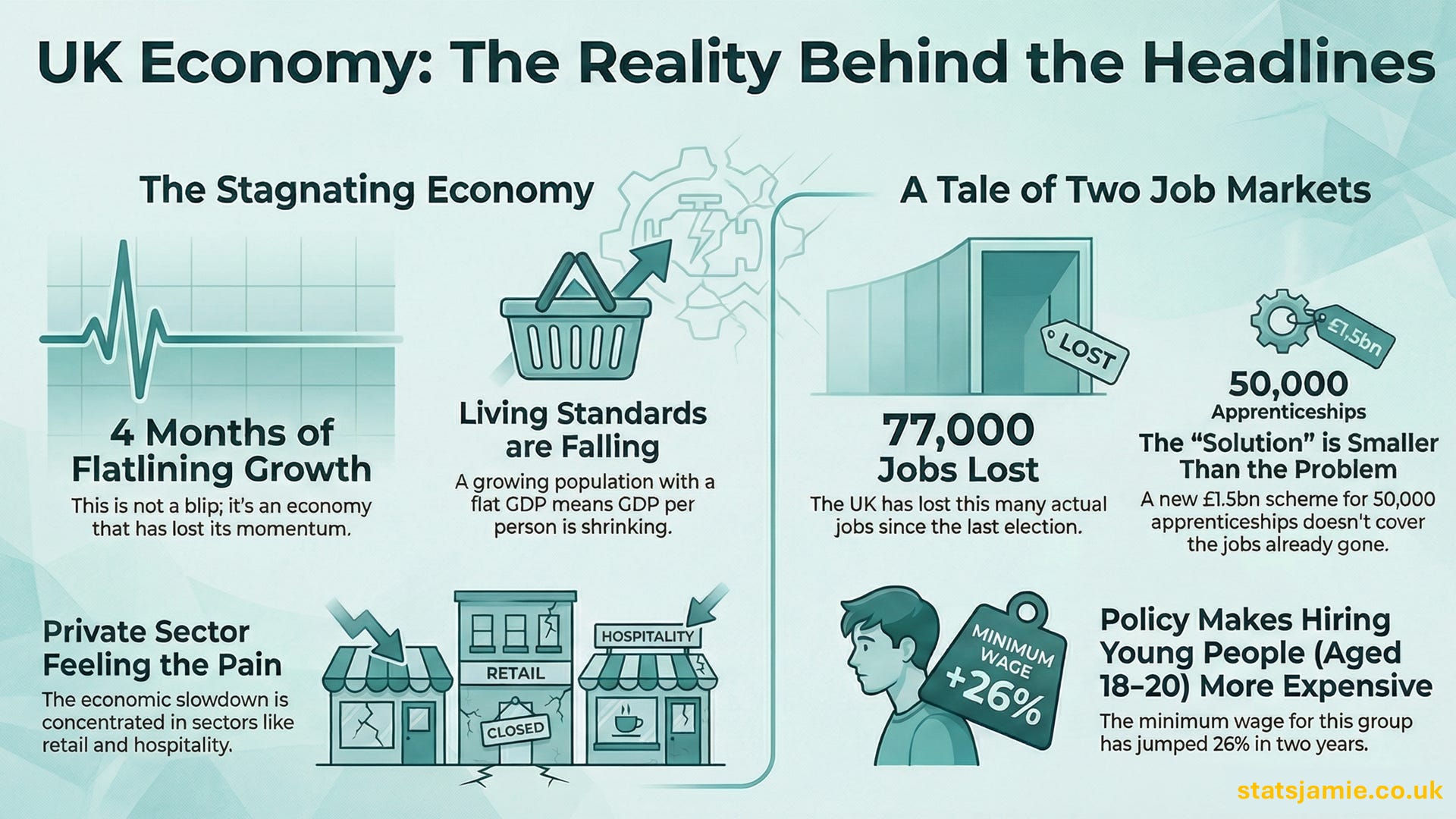
It’s good to pay people more. But the structure matters. The 18–20 rate is jumping from £8.60 to £10.85 — a 26% rise in two years — versus roughly 11% for adults 21+. Narrow that gap too quickly and employers respond in predictable ways: fewer entry-level hires, fewer hours, or more automation, particularly in retail and hospitality.
This is the circular policy failure: make jobs more expensive, watch jobs vanish, then spend billions trying to “create” them again.

😷 Masks: The Comeback Nobody Asked For
During the pandemic, many people assumed masks were an obvious win. That was understandable at the time. But we’ve now had years of real-world data — and the evidence doesn’t support the idea that masks delivered a meaningful population-level impact.
Across studies and reviews, the pattern is consistent:
No clear, reliable, real-world reduction in infection outcomes
Comparisons between high-mask and low-mask groups generally show no meaningful difference
The highest-quality evidence struggles to find a clear benefit in community settings
So if politicians or commentators want to revive mask messaging, they need to answer one basic question:
What new evidence are they relying on — that we didn’t already have?

🗳️ Wales: An Election About Stopping Reform — Not Fixing Wales
With Senedd elections next year, Welsh politics is starting to crystallise — and it’s not especially encouraging.
Plaid Cymru’s core pitch increasingly appears to be “stop Reform”, rather than offering a clear, costed plan to improve Wales. There’s little serious discussion of productivity, growth, or living standards — and almost no scrutiny of the billions tied up in Plaid’s independence project, or what that would realistically mean for jobs and investment.
What makes this clearer still is Plaid’s recent budget deal with Welsh Labour. In practical terms, that tells voters everything they need to know:
if Plaid were to win the Senedd election — or enter another coalition with Labour — the result would likely be more of the same. Same spending priorities. Same economic drift. Same excuses.
Meanwhile, Welsh Labour continues to claim it is “easing the cost of living for working families”. But the data tells a different story:
Inflation remains elevated
Labour’s jobs tax pushes up prices and costs jobs
Rachel Reeves’ tax rises ultimately hit take-home pay
If the next Senedd election becomes a referendum on blocking Reform, rather than fixing Wales, voters are entitled to ask a simple question:
What actually changes the day after the election?
📅 Coming Up Next Week
Next week brings a fresh run of big releases:
Labour market: Are payroll jobs still falling?
Inflation: Are price pressures really easing?
Public finances: what’s happening to borrowing and debt?
If growth remains weak and hiring continues to slow, it will get harder for ministers to keep blaming the past. The numbers will be pointing firmly at decisions being made now.
✅ Bottom Line
You don’t rebuild living standards with weak growth, rising hiring costs, and policy-by-headline. And you don’t rebuild trust by resurrecting pandemic-era debates after the evidence has moved on.
As ever: no drama — just the numbers.
✍️ Jamie Jenkins
Stats Jamie | Stats, Facts & Opinions
📢 Call to Action
If this helped cut through the noise, share it and subscribe for free — get the stats before the spin, straight to your inbox (no algorithms).
📚 If you found this useful, you might also want to read:

📲 Follow me here for more daily updates: