

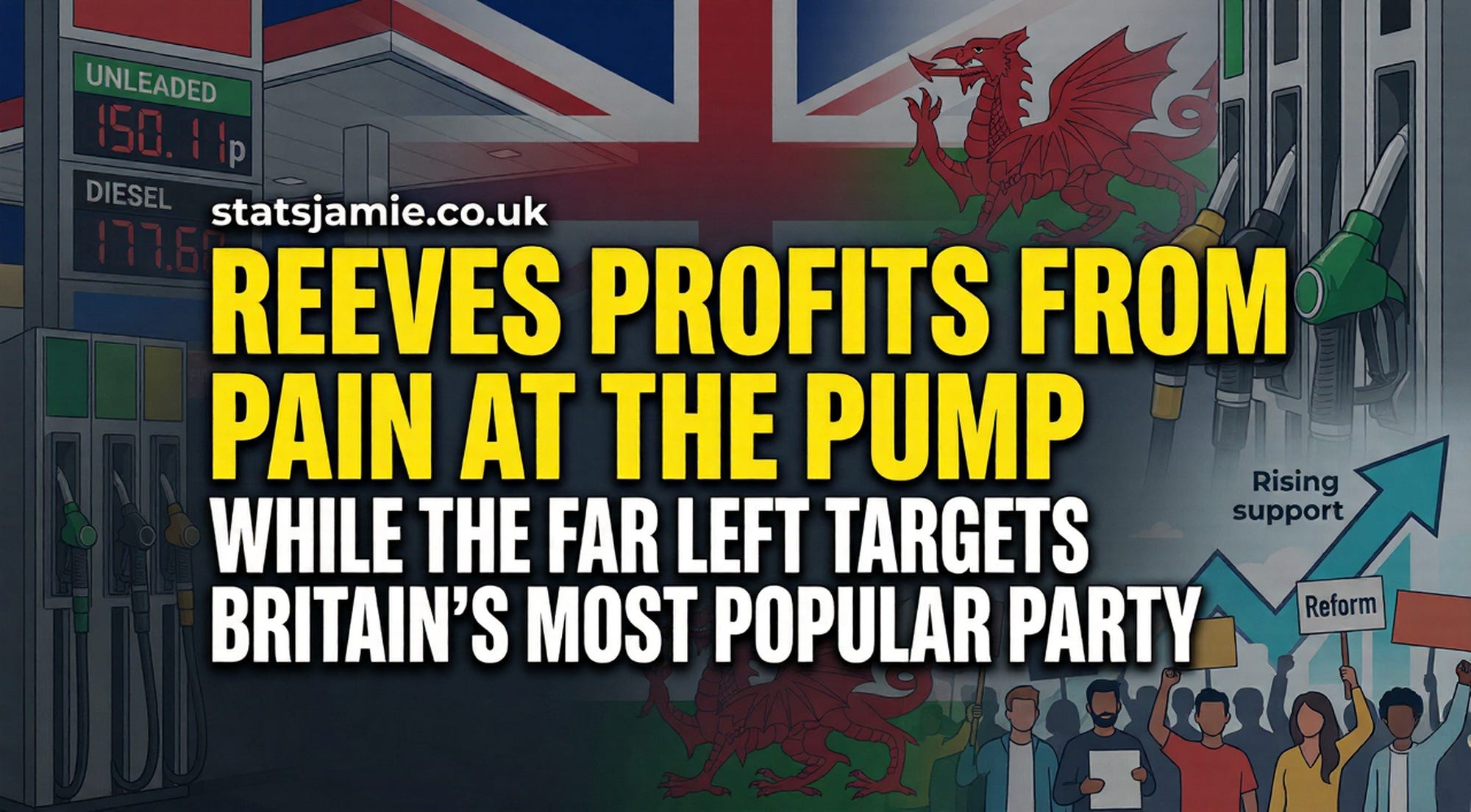
This week’s Stat of the Nation starts at the forecourt, where higher petrol and diesel prices are not just squeezing drivers but quietly boosting the Treasury’s tax take too. From there, it heads to Wales, where a new poll points to a collapse in Welsh Labour support and a political establishment already talking openly about how to stop Reform from taking power.
Then there is the London march against the so-called “far right”. But if that label now includes a party leading some mainstream polls, what exactly does the term even mean anymore? Put together, these stories point to the same thing: a growing gap between establishment language and public reality.
⛽ The Treasury Wins Twice When Fuel Prices Rise
The latest RAC figures show average pump prices at 150.11p a litre for petrol and 177.68p for diesel on 27 March. RAC says that since the conflict began on 28 February, petrol has risen by 17.3p a litre and diesel by 35.3p. That is a big hit for drivers. But it is also good news for the Treasury.
Fuel duty alone is expected by the Office for Budget Responsibility to raise £24 billion in 2025-26 — about £460 million a week before VAT is even counted. Then there is the extra windfall from higher pump prices. Using official 2024 road-fuel demand, the rise in petrol and diesel prices over the past month implies the Treasury is now taking roughly £36 million more in VAT every week than before on RAC’s comparison. If those prices were sustained, that would be worth roughly £1.9 billion a year in extra VAT alone. That is an estimate, not a Treasury forecast, and it assumes fuel demand holds up.
And diesel matters far beyond the forecourt. Official data shows the UK still uses far more road diesel than petrol, which tells you this is not just about private motorists. Diesel is tied to haulage, delivery fleets and business transport, so when diesel prices surge, the cost does not stay with drivers alone. It feeds through into the cost of moving goods around the country, which means households often end up paying again through higher prices in the shops.
So the state wins twice: it collects the fixed duty on every litre sold, and then takes a bigger slice in VAT as prices climb. And if road use does start to fall, that may not worry many policymakers too much either, given how often transport policy now points in the direction of making driving less attractive. Either way, motorists — and often households more broadly — lose.
🏴 Drakeford Says The Quiet Part Out Loud
I covered earlier this week how bleak the picture now looks for Welsh Labour. The latest YouGov MRP for the 2026 Senedd election puts Plaid Cymru on 33%, Reform UK on 27%, and Labour on just 13%. The seat projection puts Plaid on 43 seats, Reform on 30, and Labour on just 12.

That is not a wobble. It looks like a party running out of road.
Then came this moment from Politics Wales on the BBC, where Mark Drakeford openly discussed left-wing parties working together to block Reform from taking power in Wales.
That matters because it says a lot about where the Welsh Labour mindset now is. This is no longer the language of a party confident in its own support. It is the language of an establishment already thinking about how to stop a challenger, even as its own vote collapses.
And there is a deeper problem with that argument. Turnout at the last Senedd election in 2021 was just 46.6%. Even at a record high for a Senedd election, more than half of eligible voters did not vote.
So yes, left-wing parties may be able to combine for a majority of seats. But that is not the same as having the support of most people in Wales. Not even close.
And if voting were compulsory, with a proper None of the Above option on the ballot, I suspect the result would be even more uncomfortable for the Welsh establishment.
🚩 If Reform Is “Far Right”, What Is The Centre Now?
Around 50,000 people marched through central London on Saturday in a “March to Stop the Far Right”, while Green Party leader Zack Polanski claimed the turnout was “half a million”. That gap alone tells you something about modern political activism and media narrative.

But the more interesting question is not the crowd estimate. It is the label itself.
Because if Reform UK is one of the main targets, then this is no longer a protest against some tiny fringe movement on the edge of public life. Reform is now polling at 23% in the latest YouGov Westminster voting-intention poll, ahead of Labour on 19%, with the Greens on 18% and the Conservatives on 17%.
The event also looked less like a narrow argument about one party and more like a wider progressive coalition. It was organised by the Together Alliance and backed by trade unions, charities and campaign groups, while police also reported 25 arrests linked to this march and a concurrent pro-Palestinian protest.
That does not settle every argument about labels. But it does raise an obvious one. When a party is leading some mainstream polls, calling it “far right” starts to sound less like a neutral description and more like political branding. And when that label is being used against millions of voters, it may tell us as much about the worldview of the people using it as the people they are trying to condemn.
🔍 The Old Story No Longer Fits
This is the thread connecting the week.
Fuel prices rise, and the state quietly gains from it. Welsh Labour slides towards a historic humiliation, and the answer from the old machine is not renewal but blocking tactics. Protesters march against the “far right”, but the object of their anger now includes a party with very substantial democratic support.
The old political class still talks as though it is managing events. More and more, it looks as though it is reacting to them.
That is why this week matters. Not because each story on its own is unprecedented, but because together they point in the same direction: weaker legitimacy, deeper frustration, and a widening gap between establishment language and public reality.
More and more people can see it.
✍️ Jamie Jenkins
Stats Jamie | Stats, Facts & Opinions
📢 Call to Action
If this helped cut through the noise, share it and subscribe free by entering your email in the box below and get the stats before the spin, straight to your inbox (no algorithms).
📚 If you found this useful, you might also want to read:
Beyond the Fairy Tales: The Cold Hard Stats on Stealth Taxes and the Brain Drain

I joined the The Mike Graham Show this week to look past the political theatre of the recent financial statements and examine what is actually happening to your money. If you listen to the Chancellor, you’d think we are on the “right economic plan.” But if you look at the statistics, we are witnessing an economy being choked by taxation, energy insecurity, and a fundamenta…
📲 Follow me here for more daily updates:
Thanks for this post. I'm a Reform member but I was dismayed that reform did not vote in the Tory bill to resume exploration in the north sea. One of the big reasons I joined reform was because of their policy on net zero. I know that the bill was not going to succeed but all the same. Why didn't reform vote for the bill?
Thank you Jamie for helping us through the noise and spelling it out clearly for us. It is terribly worrying and frustrating to see all this happening before our eyes and feeling like there is little that we can do other than vote. Something has to change! We cannot expect different results from the same, Labour government. It has been shameful!