

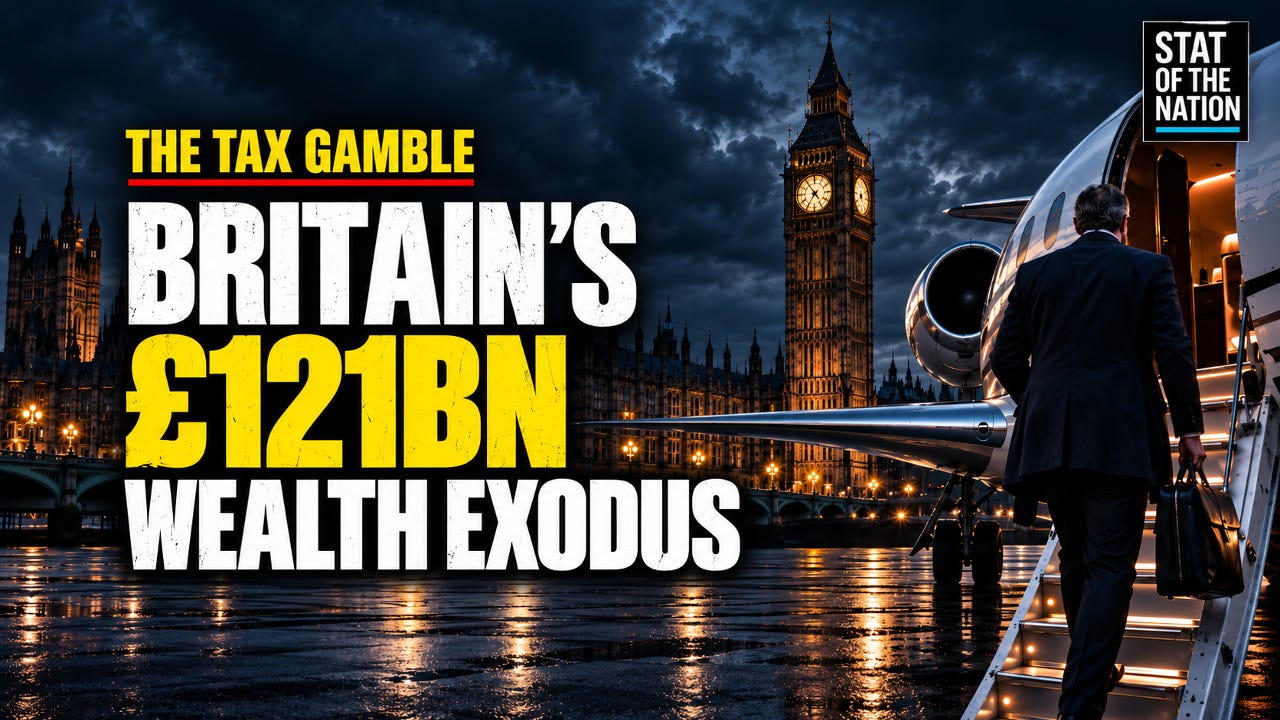
An analysis of the Bloomberg Billionaires Index has found that super-rich UK residents with combined wealth of around £121 billion have either left Britain or loosened their UK ties since 2024.
That does not mean £121 billion has physically disappeared from Britain.
Some of those individuals will still own businesses, investments and property here. Some will continue to pay UK tax.
But it raises an important question.
What happens when some of the people paying the largest tax bills decide Britain is no longer the best place to live?
The Top 1% Pay More Than a Quarter of Income Tax
Britain’s Income Tax system is heavily reliant on a relatively small number of people.
HMRC projects that in 2026/27 the top 1% of Income Tax payers will receive 12.8% of total income but account for 26.6% of all Income Tax liabilities.
That’s more than £1 in every £4 of Income Tax coming from the top 1%.
And the figures for Britain’s former non-dom population tell a similar story.
HMRC estimates that at least 81,900 non-dom and deemed-dom taxpayers generated £13.6 billion in tax and National Insurance liabilities in 2024/25.
Their numbers actually fell by around 1%, from 83,100 to 81,900, yet their combined liabilities increased by 9%.
This isn’t an argument that wealthy people shouldn’t pay more tax. Britain deliberately has a progressive tax system.
But it does explain why their behaviour matters.
When a relatively small group contributes billions of pounds, losing some of them can matter to the public finances.
Britain Changed the Rules
The old non-dom system allowed qualifying UK residents to receive favourable tax treatment on foreign income and gains.
The previous Conservative government announced in March 2024 that the old system would be abolished from April 2025 and replaced with a residence-based regime.
Labour proceeded with the reform after taking office, while changing parts of the package, including the treatment of trusts and inheritance tax. The new system took effect from 6 April 2025.
The principle behind it is straightforward.
If someone makes Britain their long-term home, the Government believes they should eventually pay UK tax on their worldwide income and gains rather than continue indefinitely under the old non-dom arrangements.
The purpose was therefore not to make wealthy people leave.
It was to collect more tax from them.
But there was always a catch.
Some were expected to leave.
The OBR Expected Some Rich People to Leave
When the Office for Budget Responsibility assessed the reforms, it did not assume every affected taxpayer would simply stay in Britain and pay more.
It expected some to leave.
Among non-doms who would lose the old tax treatment, the OBR assumed around 12% of those without trusts and 25% of those with trusts would leave the UK.
Those estimates were higher than under the original Conservative plans because Labour’s revised package increased some tax liabilities, particularly through inheritance tax and other capital-tax changes.
So the Government’s own fiscal watchdog was already expecting a sizeable behavioural response.
The question now is whether even more people leave than the forecasts allowed for.
So why introduce a policy if you expect some taxpayers to leave?
Because the calculation is that the extra tax collected from those who stay will outweigh the tax lost from those who go.
Imagine 100 people each pay £1 in tax.
You change the rules so they now pay £2.
If 20 leave, the remaining 80 still pay £160 instead of the £100 you collected before.
You’ve lost taxpayers, but you’ve raised more money.
The problem comes if too many leave.
That’s the gamble.
Why Does This Matter to Everyone Else?
One recent example shows how much can be involved.
Hedge-fund billionaire Chris Rokos was estimated to have paid around £330 million in UK tax in the latest tax year, making him Britain’s third-largest individual taxpayer on the Sunday Times Tax List.
He has since moved to Greece.
That does not mean the Treasury automatically loses £330 million every year. The figure itself is an estimate rather than an HMRC-published personal tax bill, and Rokos may continue to have UK tax liabilities.
But it shows why the decisions of a very small number of people can matter.
Britain is also competing with other countries for these internationally mobile residents.
Greece, Italy and Portugal have introduced preferential regimes intended to attract wealthy foreign residents, while Monaco, Switzerland and the UAE remain obvious alternatives.
And there is another effect that is much harder to count.
It isn’t only about people already living here deciding to leave.
Tax competitiveness can also influence whether wealthy entrepreneurs and investors choose Britain in the first place.
If somebody who might once have chosen London instead chooses Athens, Milan or Dubai, there is no departure for the statistics to record.
But Britain may still miss out on their tax contribution, investment, spending and business activity.
So Is the Policy Working?
Right now, the answer is:
We don’t know.
The £121 billion figure is striking, but it is a media analysis of the wealth of a selected group of billionaires.
It is not £121 billion of tax revenue.
And it is not proof that the policy has failed.
Some departures were explicitly built into the Government’s fiscal forecasts.
The real test is much simpler.
HMRC tells us that non-dom and deemed-dom taxpayers generated £13.6 billion in tax and National Insurance liabilities in the final year before the new regime.
The OBR expected a meaningful proportion of affected taxpayers to leave.
So what matters now is whether the additional tax collected from those who remain outweighs the tax lost from those who go.
That will take time to establish properly.
The Bottom Line
Britain should expect wealthy residents to contribute significantly to the country in which they live.
The figures show that they already do.
But governments also have to recognise that some of the people paying the largest tax bills have the greatest ability to move internationally.
An analysis of Bloomberg’s billionaire data suggests UK residents with combined wealth of around £121 billion have either left Britain or loosened their ties since 2024.
That doesn’t prove the tax reforms have failed.
But it makes one question increasingly important:
Did the Government correctly calculate how many wealthy taxpayers would be prepared to leave?
Because ultimately, this isn’t about how many billionaires Britain has.
It’s about how much tax Britain actually collects.
✍️ Jamie Jenkins
Stats Jamie | Stats, Facts & Opinions
If you found this analysis useful, please share it and subscribe for more.
📲 Follow me here for more daily updates:
They've got this wrong like virtually all Labour policies - cretinous in the extreme.
The net migration figures are coming down but what if we are losing young tax paying Brits and importing migrants who go straight into benefits for life bringing their many family members in too eventually. Thats a hidden underbelly we won’t be able to count… but might account for the spiralling benefits bill. What think you?!