

I joined Mike Graham on the The Mike Graham Show this week to discuss what is happening in Wales, but the conversation quickly widened into something much bigger.
Welsh politics. Labour’s decline. Plaid Cymru. Reform. Population growth. Migration. The dark economy. Digital ID.
On paper, these can look like separate issues. They are not.
They all point to the same deeper problem: Britain is drifting, Wales is drifting, and the people in charge do not appear to have a serious plan.
Wales May Be About To Send Labour A Brutal Message
Wales is heading into a major political moment.
For months, Reform and Plaid Cymru have been close in the polls. Some polls have put Reform ahead. Some have put Plaid ahead. But the polling is only one part of the story.
The real question is turnout.
In Wales, even for national Welsh Parliament elections, we have never had more than half the population bother voting. That tells you something about the state of politics here.
A lot of people are disengaged. A lot are frustrated. And a lot simply do not believe anything will change.
That matters for Reform.
Reform may be doing well in the polls, but one of their biggest challenges is converting disillusionment into actual votes. Many Reform supporters are people who have lost faith in mainstream politics. The problem is that those voters may also be less likely to turn out.
Meanwhile, Labour looks exhausted.
Driving around parts of the Welsh valleys, you used to see Labour placards everywhere. This time, I have barely seen any. It feels like people do not even want to admit they still support the Labour Party.
My prediction is simple: Plaid Cymru probably become the largest party, Reform do well, and Labour take a serious hit.
But the bigger question is whether anything actually improves.
And I am not convinced it does.
Will Anything Really Change In Wales?
Labour has never really ruled Wales alone in the way some people imagine.
Because of the electoral system, Labour has usually needed support from other parties. There have already been agreements between Labour and Plaid Cymru.
So if Plaid become the largest party, will Wales suddenly change direction?
I doubt it.
The deeper problem in Wales is not just which party is in charge. It is the quality of political leadership.
Too much of Welsh politics feels small, stale and low calibre.
I always ask people a simple question: how many of the people standing for these roles would earn £80,000 a year in the private sector?
Very few.
That is not a throwaway point. It matters because we are handing these people responsibility over health, education, transport, taxation, housing, business and public services.
These are serious jobs. They require serious people.
Instead, too much of politics now feels like a taxpayer-funded career path for people who would struggle to command the same responsibility elsewhere.
That is why I am sceptical about the idea that a change of party automatically means a change of direction.
Wales has had decades of Labour. Plaid Cymru have helped prop that system up. The Greens may yet help prop up Plaid.
Different badges. Same basic direction.
That is not renewal.
That is rotation.
The Population Is Still Growing — And Migration Is Doing The Heavy Lifting
The latest population projections matter because they are not just abstract numbers.
They are used for planning.
Government, local authorities, the NHS, schools, housing, transport, infrastructure and businesses all need some idea of how many people will be living in the country in future.
That is why these projections matter.
The Office for National Statistics has revised down the long-term assumption for net migration from the very high levels seen after the Boris-era migration surge. Previously, the assumption was around 340,000 net migration every year into the future.
That has now been revised down to around 230,000 a year.
But let’s be honest: that is still a lot of people.
Every year.
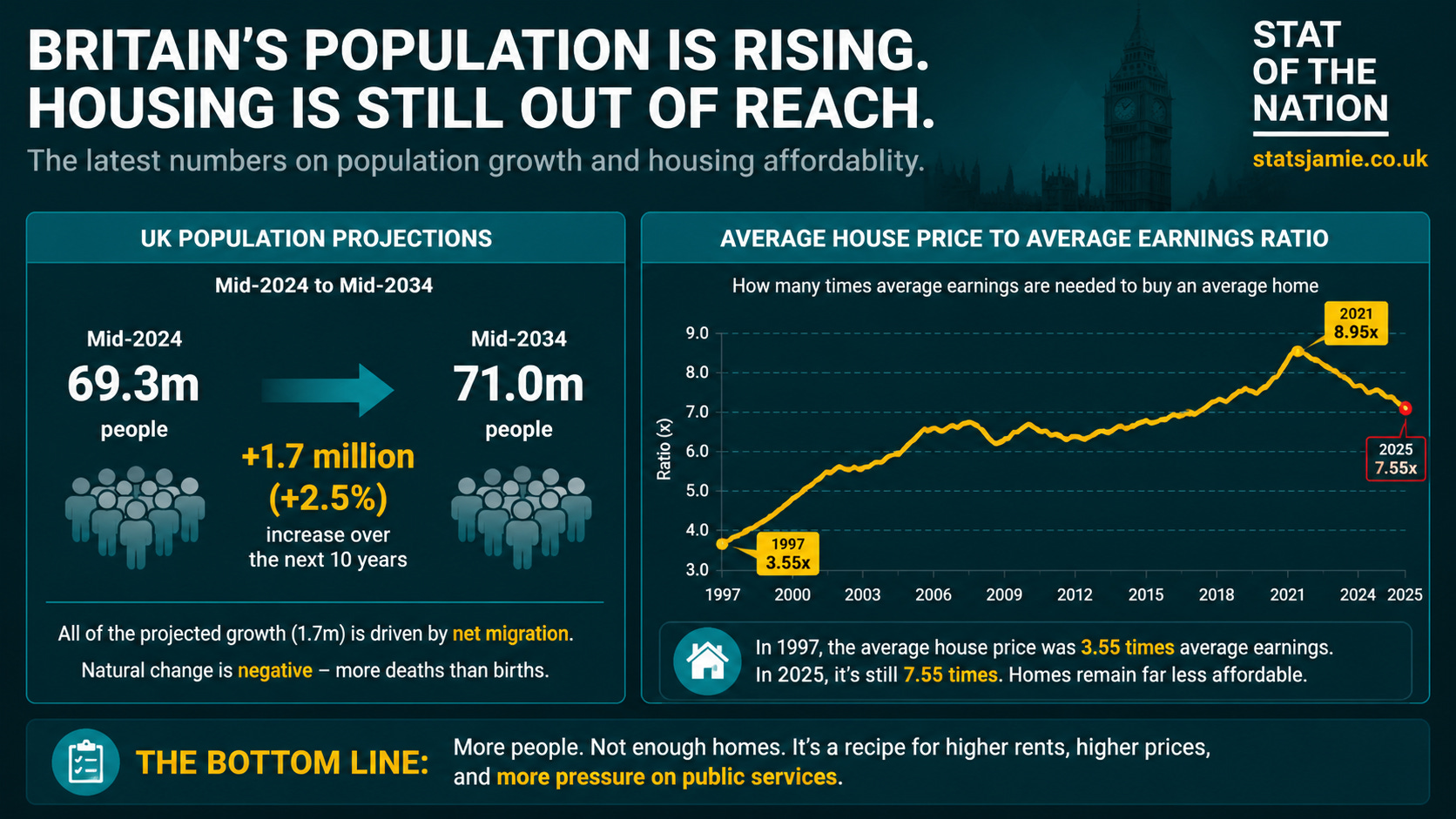
The projection suggests the UK population will rise by around 1.7 million by 2034, and that growth is entirely driven by migration. Natural change is negative because deaths are projected to exceed births.
That should force a serious national debate.
Because the obvious question is simple: where are people supposed to live?
We already have a housing affordability crisis.
Back in 1997, the average house price was around 3.6 times average earnings. That ratio is now over 7. It has come down slightly in recent years, but the basic point remains: housing has become far less affordable.
That affects family formation.
People settle down later. People have children later. Some do not have children at all because the financial pressure is too high.
Then politicians turn around and say we need more migration because the birth rate is falling.
That is not a serious solution.
That is a feedback loop.
Make housing unaffordable. Watch family formation weaken. See births fall. Then import more people into an already stretched housing market.
At some point, the country needs to stop pretending this is sustainable.

The Dark Economy Is Not A Side Issue
Mike also raised reports about organised crime and dodgy outlets operating through parts of the high street.
Convenience stores. Takeaways. Counterfeit goods. Cheap tobacco. Vape shops. Nail bars. Barber shops.
People can laugh about the endless barber shops with nobody in them, but the underlying issue is serious.
This is about the growth of the dark economy.
When counterfeit tobacco is sold under the counter, no duty is paid.
When criminal gangs control outlets, legitimate businesses are undercut.
When illegal workers are exploited, the state loses tax revenue and the public loses trust.
And this also links back to illegal migration.
Some people assume every person coming across the Channel has paid thousands of pounds upfront to smugglers. But that is not always how this works.
Some may be brought in and then expected to work off the debt through criminal networks.
That is not compassion.
That is exploitation.
And it is another reason why simply talking about “smashing the gangs” is not enough.
The gangs are not just operating on beaches or boats. They can be embedded in local economies, high streets, cheap labour markets, counterfeit goods, drugs, tobacco and cash businesses.
This is not just a border issue.
It is a state capacity issue.
Digital ID Will Not Fix This
The government’s answer to this kind of problem always seems to be the same: more control over the people already following the rules.
Digital ID is a perfect example.
If people are already smuggling themselves into the country, working illegally, selling dodgy tobacco, dealing in counterfeit goods or operating in criminal networks, are they really going to be stopped by a digital ID scheme?
Of course not.
It risks becoming like punishing insured drivers because some people drive without insurance.
The people already ignoring the law will continue ignoring the law. The people who are law-abiding will be the ones asked to give up more information, accept more monitoring, and live with more bureaucracy.
That is the wrong way around.
The problem is not that ordinary people lack digital ID.
The problem is that the state is not enforcing the rules it already has.
Britain Needs A Reset
The final point is the most important one.
Between 2021 and 2024, net migration to the UK was around 2.3 million.
Between 1981 and 2007, it was around 2.2 million.
In other words, more people were added through net migration in three years than in the entire period from 1981 to 2007.

That is a staggering change in the pace of population growth.
And yet the public services, housing stock, roads, GP surgeries, schools, water infrastructure and wider economy have not been prepared for it.
This is why we need a reset.
Not another slogan.
Not another gimmick.
Not another pretend crackdown.
Not another digital ID scheme.
A real reset.
That means getting net migration down, restoring control, tackling the dark economy, enforcing the law, and making sure public services and infrastructure can actually cope with the population already here.
Because right now, Britain is changing faster than the political class is willing to admit.
And the public can see it.
✍️ Jamie Jenkins
Stats Jamie | Stats, Facts & Opinions
📢 Call to Action
If this helped cut through the noise, share it and subscribe free by entering your email in the box below and get the stats before the spin, straight to your inbox (no algorithms).
📚 If you found this useful, you might also want to read:
Vaccinated Under False Pretences. How Public Trust Was Eroded.

The Covid inquiry says trust in vaccines must now be rebuilt. But trust was not broken by accident. It was broken by exaggerated claims, moral pressure, broken promises, and a culture that punished doubt while rewarding bad information from the right people.
📲 Follow me here for more daily updates:
My late Welsh uncle in Bridgend used to laugh at Plaid Cymru. He'd still be laughing now. They are still the wacky fools who romanticise the idea of an independent Wales only they have learnt to hide it a bit. They are as dumb as the currently fashionable Green Party. Ridiculous fools voted for by naive, uninformed voters. Decades of poor education have left us with an electorate of uneducated fools. The future is gloomy
It's even worse Jamie regarding migration as those leaving are generally high calibre individuals and the ones coming in are generally of low calibre.
This will have the effect of reducing GDP per capita even more so to use a technical expression, we'll all be fucked !