

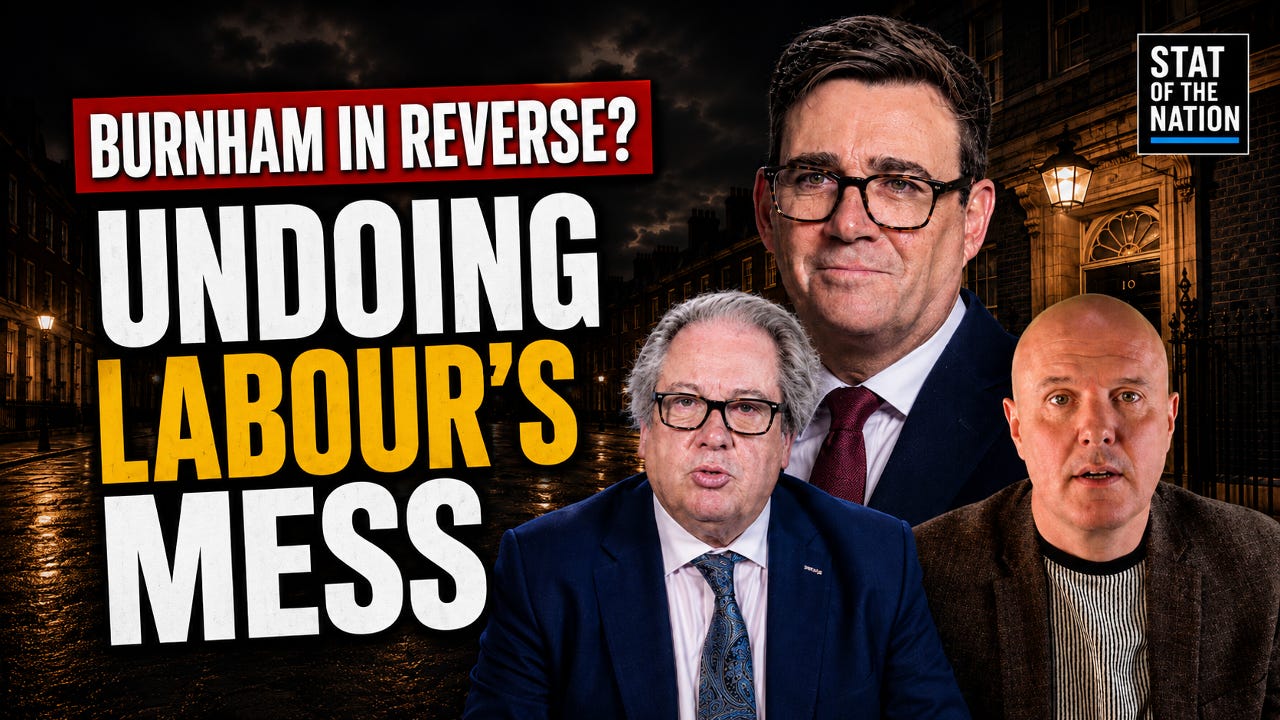
Every week, I join Mike Graham on the The Mike Graham Show to break down the numbers behind the biggest political and economic stories.
This week, we discussed Andy Burnham’s first days in Downing Street and the speed at which he has started reversing Keir Starmer’s policies. The £3 bus fare cap is going back to £2, the early release of prisoners has been paused, digital ID spending is being redirected and a cut to VAT on electricity has been announced.
Burnham clearly wants to present himself as the man cleaning up Starmer’s mess. But reversing unpopular policies is the easy part. The real challenge is showing that he has a credible plan of his own.
Watch the full discussion below.
Labour Is Reversing Labour
The speed of these reversals tells us plenty about the past two years. Labour introduced these policies, defended them and insisted they were necessary. Now, under a new leader, Labour is rapidly taking them apart.
That may be politically smart, but it raises an obvious question: what was the point of the Starmer government? Changing the person at the top does not erase the record of the party that introduced the policies in the first place.
Burnham may look and sound different, but he still inherits the same economic problems, the same public finances and the same difficult trade-offs.
£45 Back, But Taxes Are Still Rising
The proposed cut to VAT on electricity has been presented as meaningful help for households. The estimated saving is around £45 over six months, which works out at roughly 90 pence a week.
That sounds far less generous when compared with the wider tax burden. By my calculations, the average full time worker is paying around £888 more each year in Income Tax and National Insurance than before Labour entered government.
Much of that increase comes from frozen tax thresholds. As wages rise, more income is taxed, more lower paid workers are pulled into the tax system and more middle earners are dragged into the 40 per cent rate.
Mike and I also discussed the possibility of raising the personal allowance, which has remained frozen at £12,570 since 2021. Increasing it would be welcome, but it would also reduce government revenue at a time when borrowing remains high.
If Burnham raises the threshold, he must be honest about what replaces the lost revenue. Will spending be cut, will borrowing rise or will another tax increase take its place?
The government cannot take hundreds of pounds more through the tax system, return £45 and call it generosity.

Britain’s Bigger Energy Problem
Burnham has also spoken about reversing the deindustrialisation of Britain. That will not happen while British businesses face some of the highest electricity costs in the developed world.
Industrial electricity prices in the UK are around four times those faced by businesses in the United States and are among the highest in Europe. That makes Britain a far less attractive place to manufacture goods, invest in factories or create energy intensive jobs.
A temporary VAT reduction may help households at the margins, but it does nothing to solve the deeper competitiveness problem. If Burnham is serious about rebuilding British industry, he must confront the cost of energy and the policies driving those costs higher.
Without that, talk of reindustrialisation is simply another slogan.
Can Burnham End Rough Sleeping?
We also discussed Burnham’s promise to end rough sleeping across Britain. Nobody disagrees with the ambition, but his record in Greater Manchester deserves scrutiny.
In 2010, the official snapshot recorded around 41 people sleeping rough across Greater Manchester. The figure increased sharply during the following years, reaching around 268 shortly before Burnham became mayor.
Numbers later fell, particularly during the pandemic, when emergency accommodation schemes moved people off the streets. However, over the past four years, rough sleeping in Greater Manchester has been rising again.
Burnham is not personally responsible for every case, but if this is going to become a flagship national promise, voters are entitled to examine what happened in the region he governed for nearly a decade.
A national pledge is less convincing when the recent local trend is moving in the wrong direction.
The Bottom Line
Andy Burnham is undoubtedly a better communicator than Keir Starmer. He speaks more naturally, looks more comfortable in public and appears capable of delivering a speech without every sentence being written down in front of him.
But good presentation is not the same as good government.
So far, Burnham’s programme is largely built around reversing Starmer. That may win him some early applause, but it does not yet amount to a credible economic plan.
Burnham wants the country to believe Labour has changed. For now, it looks more like the same government driving rapidly in reverse.
Watch the full discussion above and let me know what you think.
✍️ Jamie Jenkins
Stats Jamie | Stats, Facts & Opinions
📢 Call to Action
If this helped cut through the noise, share it and subscribe free by entering your email in the box below and get the stats before the spin, straight to your inbox (no algorithms).
📚 If you found this useful, you might also want to read:
Britain Is Cancelling the BBC — Another 539,000 Licences Disappear

Another 539,000 television licences disappeared last year, following a fall of more than 300,000 the year before. The decline is not merely continuing; it is accelerating.
📲 Follow me here for more daily updates:
More fantasy politics from the adolescents in charge with no meaningful business or economics experience.
Burnham is replacing some if Starmer’s crap and adding his own. Fiddling with taxes when we need a comprehensive finance plan. A clear sense of direction - scandi? Free market? Some kind of failed blairite third way?
They are economically clueless and simply want power for powers sake.
He is continuing the censorship and cynicism abc has brought the filthy obscenity mcsweeny back. The main stream press are bought and paid for.
The differences between Burnham and Starmer is different slogans and minor policy changes - but said with a smile.