

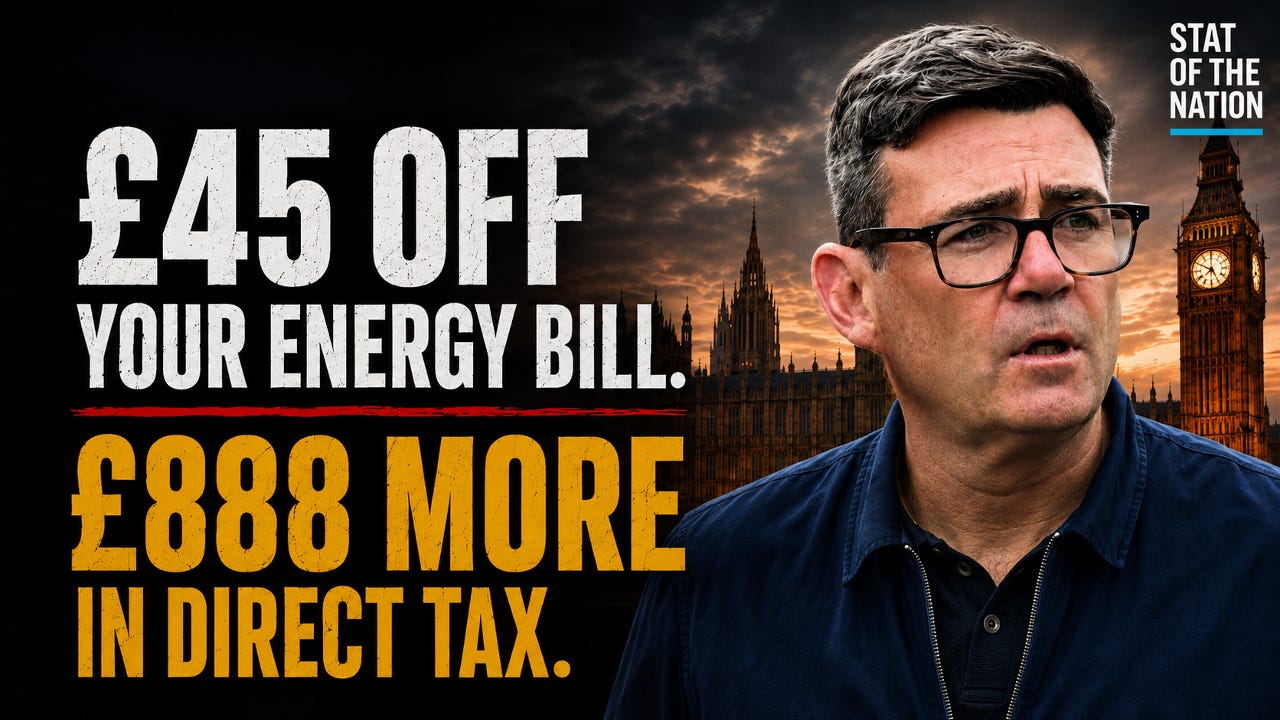
Andy Burnham has begun his premiership with a promise to put money back into people’s pockets.
From 1 October, VAT on domestic electricity will fall from 5 per cent to zero. The government says this will reduce the annual Ofgem price cap by around £45.
Any reduction in household bills is welcome. But this announcement needs to be placed against the wider financial reality facing workers.
The average full time employee is paying around £888 more in Income Tax and National Insurance than in 2024/25.
For every £1 Labour is offering back through the electricity bill, nearly £20 is being taken through direct taxation.
That is the reality behind the giveaway.
The Tax Rise Dwarfs the Energy Saving
Earlier this year, I calculated the effect of frozen Income Tax and National Insurance thresholds on an average full time worker.
Median annual earnings were £37,430 in 2024/25. Based on projected wage growth, that rises to around £40,601 in 2026/27.
Normally, rising wages should leave workers better off. But because tax thresholds have been frozen, a growing share of that income is being pulled into the tax system.
The calculation showed:
• Direct tax in 2024/25: £6,961
• Direct tax in 2026/27: £7,849
• Increase in Income Tax and National Insurance: £888
Against that increase, the government is offering households an annualised £45 reduction in electricity costs.
The difference in scale is enormous. The additional direct tax paid by one average worker is almost twenty times the value of the energy reduction offered to the entire household.
In a household with two average earners, the combined increase in direct tax would be around £1,776. The electricity saving would still apply only once.
This is not a substantial tax cut or a meaningful reversal of the pressure placed on working families.
It is a small amount being handed back after much more has already been taken.
The £45 Headline Is Annualised
The VAT reduction begins on 1 October 2026.
The government says it will reduce the yearly Ofgem price cap by around £45, cost approximately £850 million during 2026/27 and lower Consumer Prices Index inflation by around 0.10 percentage points.
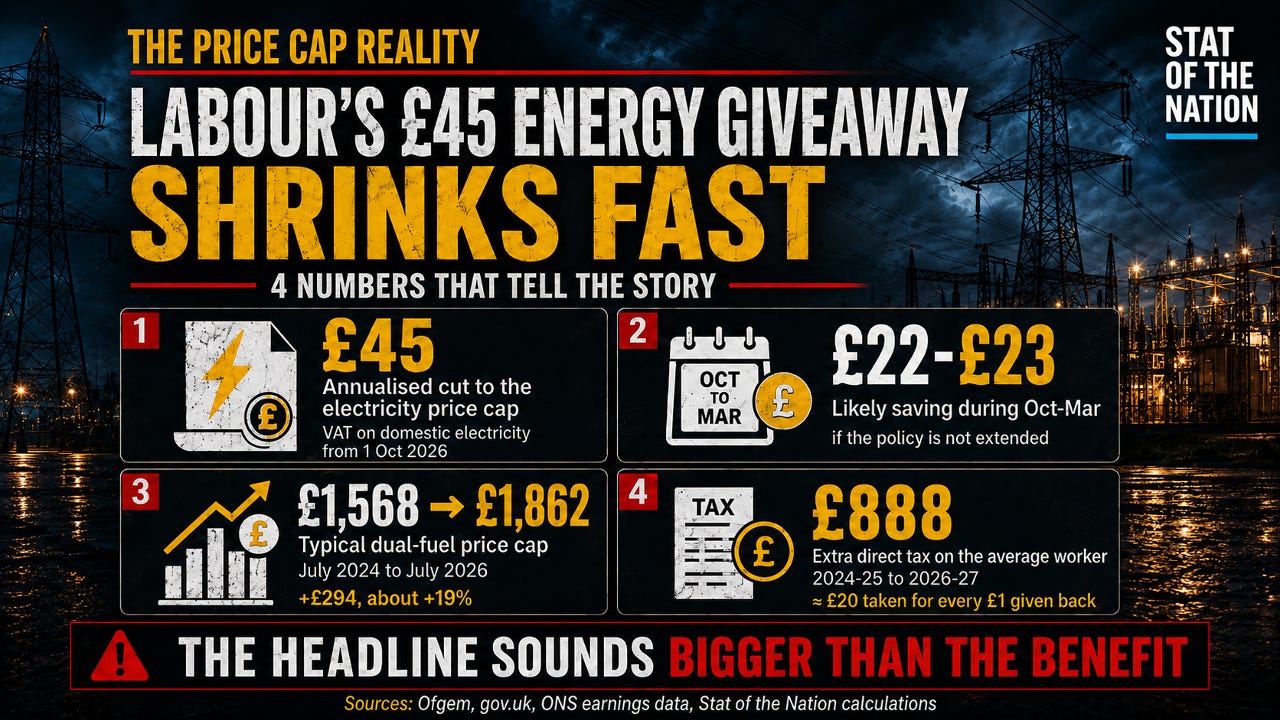
But funding has so far been identified only for the period from October to the end of this financial year. The government has not guaranteed that the VAT reduction will continue beyond March 2027.
If the policy ends then, a household using a typical amount of electricity would save closer to £22 or £23 during the currently funded period. The exact amount would depend on consumption.
So the £45 is not necessarily the cash saving households will receive this financial year.
It is an annualised headline attached to a policy that has not yet been guaranteed for a full year.
Energy Bills Are Still £294 Higher
The current Ofgem price cap for a typical dual fuel household paying by direct debit is £1,862 a year.
When Labour entered government in July 2024, the equivalent cap was £1,568.
That means the current cap is:
• £294 higher than in July 2024
• Almost 19 per cent higher
Even after applying the full £45 annualised VAT reduction, the cap would remain around £249 above the level Labour inherited.
Labour can claim it is reducing one element of the bill. It cannot credibly claim that household energy has become cheaper since it entered office.
The longer term comparison tells the same story:
• 2019: around £1,137
• July 2024: £1,568
• July 2026: £1,862
The international energy crisis caused a huge increase during 2022. Prices later fell from their peak, but they remain far above their pre crisis level and are rising again.
Removing VAT reduces the visible price. It does not increase domestic production, improve energy security or reduce the underlying cost of the energy system.
Burnham Promises to End Rough Sleeping Again
Energy bills were not Burnham’s only opening promise. He has also pledged to tackle homelessness and end long term rough sleeping in England.
It is an admirable objective, but his record in Greater Manchester deserves scrutiny because he made a similar commitment after becoming mayor in 2017.
My calculation, adding together the official snapshot figures for Greater Manchester’s ten local authorities, shows the estimated number of people sleeping rough on a single autumn night was:
• 2010: 41
• 2017: 268
• 2021: 90
• 2025: 197
Burnham can legitimately point to a substantial fall during the early part of his mayoralty. The figure declined from 268 in 2017 to 90 in 2021, which was real progress.
But the pandemic was also important. The national Everyone In programme, emergency accommodation and temporarily available hotel rooms helped produce unusually low rough sleeping figures during 2020 and 2021.
Since that low point, the trend has reversed. By 2025, the Greater Manchester total had risen to 197, more than double the 2021 figure.
It remains below the exceptionally high level Burnham inherited, so it would be unfair to claim that no progress was achieved.
But he promised to eradicate rough sleeping in Greater Manchester.
He did not.
Rough sleeping was reduced. It was not eradicated.
Burnham is now making a similar promise nationally. His record suggests the public should demand measurable milestones, transparent reporting and a clear definition of success.
Promises are easy. The numbers will show whether anything genuinely changes.
Labour’s Old Problems Rearranged
Burnham has presented his arrival as a break with the Starmer government.
There have been significant changes, with John Healey becoming Chancellor, Louise Haigh becoming First Secretary of State and Minister for the Cabinet Office, and Ed Miliband becoming Foreign Secretary.
But the Cabinet still relies heavily on familiar figures from Labour’s existing government.
Shabana Mahmood remains Home Secretary, Jonathan Reynolds remains at Business, Heidi Alexander remains at Transport and Lisa Nandy remains responsible for Culture, Media and Sport.
This is not a government built from outside the political establishment. It is largely the same parliamentary Labour Party, with ministers retained, promoted or moved between departments.
Many served in the government that delivered higher taxes, falling payroll employment, weak growth and declining public confidence.
The decision to bring Burnham back from Greater Manchester suggests Labour did not believe any of the obvious candidates already around the Cabinet table could restore public confidence.
Burnham can present himself as a change from Starmer, but he is not a political outsider. He first entered Parliament in 2001 and previously served as Chief Secretary to the Treasury, Culture Secretary and Health Secretary.
This is an experienced Labour insider returning to Westminster because those already there were not considered capable of rescuing the government.
A new person is in Number 10. Much of the political operation underneath remains familiar.
The First Test of Burnham’s Government
Burnham wants Britain to believe this is a fresh start, but the first evidence is underwhelming.
A £45 annualised electricity reduction is being offered to workers paying around £888 more in direct tax. The policy begins in October, but it has not been guaranteed beyond March. If it ends then, the benefit during the currently funded period would be closer to £22 or £23.
Energy bills remain almost £300 above the level Labour inherited.
Burnham promised to eradicate rough sleeping in Greater Manchester.
He did not.
Much of the same Labour political class remains in government.
Burnham deserves to be judged fairly. Removing VAT from electricity is better than leaving it in place. Reducing rough sleeping is a worthwhile objective. Changing ministers can sometimes improve a government.
But the scale of what has been announced should not be exaggerated.
A possible £22 or £23 saving will not transform household finances. A promise does not end homelessness. A Cabinet reshuffle does not automatically create competence.
Britain does not need another political relaunch built around announcements that shrink when placed beside the data.
It needs lower taxes, genuinely cheaper energy, measurable reductions in rough sleeping and ministers capable of delivering results.
So far, Labour has changed its leader. It has not yet proved that it has changed direction.
✍️ Jamie Jenkins
Stats Jamie | Stats, Facts & Opinions
📢 Call to Action
If this helped cut through the noise, share it and subscribe free by entering your email in the box below and get the stats before the spin, straight to your inbox (no algorithms).
📚 If you found this useful, you might also want to read:
The OBR’s Warning - Britain’s Tax & Spend Time Bomb

The Office for Budget Responsibility has delivered a warning Westminster cannot keep dodging.
📲 Follow me here for more daily updates:
Communism is a disease, and burn-em has it, like they all do, congenitally, it seems
Great stats Jamie. Everything you said was exactly correct.
I can tell from his first two moves that Burnham hasn’t grasped the nettle. He is rearranging the deck chairs! He has no ideas beyond tinkering. If he had he’d have got on with it.
As you quite rightly point out the problem at hand is enormous. And his opening gambit is minute. The hype is shocking. Once again a leader has been chosen NOT knowing his views vision or ideas. When Jeremy Corbin was chosen Labour had a series of interviews. To get to know their chosen best. This didn’t happen here. He has been crowned because of popularity alone. That’s not good enough. Now Corbin was a disaster. But the system should have picked the best. But Corbin wasn’t it. He was just more skilled at talking a good talk. He didn’t have any ideas either!
So I fear we have again got another tinkering leader.
As I have said before. We have a monetary system that has an amount of money in it. That one pot has to be sufficient for all our needs. It rotates and gets earned and spent to grease our palms. But more and more that money is missing. It’s sitting somewhere in banks here and abroad NOT being earned by us as a result of it being SPENT by its owners, oh no. It’s being used by those banks to leverage and loan to us in dribs and drabs. So we get indebted money instead of freely spent rotating money.
That resultant flow gives us debt and gives them our future earnings and profits. So they, the owners of that money, don’t ever have to spend it back. Not while we are all paying them our future earnings.
This withholding of money, vast sums of our much needed money makes our tax paying pot insufficient for our needs and makes our governments tax take insufficient too. All because they are allied to keep our money.
We on the other hand spend all we earn because it is insufficient. We can’t pay our way nor can we even afford to enjoy ourselves. Not because there isn’t enough money out there. No. It’s because the amount we gave us too small and too full of debt!
We have been underfunded for decades. This has to stop and the debts are becoming unsustainable.
We don’t need a reduction of vat on electric! We need the vast sums of money that sits in those bank accounts here and abroad to be spent here on our workers and in our businesses.
Taxing isn’t the answer. We need them to spend it back! That’s the only way for any economy to work. Full flow. All money being spent all of the time. Earning all the time, higher wages much higher. Enough to stop borrowing! And make all money rotate all of the time.
Trying to manage on insufficient money is disastrous.