

More than one million children in England had an active referral to mental-health services in 2024–25.
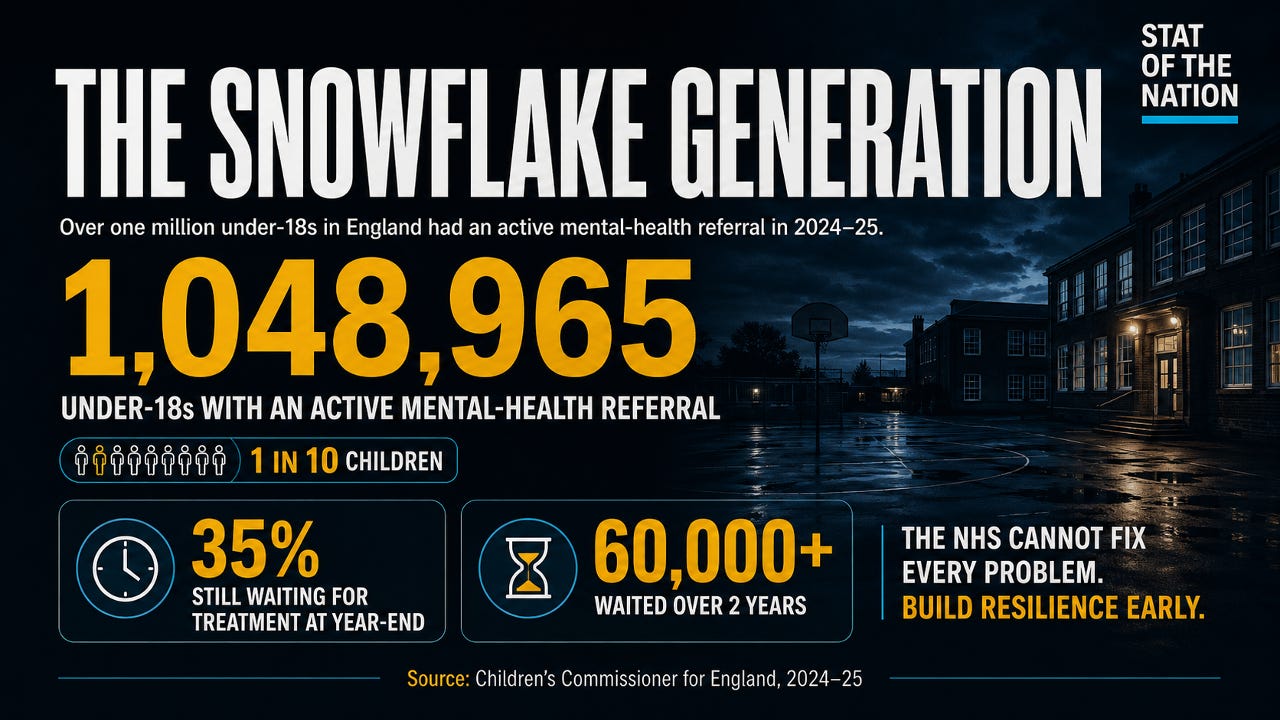
1,048,965 under-18s had been referred, were waiting or were receiving treatment through Children and Young People’s Mental Health Services during the year. It does not mean one million children received a new diagnosis in a single year.
But it is still an extraordinary figure.
The Children’s Commissioner says the total has risen from 563,639 in 2018–19 to more than one million today, although the earlier and later figures are not perfectly identical measures because the reporting methodology has changed.
Whatever caveat we attach, the direction is clear.
More children are reaching mental-health services. More are waiting. And too many are staying in the system for far too long.
Of course, some children need specialist help. Mental illness is real. Anxiety, depression, trauma, eating disorders and neurodevelopmental conditions cannot be wished away with a lecture about “toughening up”.
Children who need help should get it quickly, properly and without being left on a waiting list for months or years.
But we also need to ask a harder question.
Have we become too quick to treat some ordinary difficulties, disappointments and anxious periods in childhood as problems requiring a clinical pathway, rather than first helping children build confidence, coping skills and resilience?
Because one in ten children entering mental-health services is not only an NHS capacity problem.
It is a question about the culture we are building around childhood.
The Numbers Are Going In The Wrong Direction
The latest Children’s Commissioner report makes clear how stretched the system has become:
1,048,965 children had an active referral in 2024–25.
That was up from 958,192 the previous year.
35% of children with an active referral were still waiting for treatment at year-end.
More than 60,000 had already waited over two years.
That is unacceptable.
The NHS needs the capacity to support children with serious mental-health needs. But more appointments, referrals and assessments cannot be the whole answer.
We should also be asking why so many children are reaching the point where a clinical service is becoming the place they turn.
Support Is Not The Same As Protection
We are creating a snowflake generation.
That does not mean every young person is weak, lazy or incapable. Plenty are working hard, dealing with real pressures and trying to build a future in difficult circumstances.
But as a culture, we have become far too frightened of upsetting children.
Parents worry about saying the wrong thing. Teachers worry about giving honest feedback. Schools worry about being too demanding. Clubs worry about competition. Institutions worry that standards, consequences or disappointment might damage a child’s confidence.
The result is that too many children are being protected from the very experiences that help them grow.
They are protected from losing. Protected from criticism. Protected from being told they could do better. Protected from failure. Protected from the uncomfortable truth that effort does not always produce an immediate reward, and that sometimes someone else will simply be better.
That is not kindness. It is not compassion. It is a failure to prepare young people for real life.
Adult life does not offer a safe space from rejection, pressure, competition or disappointment. There are job interviews you do not get, promotions you miss out on, homes you cannot afford, relationships that end and moments where someone tells you that your work is not good enough.
Children need support through those experiences. But they also need to experience them. Because confidence is not built by being told you are brilliant at everything. It is built by struggling, improving, failing, getting back up and realising you can cope.
Prevention Is Better Than Cure
If one in ten children is now entering mental-health services, we should not only ask whether the NHS has enough clinicians.
We should ask what is happening before a child ever reaches a referral form.
Parents are not expected to be therapists. Teachers are not expected to solve every family problem. Sports coaches cannot replace a stable home or a functioning health service.
But children do not grow up in NHS waiting rooms. They grow up in families, schools, friendship groups, clubs and communities. Those are the places where resilience should begin.
A child anxious before an exam may need reassurance, perspective and help preparing. A child disappointed after not being selected may need encouragement to improve and try again. A child struggling socially may need help to build confidence and connection, alongside specialist assessment where that is genuinely needed.
Some children will need therapy, assessment, medication or safeguarding support. That is exactly what the NHS must provide.
But prevention means doing more before distress becomes crisis and before a clinical referral becomes the only route to help.
If more than one million children are being routed into mental-health services, something is not working in the support systems around childhood.
Children need adults who listen.
But they also need adults who set boundaries, give perspective, expect effort, encourage independence and teach them that difficult feelings can be faced rather than feared.
Inclusion Should Not Mean Removing Competition
Sport is one of the clearest examples.
Every child should have the chance to take part. Every child should be encouraged. Every child should feel included and valued.
But inclusion should not mean pretending performance does not matter, that everyone is equally good at everything, or that no child should ever experience losing.
Sport teaches children that hard work can improve performance. It teaches teamwork, discipline, responsibility and commitment. It teaches that you can lose one week and come back stronger the next.
It teaches that somebody else may be better than you today, but that you can still improve tomorrow.
That is not harsh. It is healthy. Life is competitive whether we like it or not.
There is competition for jobs, homes, university places, promotions, clients, contracts and opportunities. There are standards to meet, deadlines to hit, difficult feedback to absorb and moments when somebody will tell you that you need to do better.
If children are never taught how to handle losing, criticism or not being the best, what do we expect when they enter adult life?
We should not be raising children to fear challenge. We should be raising them to meet it.
This Does Not End At 18
The consequences do not disappear when a child leaves school.
If we are creating young people who are less able to cope with criticism, pressure, competition, disappointment and responsibility, then we should not be surprised when some struggle to become confident, independent and employable adults.
That does not mean every young person receiving support is unwilling to work. Many are dealing with serious illness, disability or barriers that are entirely real.
But employability is not just about qualifications.
It is also about resilience. Turning up. Taking feedback. Handling rejection. Working with other people. Recovering when something goes wrong. Keeping going when life is difficult.
Those are skills children should begin learning long before they enter the workplace.
In April 2026, 511,529 Personal Independence Payment claimants aged 16 to 29 had psychiatric disorder recorded as their main condition.
Psychiatric disorder was the main recorded condition for:
83% of PIP claimants aged 16–19
77% of those aged 20–24
71% of those aged 25–29
These are not the same people counted in the children’s referral figures, and the numbers do not prove a direct pipeline from child referral to PIP.
But they show why this debate cannot end when a child turns 18.
PIP is not an unemployment benefit. Many claimants have serious, long-term conditions and many are in work.
But if more young people are reaching adulthood already defined by anxiety, diagnosis, ill-health and dependence on support systems, then the knock-on effects will be felt in workplaces, communities, public services and the welfare system.
The welfare bill is not where this story begins.
It may be where the consequences eventually show up.
What Needs To Change
The NHS must be there for children with serious mental-health needs. A diagnosis can be life-changing when it unlocks the right treatment and support.
But the NHS cannot be the answer to every problem in childhood.
Every referral needs clinicians, time and money. The more we route ordinary pressure, disappointment and anxiety into clinical systems, the harder it becomes for children in genuine crisis to get help quickly.
The goal should not be an ever-larger mental-health service dealing with ever-larger numbers of children.
It should be fewer children reaching crisis point in the first place.
That means parents, schools, clubs and communities doing more to build resilience early, setting boundaries, encouraging effort, giving honest feedback and helping children learn that difficult feelings can be faced, managed and overcome.
Treatment matters.
But prevention, resilience and preparation for adult life matter just as much.
The Bigger Question
A country that sends more than one million children into mental-health services is not just facing an NHS capacity crisis.
It is being forced to confront a harder question.
What generation are we creating?
Children deserve fast, serious help when they are unwell.
But they also deserve a childhood that equips them to cope with pressure, rejection, criticism and failure.
A healthier generation will not be created solely by adding more appointments at the end of the process. It will be created by adults, families, schools, clubs and communities doing more at the beginning of it, building confidence, setting boundaries, encouraging effort and teaching children that difficult feelings can be faced, managed and overcome.
That is not old-fashioned.
It is essential.
✍️ Jamie Jenkins
Stats Jamie | Stats, Facts & Opinions
📢 Call to Action
If this helped cut through the noise, share it and subscribe free by entering your email in the box below and get the stats before the spin, straight to your inbox (no algorithms).
📚 If you found this useful, you might also want to read:
Disability Benefits Hit 4 Million — 500k Young Claimants With Psychiatric Disorders

New PIP figures are out, and the benefit has reached a major milestone.
📲 Follow me here for more daily updates:
Great observation Jamie.
I think there are many factors that lead our children into this new phenomenon.
Firstly I think that children are not being put into work environment until mid twenties!
This delay is detrimental. They learn not to work. They learn to be lumbered with the debt of University. They travel and learn to run away. And they are subjected to pressures from social media and the schools need to do well for their own benefits. Teachers and heads are under pressure to do well and that pressure is passed onto the shoulders of our children.
Parents who themselves are under pressure from debt and high costs of living. Or are from poor backgrounds and drugs are an obvious part of their growing up. But more do now are the struggles of their parents. With more family’s having to have two bread winners leaving the kids to fend for themselves.
Marriage breakdown and divorce can seriously affect our young. And this heady mix of stress worry and fear is more paramount than fun freedom and care free but caring life.
Our inability to do the right things in politics has a lot to make up for. But in all honesty they too are the children of the recent past too.
My father went to war at 15. He lied about his age. His parents split at a young age. He had an education of just a blackboard and chalk. Yet he could do sums in his head faster than a calculator. Write letters and prose like no other. And defend himself and his family at every turn.
He was sent to the western desert on a diet of biscuits and beans. And survived, just. He had to fight for his life and those around him. And he never stopped. He was one of the hardest men I have ever met in more ways than one.
He taught me and my brothers how to work from an early age and gave us skills and life skills growing up. I could make do and mend by my teenage years and could earn a living if I had to in my teens. I left school at 15. Like him. And worked for a Bank.
I was shocked even then at the incapability of graduates that came after me. Who hadn’t had that upbringing. They were in early twenties and I was 15. And they had no clue what to do it how to think in the environment because they weren’t educated in doing work.
I realised then just how wrong further education is. And I still think that now.
They are not taught to think! They are taught to remember. To copy. To reach an equal level of knowledge but not understanding. And they get spat out the end having achieved nothing at all. Except the same scores of the same unwarranted exams. Because that’s what their schools and universities need for their survival.
That’s not real life! Being stuck in a bedroom learning how not to work. How not to engage. And how to avoid the realities of real life interaction and disciplines. They leave university as weak adults. And this shows in your stats.
I wonder how many 15 year olds would be able to do what my father did? Fight a war to the death and survive.
When I was in school I had to write my own programs on punch cards to do computer science. I later wrote programs for fun on my SPECTRUM computer.
Knowing your way round a keyboard isn’t the same as that. I font see even that level of basic programming being a subject today as even I did then. What that taught me was joined up thinking. Combined with working young, I could decode a car engine at 10 years old, that type of learning gave me skills to take into work at 15.
I fear the type of schooling isn’t up to the modern needs. By not allowing kids to work or learn practical skills. They learn instead not to work. Not to engage or worse leave school and do nothing or stay in and still do nothing until they realise too late in the day that their working life hasn’t started till well into their thirties.
I want more thinkers to think for themselves rather than learn aspects of other’s opinions and disjoint them together.
Learn checks and balances and reasons to doubt rather than follow a doctrine someone had forced upon them. Learn how to think and work out a problem before they are 15 so they can leave at 15 and know what to expect.
I too fear that we are letting them down by giving them false hope and a wrong path just because politicians want to deal with adults and not have to deal with unemployed children.
Out cane up with this pattern. Because he had no answer for youth unemployment. That’s his failure not theirs.
Great piece. One question: is there any anomaly in the demographic spread of claimants?