

New PIP figures are out, and the benefit has reached a major milestone.
As of April 2026, 4.0 million people in England and Wales were entitled to Personal Independence Payment. That is up 86,000 in just three months and 266,000 in a year.
PIP is not an unemployment benefit. It is designed to help with the extra costs of long-term disability, ill-health, or conditions that affect daily living and mobility.
But when a disability benefit reaches 4 million claimants, it becomes impossible to separate from the wider debate about sickness, worklessness, mental health and public spending. The headline is the caseload. The real warning sign is what sits underneath it.
The 4 Million Milestone
The latest figures show the PIP caseload in England and Wales has crossed 4 million. This is no longer a small corner of the welfare system. It is one of the biggest pressure points in the state.
The caseload has increased by:
86,000 in three months
266,000 in a year
That means the system is not simply large. It is still growing. And as the stock of claimants gets bigger, even relatively small percentage increases translate into very large numbers of people.
Who Is On PIP?
Most people on PIP are not pensioners. Around 3.3 million claimants in England and Wales are of working age, which is about 83% of the caseload.
Looking at broad age groups, the largest group is those aged 50 to 64:
16–29: 666,000 claimants
30–49: 1.15 million claimants
50–64: 1.39 million claimants
65+: 804,000 claimants
There is an important caveat on the 65+ group. PIP is mainly a working-age disability benefit. People who are already over State Pension age usually cannot make a new claim for PIP; the equivalent route for new disability support claims after that point is generally Attendance Allowance.
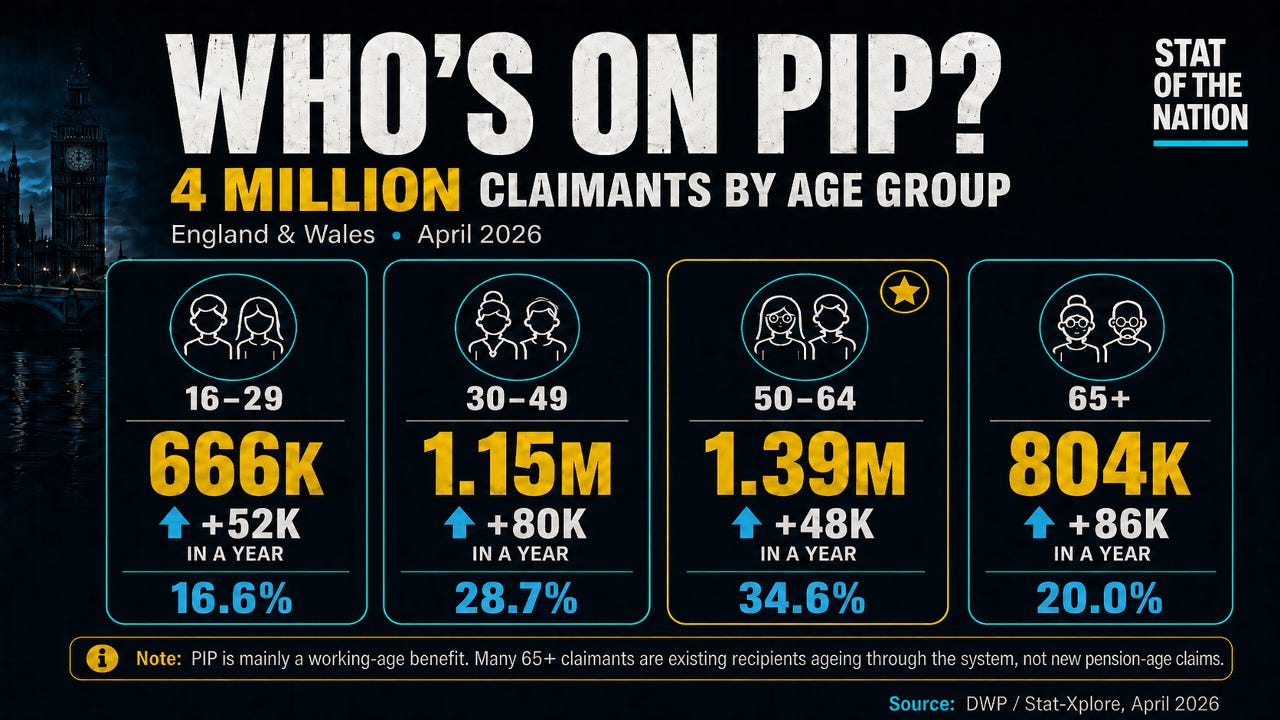
So many older PIP claimants are people who claimed before reaching State Pension age and have aged through the system while remaining entitled. That still matters, because it shows the existing caseload is ageing and staying in the system, but it should not be read as a wave of new pension-age PIP claims.
That age profile matters. PIP is often discussed as if it sits in a separate box labelled “disability benefits”, but the scale of working-age entitlement means it is also part of a much bigger national story.
Britain has a growing long-term sickness problem. We see it in the labour market, NHS waiting lists, mental health services and the welfare system. PIP is not the same as being out of work, but a country with millions of working-age adults receiving disability support has to ask harder questions about health, work, productivity and the pressures building across public services.
The Real Warning Sign: Half a Million Young Claimants
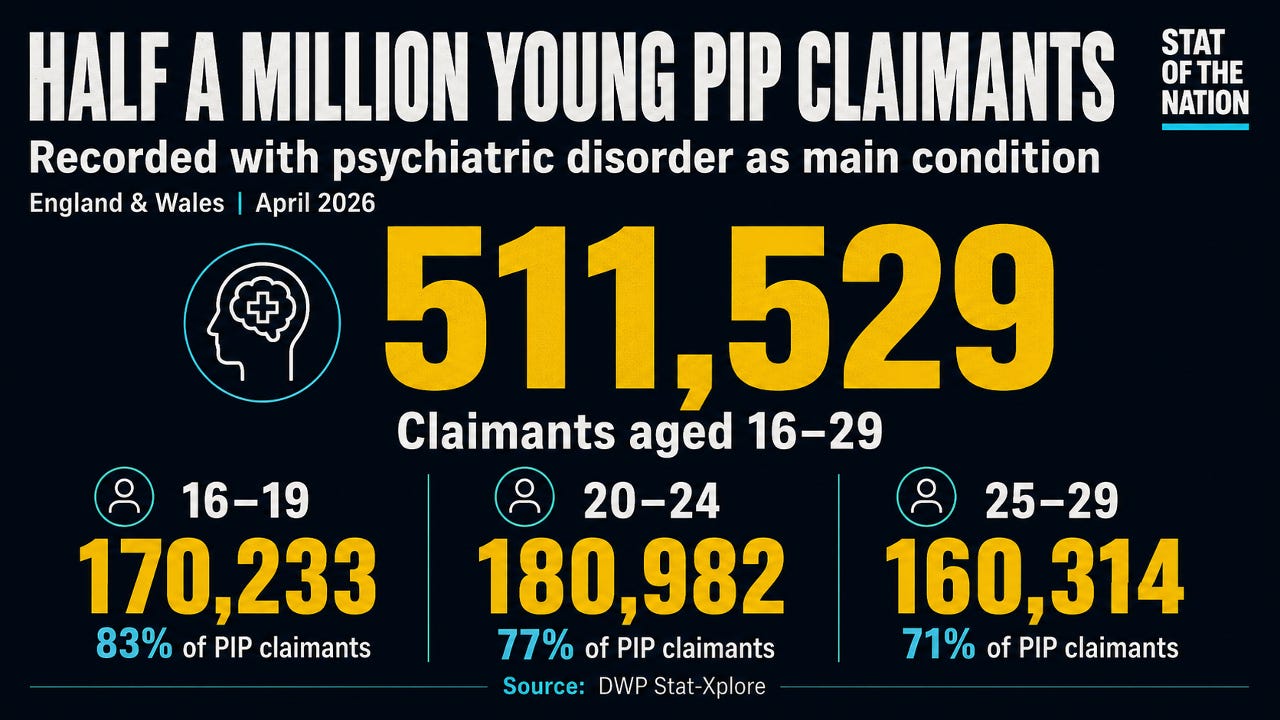
The 4 million figure is the headline. But the more worrying number may be this: 511,529 PIP claimants aged 16 to 29 have psychiatric disorder recorded as their main condition.
That is more than half a million young people.
This is where the PIP story changes. It is no longer just a debate about welfare spending or disability administration. It becomes a question about what is happening to the mental health, resilience and work readiness of younger generations.
The figures by age group are stark:
16–19: 170,233 claimants
20–24: 180,982 claimants
25–29: 160,314 claimants
Together, that adds up to more than half a million young claimants with psychiatric disorder recorded as their main condition. That should worry policymakers far more than the headline cost alone.
Among Young Claimants, Psychiatric Disorder Dominates
The same point shows up even more clearly when we look at shares. Among younger PIP claimants, psychiatric disorder is not a marginal category. It dominates the caseload.
In April 2026, psychiatric disorder was the recorded main condition for:
83% of 16–19-year-old PIP claimants
77% of 20–24-year-old PIP claimants
71% of 25–29-year-old PIP claimants
That does not mean every case is the same. “Psychiatric disorder” is a broad official category that can include severe mental illness, anxiety and depressive disorders, autism spectrum disorders, hyperkinetic disorders and other diagnoses.
But the overall pattern is clear. For younger adults on PIP, this is overwhelmingly a mental health, neurodevelopmental and psychiatric-disorder story.
That does not mean support should be denied to people who need it. But it does mean the country has to ask why so many younger people are reaching the point where they qualify for disability support.
The Welfare Bill Is the End Result
This is where the debate needs to move beyond slogans. If more than half a million 16–29-year-olds are on PIP with psychiatric disorder recorded as their main condition, that raises much deeper questions.
What is happening in schools? What is happening with diagnosis? What is happening with NHS waiting times? What is happening with family breakdown, social media, isolation, resilience and the labour market?
And what kind of economy are young people being asked to enter?
The welfare bill is not the beginning of this story. It is the end result. The causes sit much earlier.
The Fiscal Pressure Is Growing
This is also a major fiscal issue.
DWP forecasts PIP spending at £32.1 billion in 2026/27, rising to £44.7 billion by 2030/31.
That is a huge increase for a single benefit. And it comes at the same time as the labour market has weakened under this Government.
The latest PAYE data showed the number of payrolled employees falling. Put simply, fewer people in payroll work means a weaker tax base, while long-term sickness and disability spending keeps rising.
That is the basic pressure point Britain cannot ignore.
A healthy welfare state needs a healthy working population underneath it. If the number paying in weakens while the number receiving long-term sickness and disability support rises, the pressure eventually shows up somewhere: higher taxes, higher borrowing, tighter eligibility, or worse services elsewhere.
This is why the PIP debate cannot just be about compassion or cost. It is also about whether Britain still has the productive base needed to support the welfare state it has built.
The Debate Is Too Small
The political debate around welfare usually collapses into two simple arguments: one side talks about compassion, the other talks about cost. But the PIP numbers point to something deeper.
Britain needs to ask why so many working-age people are living with conditions severe enough to qualify for disability support. More urgently, it needs to ask why more than half a million young claimants are recorded with psychiatric disorders as their main condition.
It also needs to ask how a shrinking or weakening payroll base is supposed to support a welfare system with rising long-term sickness and disability costs.
That is not just a Department for Work and Pensions issue. It is a long-term sickness crisis, a mental health crisis, a labour-market crisis, and increasingly a welfare-state crisis.
The question is whether Britain is prepared to tackle the causes — or whether we will simply keep managing the bill.
✍️ Jamie Jenkins
Stats Jamie | Stats, Facts & Opinions
📢 Call to Action
If this helped cut through the noise, share it and subscribe free by entering your email in the box below and get the stats before the spin, straight to your inbox (no algorithms).
📲 Follow me here for more daily updates:
Let me caveat this by saying I receive PIP. I am profoundly physically disabled full time power chair user and at the moment fighting to keep the use of my arms and my eyesight.
But you tell me how your average mental health condition should qualify? When the criteria is so rigid.
Needing help getting in and out of bed. Needing help washing, dressing, cooking, or need constant supervision and it has to be for 9 months or longer that you have been like that.
How does your average depressive fit that criteria or anxious person? If someone is so depressed they don't get out of bed, it never lasts that long.
Vaccinations of infants, then through life e.g. aluminium as an adjuvant. Diet, food additives over the years. Convenience foods.