

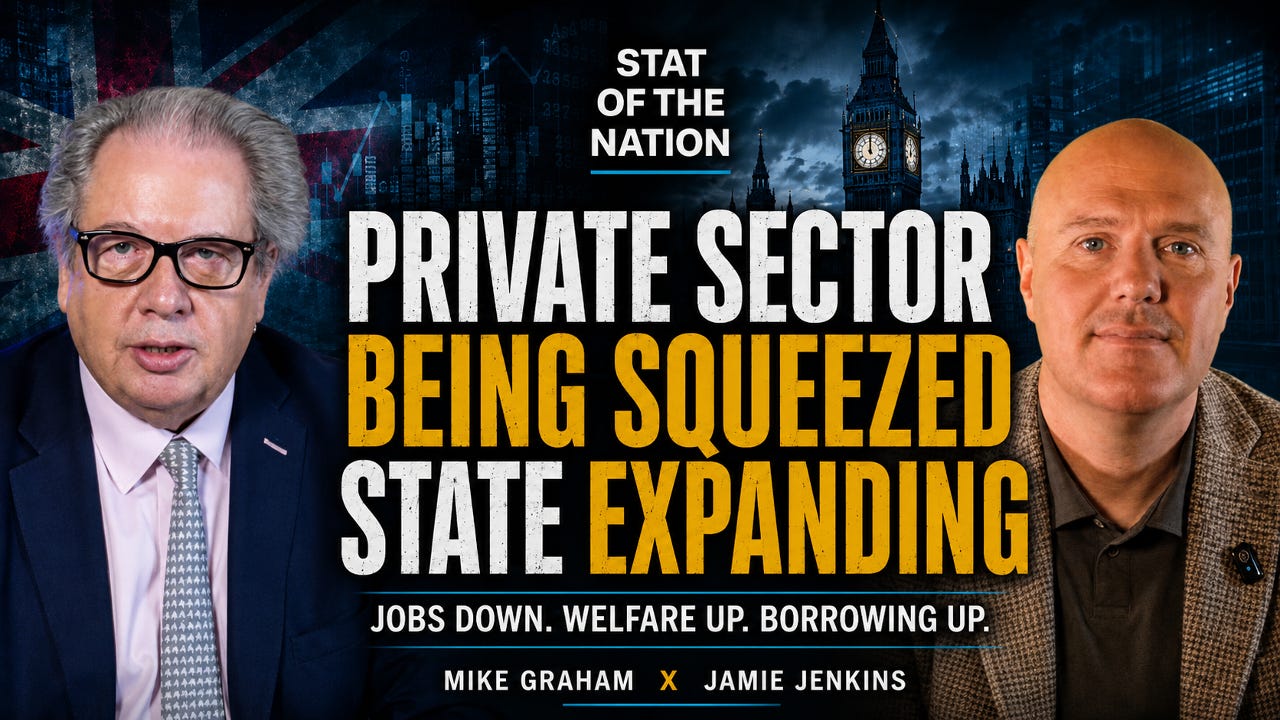
This week on The Mike Graham Show I joined Mike for our usual Thursday morning look at the numbers behind the headlines. The main focus was the latest labour market data, but the wider theme was hard to miss: Britain’s private sector is under pressure, the welfare bill is rising, borrowing remains far too high, and the state keeps expanding its reach.
Payroll jobs are now down by 192,000 since the election, vacancies are falling, and the sectors being squeezed are exactly the ones most exposed to Labour’s jobs tax — hospitality, retail, manufacturing and smaller businesses. At the same time, public sector employment is rising, public sector pay is outpacing the private sector, and disability benefit claims are close to 4 million.
But the conversation also moved beyond the economy. We discussed the government’s proposed social media restrictions for young people, the dangers of drifting toward digital ID, and the BBC’s bloated legacy model as YouTube and independent broadcasters continue to gain ground. Different topics, same underlying question: how much more of national life should be run, funded or controlled by the state?
The Numbers Tell The Story
The clearest way to understand the state of the country is to put the latest figures side by side. Once you do that, the government’s claim that its economic plan is working becomes much harder to sustain.
192,000 fewer payroll jobs since the election
Vacancies falling as employers cut back hiring
Private sector pay growth: 2.9%
Public sector pay growth: 5.1%
PIP claims close to 4 million
£24.3 billion borrowed in April alone
That is the contradiction at the heart of Labour’s economy. The people and businesses expected to fund the system are being squeezed, while public spending, public employment and welfare dependency keep moving in the opposite direction.
You cannot build a strong economy by making work more expensive, weakening the tax base, expanding the state and then borrowing to fill the gap.
The Jobs Market Is Flashing Red
The fall in payroll jobs matters because these are not abstract numbers on a spreadsheet. They are real jobs, real pay packets and real tax receipts disappearing from the economy. When payroll employment falls by 192,000 since the election, that is a serious warning sign for any government claiming to have a growth plan.
The weakness is also showing up in exactly the sectors most exposed to Labour’s jobs tax: hospitality, retail, manufacturing and smaller businesses. These are lower-margin employers where higher National Insurance, rising wage costs and weak consumer demand quickly feed into hiring decisions.
This is why the employer National Insurance rise matters. Businesses do not absorb higher employment costs in a fantasy world. They respond by hiring fewer people, delaying expansion, cutting hours, raising prices or reducing investment. When the government makes work more expensive, it should not be surprised when fewer jobs are created.
Vacancies are another important warning sign because they look forward. A fall in payroll employment tells us what has already happened, but falling vacancies tell us what employers think is coming next. Right now, they are not behaving like firms preparing for a boom.
Rachel Reeves keeps saying the economic plan is working. But 192,000 fewer payroll jobs since the election is not what success looks like.
The Private Sector Is Paying The Price
The private sector ultimately funds the state. It creates the wealth, pays the wages, generates tax receipts and supports the public services politicians like to promise. If that part of the economy weakens, the whole fiscal model becomes more fragile.
That is why the pay figures matter. Private sector regular pay growth is now around 2.9%, while public sector regular pay growth is around 5.1%. That does not mean every public sector worker is overpaid, and many do difficult jobs, but at the national level the imbalance is obvious: the people paying for the system are seeing weaker pay growth than the people employed by it.
A country cannot keep increasing the cost of the public sector while the private sector slows down. You can do it for a while through higher taxes and borrowing, but eventually the numbers stop adding up.
That is the split we are seeing now. The private sector is adjusting to pressure. The state is carrying on regardless.
The State Keeps Growing
While payroll jobs are down since the election, public sector employment has been rising over the past year. That is exactly the wrong balance for the economy.
A healthy economy needs a growing private sector and a public sector that is efficient, focused and affordable. Britain increasingly looks like it is moving in the opposite direction: more pressure on business, more people dependent on the state, and more public spending financed by a weakening productive base.
This creates a dangerous political incentive. Governments can keep spending, hiring and promising more because the cost is spread across taxpayers or pushed into future borrowing. Businesses cannot operate like that. If costs rise and demand is weak, they have to make decisions immediately.
The result is a two-speed economy. The private sector has to live in the real world. The state behaves as if the real world can be postponed.
Welfare Is Becoming A Parallel Economy
The jobs figures cannot be separated from what is happening in welfare. Personal Independence Payment claims are now close to 4 million, and the rise among younger claimants is particularly concerning.
One of the most striking trends is the number of young adults claiming disability benefits for psychiatric disorders. There will always be people who genuinely need support, and a civilised country should provide a safety net for those who cannot work, but a safety net is not supposed to become a parallel labour market for people written off before they have properly started adult life.
The question is not whether mental health problems exist. Of course they do. The question is whether the welfare system is now too quick to move people out of the labour market and too slow to help them back in.
If hundreds of thousands of young people are leaving education and drifting into long-term benefit dependency, Britain has a serious social and economic problem. It means fewer people working, fewer people paying tax, higher welfare costs and more lives lost to inactivity.
That is not compassion. It is failure dressed up as support.

Borrowing Is The Escape Route
When jobs fall, tax receipts come under pressure. When welfare rises, spending goes up. When public sector employment and pay rise, the state becomes more expensive. Put those together and the answer becomes obvious: more borrowing.
In April, the first month of the financial year, public sector borrowing was £24.3 billion. That is an extraordinary figure outside the kind of emergency period we saw during Covid.
This is the part politicians prefer to avoid. Every spending promise has to be paid for through taxation, borrowing or cuts elsewhere. If the government is not willing to cut spending, and if the private sector is weakening, then borrowing becomes the default option.
That is how countries become poorer slowly: not through one dramatic crash, but through years of weak growth, high borrowing and bad incentives. The state expands, the tax base weakens, the debt bill rises, and eventually more of the national income goes on servicing yesterday’s promises.

The Social Media Ban And The Drift Toward Digital ID
We also discussed the government’s proposed social media restrictions for young people. Ministers and broadcasters have tried to present the policy as if parents overwhelmingly support an outright ban, but the real debate is more complicated.
Many parents are rightly worried about addictive features, algorithms, late-night scrolling and online harms. That is understandable. But concern about social media is not the same as support for a blanket ban, and it is certainly not the same as handing the state and big tech the machinery to police access to the internet.
This matters because the systems needed to enforce online age restrictions are not trivial. Once people are required to prove who they are to access online services, the debate quickly moves from child safety into digital ID territory.
A serious government would ask what specific harm it is trying to reduce, what evidence exists, and what the least intrusive solution would be. Instead, the instinct is too often the same: regulate first, expand power, and ask awkward questions later.

The BBC, YouTube And The End Of The Old Media Monopoly
The BBC also came up, particularly after reports of cuts and restructuring. The reaction from parts of the legacy media world was predictable: outrage, sadness and claims that something vital is being lost.
But there is another side to this debate. Anyone who has worked around large public institutions knows how much duplication and waste can build up over time. Multiple teams covering the same story. Layers of production. Different departments doing work that leaner organisations would do with far fewer people.
The point is not that every BBC worker is bad at their job. It is that the model is bloated. When an organisation is funded by a compulsory licence fee, it has a duty to be ruthlessly efficient with public money. It cannot behave as if every internal job is sacred while households and businesses are forced to do more with less.
The media world has changed. Independent broadcasters, YouTube channels, podcasts and online platforms are now producing political and current affairs content with far smaller teams and far lower costs. Mike Graham’s show is part of that shift. Viewers are moving away from legacy gatekeepers and toward people they trust to speak directly, without the old broadcast machinery.
That is healthy. The BBC should not be protected from the same efficiency pressures that households and businesses face every day.
The Bigger Picture
Jobs, welfare, borrowing, social media regulation and the BBC may sound like separate issues, but underneath them is the same bigger question: is Britain building a stronger society, or just a bigger state?
Right now, the numbers point in the wrong direction. Fewer payroll jobs. Falling vacancies. More welfare dependency. More borrowing. More regulation. More state control.
That is not renewal. It is managed decline.
Britain needs more people in work, more businesses hiring, more investment, and a welfare system that protects those who genuinely need help without writing off people who could still contribute. It also needs a public sector that improves productivity rather than simply demanding more money, more staff and more borrowing.
The country cannot keep loading costs onto the people and businesses that pay for everything else.
Conclusion
Rachel Reeves says the economic plan is working. The data says otherwise.
Payroll jobs are down by 192,000 since the election. Vacancies are falling. Private sector pay growth is weak. Public sector employment is rising. Welfare claims are climbing. Borrowing is already far too high.
This week’s discussion with Mike Graham kept coming back to the same point: Britain is drifting into a bigger state, a weaker labour market and a heavier burden on taxpayers.
The question now is simple. How long can Britain keep expanding the state while the productive economy underneath it gets squeezed?
Because at some point, the numbers win.
And right now, the numbers are flashing red.
✍️ Jamie Jenkins
Stats Jamie | Stats, Facts & Opinions
📢 Call to Action
If this helped cut through the noise, share it and subscribe free by entering your email in the box below and get the stats before the spin, straight to your inbox (no algorithms).
📲 Follow me here for more daily updates:
Labour always does the same that is why people needs to wake up and stop voting labour, they are a socialist elite they dont serve British citizens, they want to replace us all with illitetate foreigners get it ?
Isn't this the Fabians plan to have a welfare state. So they have full control. Which is crazy, when there are no working people left where are they going to get their money from?