


The 2026 Senedd election did not just end Labour’s dominance in Wales. It exposed the new divide shaping Welsh politics.
Young Wales went Plaid. Older Wales went Reform. Labour lost both.
For more than a century, Welsh politics had one central fact: Labour dominated. That fact no longer holds. YouGov’s post-election analysis, based on a reanalysis of its successful pre-election MRP, shows a country increasingly divided by generation, education, identity, ownership and trust.
This is not “two nations” in a constitutional sense. It is two political electorates: younger, more Plaid-leaning Wales on one side, and older, more Reform-leaning Wales on the other.
That is the real story.
The Official Result: Labour Wales Is Over
Before looking at the voter breakdown, it is worth reminding ourselves what actually happened. The 2026 Senedd election delivered one of the biggest political shocks in modern Welsh history.
The new 96-member Senedd looks like this:
Plaid Cymru: 43 seats
Reform UK Wales: 34 seats
Welsh Labour: 9 seats
Welsh Conservatives: 7 seats
Wales Green Party: 2 seats
Welsh Liberal Democrats: 1 seat
This was the first Senedd election since devolution where Labour did not win the most seats. Plaid Cymru became the largest party, Reform UK Wales became the second-largest party, and Welsh Labour was reduced to just nine seats.
That is the official result. But the YouGov analysis tells us something even more important: who voted for whom, and what kind of Wales is now emerging.
YouGov says it reanalysed the data behind its pre-election MRP, which successfully forecast the results of the vote, to break down how Wales voted by key demographic and political divides. The topline breakdown in the YouGov table is:
Plaid Cymru: 35%
Reform UK: 29%
Labour: 11%
Conservatives: 11%
Greens: 7%
Liberal Democrats: 5%
The analysis is based on 2,391 adults in Wales, with fieldwork carried out between 25 April and 4 May 2026. The table excludes those who said they did not know or would not vote.
Labour was not merely beaten. It was pushed into the pack, level with the Conservatives and far behind both Plaid Cymru and Reform UK.
For a party that once treated Wales as its safest political territory, that should be a warning siren.
Young Wales Went Plaid
Among younger voters, the result was overwhelming.
Among 16-29 year olds:
Plaid Cymru: 60%
Greens: 15%
Reform UK: 14%
Labour: 5%
Liberal Democrats: 3%
Conservatives: 2%
That is not a narrow youth lead. That is dominance.
There is a turnout caveat. Younger voters are often less likely to vote than older voters, so Plaid’s youth dominance does not automatically mean young Wales alone will decide elections. These figures show the preferences of voters, not every young person in Wales.
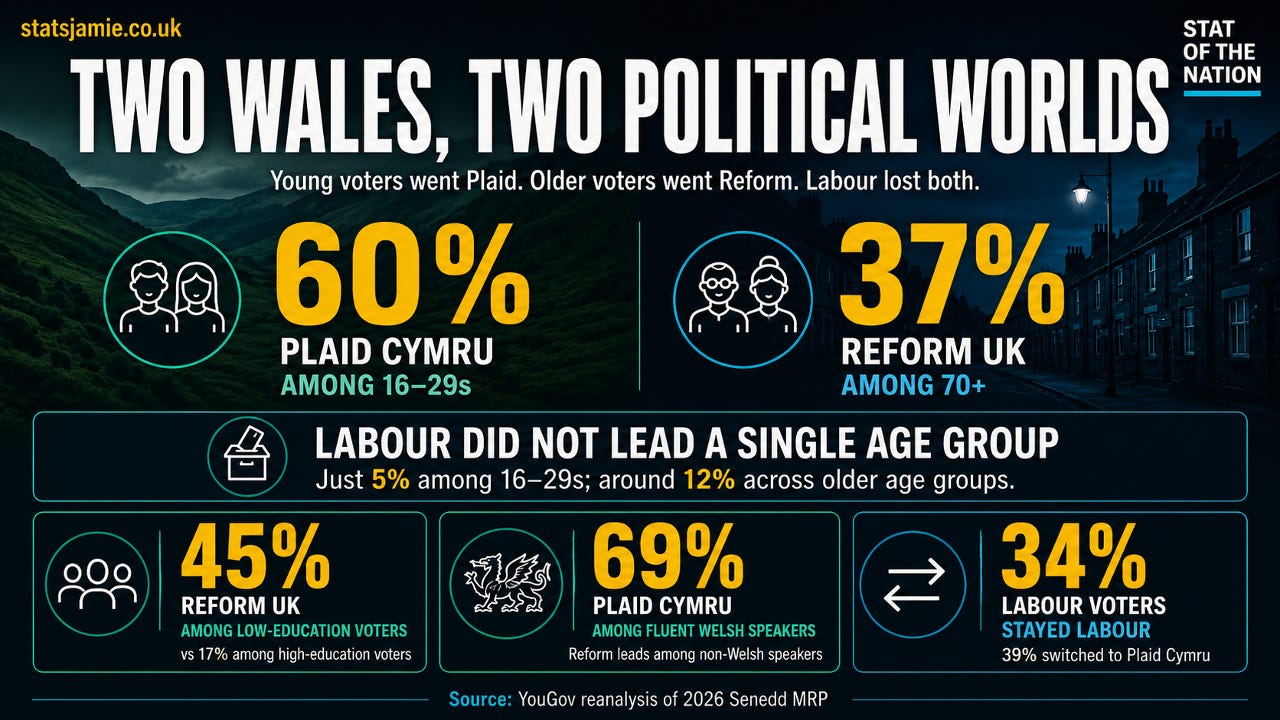
But as a signal of political direction, the number is striking.
For younger Wales, Plaid has become the main vehicle for change. That may be about Welsh identity, housing, climate, language, public services, culture or frustration with both Westminster and Cardiff Bay. It is unlikely to be one single issue.
Whatever the mix of reasons, the political outcome is clear. Labour no longer owns the future-facing vote in Wales. Plaid does.
That matters because political parties need a pipeline of support. If younger voters do not begin their political lives with Labour, Labour cannot assume they will return later out of habit.
The old Labour habit in Wales has weakened.
Older Wales Went Reform
Now look at the other end of the age scale.
Among voters aged 70 and over:
Reform UK: 37%
Plaid Cymru: 22%
Conservatives: 18%
Labour: 12%
Liberal Democrats: 4%
Greens: 4%
Reform also led among every age group above 50:
50-59: 34%
60-69: 36%
70+: 37%
Plaid’s support moved in the opposite direction, falling from 60% among 16-29s to 22% among over-70s.
This is not just a party split. It is an age split. Younger and older voters in Wales are increasingly voting as if they live in different political worlds.
One side is moving heavily towards Plaid. The other is moving heavily towards Reform.
That tells us something important about the emotional and political divide inside Wales.
Generation Or Life Stage?
There is one important caveat. Young people have often leaned left, radical or progressive. That is not new.
When people are younger, they are less likely to own homes, less likely to have accumulated assets, less likely to be paying higher levels of tax, and often more open to political movements promising change. As people get older, priorities can shift. They pay more tax, they may own property, they may have children, and they may become more focused on pensions, public order, migration, local services and whether the system rewards work.
In other words, some of this divide may be about life stage, not just generation. A 22-year-old renter and a 72-year-old homeowner are likely to see the world differently because they occupy very different positions in it.
But that caveat does not remove the significance of the YouGov figures.
Among 16-29 year olds, Plaid Cymru reached 60%. Among voters aged 70 and over, Reform UK reached 37%. Labour was stuck on 5% among 16-29s and 12% among over-70s.
That is the problem for Labour. Even if some younger voters move rightwards as they age, Labour is not currently the party they are starting with. Among older voters, Labour is not the party they are ending with either.
That is how a dominant political coalition disappears.
Labour Is Trapped In The Middle
The most brutal number for Labour is this: Labour did not lead any age group.
Its support was:
16-29: 5%
30-39: 12%
40-49: 12%
50-59: 12%
60-69: 12%
70+: 12%
That is remarkably flat. But flat is not the same as strong.
Labour appears to have become a party with residual support everywhere, but dominance nowhere. It is no longer the obvious party of younger voters, and it is no longer the obvious party of older working-class Wales.
Political dominance usually ends like this. Not all at once, but by losing different parts of the coalition to different opponents.
Plaid has taken the young, Welsh-speaking and graduate-heavy lane. Reform has taken much of the older, Leave-leaning and lower-education lane. Labour is left trying to speak to both while clearly leading neither.
The Divides Labour No Longer Bridges
The age divide is the main story, but it is not the only divide.
Look at education.
Among voters with low levels of education:
Reform UK: 45%
Plaid Cymru: 26%
Labour: 9%
Among voters with high levels of education:
Plaid Cymru: 43%
Reform UK: 17%
Labour: 14%
This mirrors a pattern seen across many Western democracies. Politics is no longer simply organised around class in the old industrial sense. It is increasingly shaped by education, identity, age, assets and trust.
The Brexit divide has not disappeared either.
Among Remain voters, Plaid Cymru reached 48%, while Reform UK was on 10%. Among Leave voters, Reform UK reached 53%, while Plaid Cymru was on 17% and Labour just 7%.
Again, Labour is stuck between two electorates it no longer leads. It is not the main party of Remain Wales. Plaid is. It is not the main party of Leave Wales. Reform is.
Welsh language also remains central. Among fluent Welsh speakers, Plaid Cymru reached 69%. Among those who do not speak Welsh, Reform UK was the largest party on 36%.
This is why the result feels deeper than a normal party swing. It looks like two different political identities becoming organised around two different parties.
Labour once bridged these divides in Wales. It no longer does.
The Coalition Has Broken
The scale of voter movement is remarkable.
YouGov found that only 45% of Welsh voters who voted in both 2021 and 2026 backed the same party both times.
Labour retained just 34% of its 2021 vote. Of those who voted Labour in 2021, 39% switched to Plaid Cymru, 13% switched to Reform UK, and only 34% stayed with Labour.
The Conservatives had a similar problem. More than half of their 2021 voters, 55%, switched to Reform UK.
The same pattern appears when looking back to the 2024 general election. Only 30% of 2024 Labour voters who voted in 2026 stuck with Labour. Nearly half, 45%, moved to Plaid Cymru, while one in ten moved to Reform UK.
That is not a normal electoral wobble. That is a coalition breaking apart.
It also suggests voters were not merely choosing between policy platforms. Many were choosing between competing stories about what has gone wrong in Wales and who represents change.
The Accountability Question
This should worry Labour, but it should also worry anyone interested in whether Wales is working.
Welsh voters are not changing parties for sport. They are reacting to outcomes: public services, living standards, NHS performance, housing, trust and whether they believe the political system is listening.
The old Labour offer was built on a simple assumption: Wales was Labour, and Labour was Wales. That assumption no longer holds.
The new question is harder. After decades of devolved Labour dominance, do Welsh voters believe Wales has improved enough?
The 2026 result suggests many do not.
Young voters appear to have decided that Plaid offers a better future. Older voters appear to have decided that Reform offers a louder challenge to the status quo. Labour, meanwhile, has been left defending a record that many voters no longer seem willing to reward.
That is the accountability story beneath the election result.
Conclusion
Wales has not just changed government. It has changed shape politically.
Young Wales is moving towards Plaid, while older Wales is moving towards Reform. Labour is losing both ends of the electorate.
Some of this may be life stage. Younger voters often lean left or progressive before taxes, mortgages, family costs and asset ownership shift their priorities. But that does not save Labour, because Labour is no longer the natural party of the young and it is no longer the natural party of older working-class Wales.
Labour did not just lose an election. It lost the ability to bridge Wales’ political divides.
That is the real lesson from the YouGov analysis.
The next phase of Welsh politics will not be defined simply by left versus right. It will be defined by generation, identity, education, ownership and trust.
For Labour, the message is brutal. The party that once united Wales is now being pulled apart by the divides it no longer seems able to bridge.
✍️ Jamie Jenkins
Stats Jamie | Stats, Facts & Opinions
📢 Call to Action
If this helped cut through the noise, share it and subscribe free by entering your email in the box below and get the stats before the spin, straight to your inbox (no algorithms).
📲 Follow me here for more daily updates:
What was the turnout? Did lots of young people turn out? I do wonder about Plaid - it doesn't have a particularly inspiring track record (although I admit that no political party has!). I have a trustafarian niece who moved over the border into north Wales, learnt Welsh and adopted a faux peasant lifestyle. She is ardently left-leaning and probably struggled between Plaid and the Greens. Having no concerns about steel works or coal mines or unemployment or poor schools/hospitals/infrastructure she can afford to vote for a party proposing some romantic notion of returning to the good old days of druids, dragons and handsome fighting princes. Which is what Plaid still represent underneath it all. If she lived in the real world would she vote differently? There are a lot of students and hippy English living in Wales who can afford to vote romantically. How many of the unemployed uneducated working class kids voted?
I don't think Refom really had a good ground game in Wales either. I talk to people who just don't like Farage and just won't vote for him.
He did very badly on the who is a Welsh person question.
Wales wants change and like Westminster. I don't think we are getting very good candidates.
I wish people actually read manifestos too. Plaid sounded like Corbyn had written it!
We shall see how they do. As you say no one is really tribal for parties anymore, the peasants are being brutal.
Deliver or get out!