

The Bank of England has today raised interest rates from 3.75% to 4%, attempting to contain another surge in inflation.
But much of the latest inflation shock originates in global energy markets. Petrol and diesel prices have soared, household energy bills are forecast to rise sharply, and mortgage costs have already increased substantially.
Meanwhile, private-sector wages are barely keeping pace with inflation, while higher taxes are taking another bite out of household incomes.
So why are we making borrowing even more expensive to tackle an inflation problem largely originating outside the British economy?
Mortgages: Another £1,600 a Year
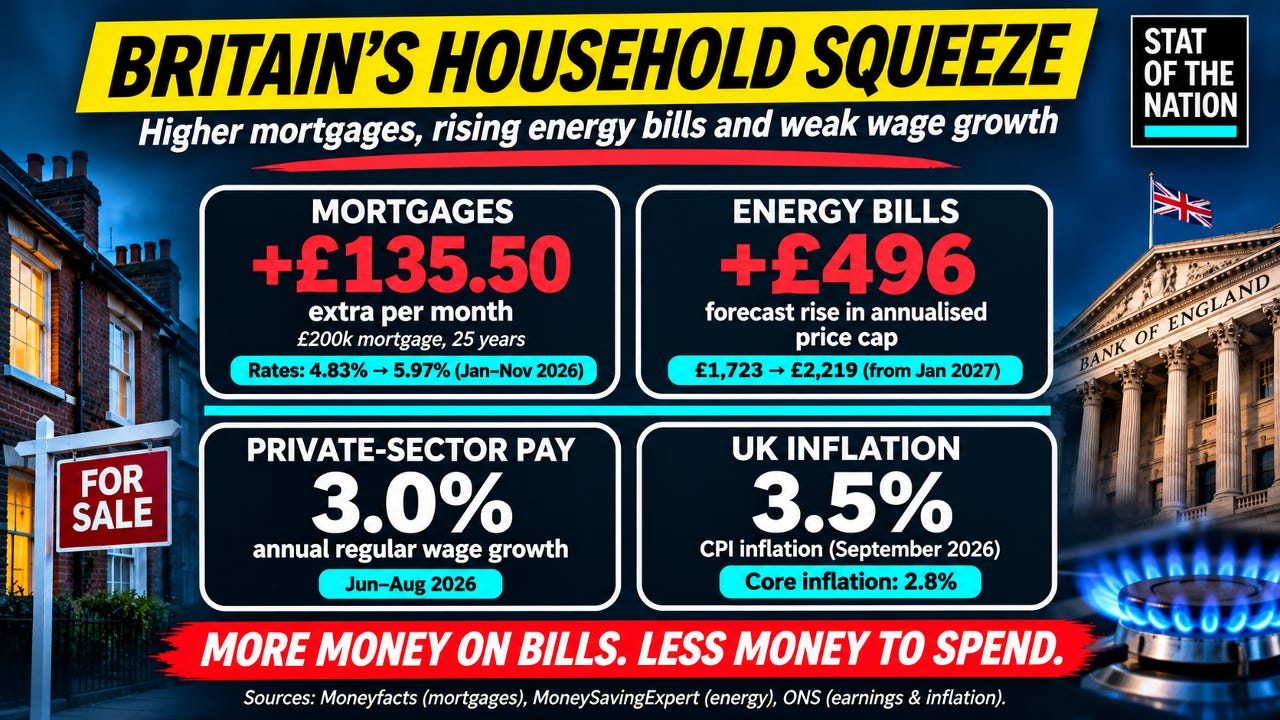
According to Moneyfacts, the average advertised two-year fixed mortgage rate has risen from 4.83% in January to 5.97% in early November.
For somebody taking out a £200,000 repayment mortgage over 25 years, monthly repayments would increase from approximately £1,149 to £1,285.
That’s around £135.50 more every month, or £1,626 a year.
These are illustrative repayments on equivalent new mortgages. Existing fixed-rate borrowers won’t necessarily experience that increase until they refinance.
But lenders have already increased rates in anticipation of tighter monetary policy.
When households spend more on mortgages, they have less money available for shops, restaurants and other businesses. That’s part of how higher interest rates work: reducing demand.
But when expensive energy is already reducing household spending power, how much additional pressure is necessary?
Households Pay More — Banks Remain Profitable
Higher mortgage payments generate interest income for lenders, although banks must also cover funding costs, pay interest to savers and manage the risk of borrowers defaulting.
Nevertheless, Britain’s major banks remain highly profitable.
According to the Bank of England’s July Financial Stability Report, major UK banks achieved an underlying return on tangible equity of 15.3% in the first quarter of 2026.
They also returned £7.7 billion to shareholders through dividends and share buybacks during that quarter.
Higher interest rates don’t automatically mean higher bank profits. But lenders can benefit when the interest earned on loans increases faster than their funding costs.
Last week’s Budget announced a temporary increase in the Bank Corporation Tax Surcharge from 3% to 6% for 15 months, expected to raise £1.5 billion.
That is a meaningful additional tax contribution, but it doesn’t change the immediate financial pressure facing mortgage holders.
While borrowers face rising repayments, Britain’s major banks continue to generate substantial returns.
Wages Are Barely Keeping Pace — And Taxes Take More
The latest ONS earnings figures reveal a striking contrast.
Annual regular wage growth in the three months to August was:
Private sector: 3.0%
Public sector: 6.3%
The public-sector figure is influenced by the timing of pay awards, particularly in the NHS. Nevertheless, private-sector wage growth has slowed considerably.
With CPIH inflation averaging 3.1% over the same period, private-sector regular earnings were essentially stagnant in real terms.
And then there’s fiscal drag.
As I explained in last week’s Stat of the Nation on the Budget, frozen tax thresholds mean that even inflation-matching pay rises can leave workers worse off.

Add higher mortgage repayments and energy bills, and that pay rise can quickly disappear.
Workers may understandably demand higher wages to compensate. But employers facing higher energy, transport and borrowing costs may struggle to afford them.
Households are being squeezed from almost every direction, even before the latest interest-rate rise takes effect.
Energy Bills Are Rising — And More Money Leaves Britain
According to the latest MoneySavingExpert forecast, the household energy price cap could increase from £1,723 to £2,219 from January.
That’s a forecast increase of 28.8%, equivalent to almost £500 a year at typical annual consumption rates.
The new cap has not yet been confirmed, and actual household costs will depend on consumption and subsequent quarterly prices.
The government has announced a £100 energy payment for eligible households in England, with similar support planned in Scotland and Wales.
But that provides only limited relief against potentially much larger energy costs.
There is also a wider economic problem.
Britain is a net importer of energy. When global prices rise, more of our purchasing power can flow overseas.
The UK depended on net imports for 43.5% of its energy needs in 2025. Our net oil import bill alone was approximately £15.0 billion, according to the ONS.
Higher import costs can leave Britain poorer, reducing the purchasing power available elsewhere in our economy.
That’s why energy security must be a priority: affordable domestic supply, reliable generation and reduced exposure to international price shocks.
It is a structural problem that higher interest rates cannot solve.
Core Inflation Still Feels the Energy Shock
The latest ONS figures show annual CPI inflation increasing to 3.5% in September, with motor fuel prices rising 29.8% over the year.
Core inflation, excluding energy, food, alcohol and tobacco, stood at 2.8%, while services inflation was higher at 3.7%.
Services inflation matters because persistent domestic price pressures can make it harder for the Bank to return inflation sustainably to 2%.
But there’s something that is too often overlooked.
Excluding energy from core inflation doesn’t remove the effect of higher energy costs on everything else.
Factories need electricity. Delivery vehicles need diesel. Airlines need aviation fuel. Shops and restaurants need energy to operate.
When those costs rise, businesses either absorb the increase or pass some of it on to customers.
Those price increases can then appear in core inflation, even though the original pressure came from energy.
The Bank of England itself acknowledges these indirect effects.
What matters is whether those price increases become persistent, feeding into higher wage demands, inflation expectations and further price increases.
Yet the Bank’s September Monetary Policy Committee minutes stated:
“There has been little evidence so far of material second-round effects in price and wage-setting.”
That is an important finding from the Bank’s own assessment, although such effects can emerge with a lag.
There is a legitimate argument for raising rates before inflation becomes entrenched. Higher interest rates can also support sterling, potentially limiting imported inflation, particularly when oil is priced in dollars.
But a stronger pound is not guaranteed, and tighter monetary policy comes at a cost to household finances and economic activity.
With private-sector wage growth at just 3%, the Bank must demonstrate why further monetary tightening is necessary when households are already facing such substantial financial pressure.
Britain Isn’t Alone in Facing Higher Inflation
The international figures reinforce the importance of distinguishing global shocks from domestic inflationary pressures.
In September, annual inflation stood at 3.5% in the UK, compared with 3.8% across the euro area and 3.7% in the United States.
The latest Eurostat estimate, shows euro-area inflation rising further to 4.0% in October, with energy prices increasing 20.8% over the year.
These economies have different governments, fiscal policies and central banks, yet are experiencing similar international energy pressures.
Different inflation measures limit precise comparisons, and domestic factors still matter. But Britain is clearly not alone.
When the same energy shock affects economies across Europe and beyond, policymakers should be cautious about treating every increase in inflation as evidence of excessive domestic spending.
The Bigger Picture: Households Are Paying Twice
Britain has been through this before.
Between December 2021 and August 2023, the Bank increased interest rates from 0.1% to 5.25% as the country confronted the previous inflation and energy crisis.
Mortgage holders subsequently felt the consequences, often long after the original shock.
Now another international energy crisis is pushing inflation higher, while households are already dealing with expensive mortgages, weak real wage growth, frozen tax thresholds and rising energy bills.
The Bank is right to be concerned about persistent inflation. But monetary policy works with a lag, and higher household costs are already reducing the amount people can spend elsewhere.
In my view, raising interest rates again risks imposing unnecessary additional costs on households for an inflation shock that monetary policy can only partly control.
The government also needs to confront Britain’s dependence on imported energy rather than relying on temporary financial support whenever global prices rise.
The Bank cannot lower the price of oil. It can only influence borrowing costs and demand. Today it chose to make borrowing more expensive, and mortgage holders will bear part of the price.
✍️ Thanks for reading Stat of the Nation. If you find my analysis useful, please share or subscribe to support my work.
✍️ Jamie Jenkins
Stats Jamie | Stats, Facts & Opinions
📲 Follow me here for more daily updates:
I thought the government's priority was growth. We didn't realise they meant growth in energy costs and in sweeping regulation by the EU (for which we will pay the EU) under a 'reset'.