

Imagine negotiating a pay rise that matches inflation, only to discover that you can no longer afford the same standard of living. Meanwhile, the Treasury is now expected to collect £17.4 billion more a year in income tax and National Insurance by 2030–31 than forecast just seven months ago.
That’s one of the most revealing findings from the latest Office for Budget Responsibility (OBR) forecasts, published alongside Chancellor John Healey’s first Budget. Higher inflation could push wages upwards as workers seek to keep pace with rising prices, but with income tax thresholds frozen, the government stands to collect more tax even when workers aren’t becoming better off in real terms.
And the wider economic picture is hardly encouraging. Inflation is expected to remain higher for longer, economic growth has been downgraded, government borrowing is forecast to increase, and Britain’s overall tax burden is heading towards record levels.
The Chancellor has promised breathing space through temporary energy support and other measures. But behind those announcements lies an uncomfortable reality: the Treasury could collect billions more while ordinary households struggle simply to maintain their existing living standards.
💷 Your Pay Rise, the Treasury’s Tax Windfall
One of the biggest stories in this Budget isn’t a newly announced tax increase. It’s how higher inflation could amplify the impact of tax thresholds that have already been frozen.
For most workers in England, Wales and Northern Ireland, the personal allowance remains at £12,570 and the higher-rate income tax threshold at £50,270. These thresholds are due to remain frozen until April 2031, meaning more earnings become taxable as salaries increase and some workers move into higher tax brackets.
Economists call this fiscal drag. It allows the Treasury to collect more income tax without increasing headline rates, and the effect becomes particularly noticeable during periods of higher inflation.
Back in March, the OBR expected inflation to return to 2% in 2027. It now forecasts 3.4%, potentially increasing pressure on employers to award larger pay rises. But even when workers successfully negotiate increases matching inflation, frozen thresholds can leave their purchasing power falling.
How a 4% Pay Rise Can Leave You Worse Off
Consider someone earning £49,000 a year, taking home approximately £38,800 after income tax and employee National Insurance. For simplicity, let’s assume they spend all that income on their everyday living costs.
If prices rise by 4%, maintaining exactly the same lifestyle would cost an additional £1,552 a year, taking their living expenses to £40,352.
They successfully negotiate a 4% pay rise, increasing their salary by £1,960 to £50,960. But their income tax and National Insurance deductions increase from approximately £10,200 to £10,846, leaving them with take-home pay of £40,114.
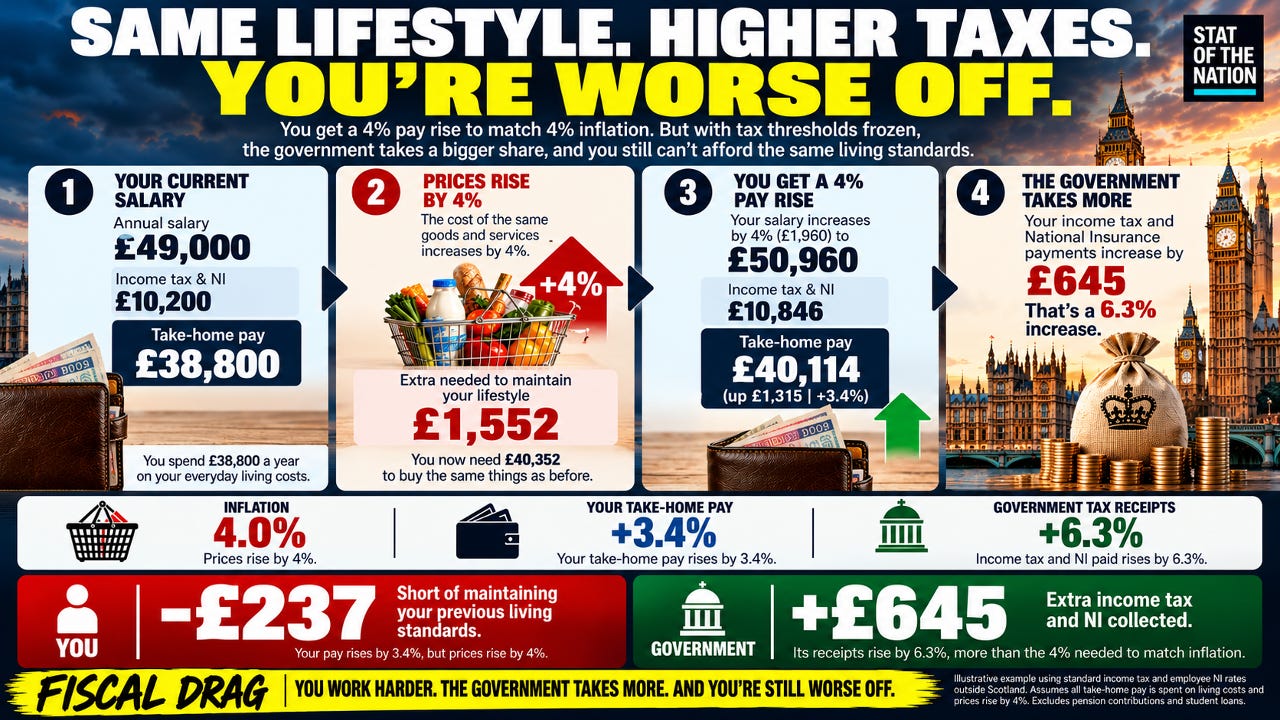
Their gross salary has increased by 4%, but their take-home pay has risen by only 3.4%. They are £237 short of maintaining their previous living standards, while the Treasury collects an additional £645 in income tax and NI — an increase of 6.3%.
And here’s another revealing comparison. The Chancellor has announced a one-off £100 energy payment for eligible households, yet the additional annual tax and National Insurance deductions in our example amount to £645 — more than six times that payment.
The £645 isn’t a new Budget tax charge, and the energy payment would offset part of the household’s increased costs if they qualify. But the comparison illustrates the difference between temporary financial support and the ongoing impact of frozen tax thresholds.
The government’s tax receipts from that worker have increased faster than inflation, while the worker’s take-home pay has increased more slowly. That’s fiscal drag in action, and although our example uses someone crossing the higher-rate threshold, the underlying effect applies to many basic-rate taxpayers too.
The OBR now forecasts income tax and National Insurance receipts in 2030–31 to be £17.4 billion higher annually than expected in March. Not all of that increase comes from fiscal drag; it also reflects other changes to earnings and revenue forecasts. Nevertheless, higher nominal earnings combined with frozen thresholds are important contributors.
This isn’t a newly announced £17.4 billion tax rise. It’s additional revenue the Treasury expects to collect compared with its previous forecast.
Britain’s overall tax burden is now forecast to reach 38.6% of GDP by 2031–32, compared with 32.9% before the pandemic. That would be a record high.
📉 Record Taxes, Yet Another £65 Billion in Borrowing
You might expect that with the government collecting an increasing share of the country’s income, borrowing would be falling rapidly. Unfortunately, the latest forecasts tell a different story.
In March, the OBR expected government borrowing of £115.5 billion in 2026–27. Seven months later, that figure has been revised upwards to £133.2 billion, an increase of £17.7 billion. Across the five financial years to 2030–31, the government is now forecast to borrow £65 billion more than expected in March.
That’s a deterioration in the forecasts, not £65 billion of new spending announced by the Chancellor. Much of the change reflects higher energy prices, inflation and borrowing costs following the conflict in the Middle East, highlighting how vulnerable Britain’s finances remain to international events.
The cost of servicing existing government debt is also enormous, with gross debt interest forecast to reach around £160 billion a year by 2031–32. Borrowing is still expected to decline over the coming years, but the latest forecasts show a slower reduction than previously anticipated.
The uncomfortable reality is that Britain is heading towards record taxation while continuing to borrow substantial sums to finance government spending. Much of the planned improvement in the public finances depends on the Treasury collecting more revenue as a share of the economy.
⚡ Higher Inflation and Britain’s Energy Security
The biggest reason for the worsening economic outlook is the latest energy-price shock. The conflict in the Middle East has pushed up global energy costs, with consequences for households, businesses and the public finances.
The OBR now expects inflation to average 3.4% in 2027, rather than the 2% it forecast in March. That doesn’t mean prices will fall when inflation eventually eases; it simply means they will be rising more slowly.
Britain remains particularly exposed to international gas markets, partly because gas-fired power stations frequently determine wholesale electricity prices.
As recently as 2012, coal generated almost 40% of Britain’s electricity, yet our final coal-fired power station closed in September 2024. Carbon pricing helped accelerate coal’s decline, alongside environmental regulations and changing electricity generation economics.
Retaining some domestic coal-fired generating capacity would have given Britain another source of electricity to call upon during international gas-price shocks, reducing the need to rely on gas-fired generation. Coal would not have removed gas’s influence over wholesale electricity prices, but it would have provided another option within Britain’s energy mix.
The wider question is whether Britain has maintained the right balance between decarbonisation, energy security and affordability. That applies equally to North Sea oil and gas, nuclear power, renewables and the infrastructure needed to provide reliable electricity.
What Has the Chancellor Announced?
The Budget includes a one-off £100 Household Energy Payment for households in council tax bands A–D in England, alongside additional targeted support. The payment will be delivered through local authorities from January 2027, with equivalent funding arrangements for the devolved nations.
The temporary VAT cut on domestic electricity has also been extended until July 2027, while the fuel duty freeze continues until July.
There are plans to remove daily standing charges from household gas bills. However, the costs will instead be incorporated into unit prices, meaning the financial impact will depend on how much gas a household uses.
The government argues these measures will provide breathing space for households facing rising bills, and they will help some families. But temporary payments cannot fully offset sustained increases in living costs, particularly when higher energy prices also feed through into food, transport and other everyday essentials.
🏠 Benefits Rise With Inflation. But Workers Lose Part of Their Pay Rises to Tax
There is another consequence of higher inflation that deserves attention: it increases the value of many benefit payments through established annual uprating arrangements.
While workers generally have to negotiate pay increases with their employers, many working-age benefits are uprated with reference to inflation, usually using the previous September’s Consumer Prices Index. The State Pension has its own arrangements, with the existing triple lock guaranteeing increases based on the highest of earnings growth, inflation or 2.5%, subject to changes announced for later years.
The Budget confirms increases in benefit payments, including a 3.5% uplift for benefits covering around 10 million recipients, while the full new State Pension is set to rise by 3.9% from April.
These increases are intended to help recipients keep pace with living costs, although inflation uprating can lag behind current price increases and not all benefits follow identical rules.
But there’s an important difference between a benefit being increased through an uprating mechanism and somebody receiving a pay rise from their employer.
If your benefit is increased by 4% in line with inflation, that payment generally rises by the full 4%, subject to the applicable benefit rules. If your gross salary rises by 4%, you don’t receive that full increase in your pocket because income tax and National Insurance take a share.
Our £49,000 worker demonstrates the distinction. They receive a 4% pay rise, but their take-home pay increases by only 3.4%, leaving them unable to buy quite as much as before.
That doesn’t mean every benefit recipient is protected against inflation, nor that households receiving benefits face no tax or other financial pressures. It does mean workers’ gross pay rises and inflation-linked benefit increases are treated differently.
And it creates a further challenge for the Treasury. Higher inflation can generate more income tax through fiscal drag while simultaneously increasing government expenditure on inflation-linked benefits and pensions.
The wider welfare bill also faces longer-term pressures from an ageing population, state pension costs and rising health-related benefit caseloads. The Budget offers some immediate support, but those underlying expenditure pressures remain.
📊 So Are We Actually Getting Better Off?
Ultimately, the most important question is whether people’s living standards are improving. Here, the latest forecasts provide little comfort.
Perhaps the most revealing statistic concerns household disposable income — broadly, the money households have available after taxes and benefits, adjusted for inflation.
By 2029–30, real household disposable income per person is forecast to be only around 1% higher than before the pandemic. After years of rising prices and increasing taxation, that represents remarkably little improvement over roughly a decade.
The wider economic outlook helps explain why. The OBR has downgraded its forecast for GDP growth in 2027 from 1.6% in March to just 1.0%, while expecting no real earnings growth in either 2027 or 2028.
In other words, average earnings are expected to make virtually no progress in purchasing-power terms during those years, even if wages continue rising in cash terms.
The Chancellor’s energy payments and other measures may provide short-term relief, but they do not fundamentally change that longer-term picture. Stronger productivity, investment, affordable energy and sustained economic growth will be important if households are to see meaningful improvements in living standards.
The Real State of the Nation
Global events have undoubtedly made Britain’s economic outlook more difficult. Higher energy prices and international borrowing costs are not entirely within the government’s control, but decisions about taxation, public spending and energy security still matter.
The Chancellor has offered temporary breathing space, but the underlying economic challenge remains. Taxes are heading towards record levels, borrowing forecasts have deteriorated, and household living standards are making painfully slow progress.
There’s also an important distinction between a temporary government payment and the continuing effect of fiscal drag. For our illustrative worker, an additional £645 in annual income tax and National Insurance deductions is more than six times the one-off £100 energy payment.
Meanwhile, established uprating rules help increase many benefit payments when prices rise, while workers must negotiate their own pay rises and then surrender part of those increases through taxation.
You can work hard, negotiate a pay rise matching inflation and still end up with less purchasing power.
If the Treasury is collecting billions more in tax while households are struggling simply to stand still, the question is whether Britain’s tax and economic policies are doing enough to improve living standards.
That’s the real state of the nation after Budget 2026.
✍️ Thanks for reading Stat of the Nation. If you find my analysis useful, please share or subscribe to support my work.
✍️ Jamie Jenkins
Stats Jamie | Stats, Facts & Opinions
📲 Follow me here for more daily updates:
Thankyou for drilling down to the detail Jamie, I didn't believe a word Silly Billy 2.0 said. I think he'll preside over economic failure as his above namesake.
Brilliant analysis as always Jamie. No figures on how defence will be funded until next year and yet they commit to spending £10 Billion more to defend Ukraine. And when our Cyprus base needed defending it took 3 weeks for just the ONE available destroyer to get there. It's like watching a comic opera being played out in front of our eyes. This government is incompetent!