

Yesterday, the Chancellor unveiled a new set of “key principles” for UK-EU alignment, presenting it as part of a broader growth pitch for the country. The government says this is about reducing friction for business, backing AI and innovation, and “unlocking growth in every region.”
Rachel Reeves keeps repeating that her economic plan is the right one. But if you step back from the announcement and look at the macro picture, the gap between the rhetoric and the reality is hard to ignore.
Behind the press release, Britain is still dealing with the same old problems: weak growth, falling output per person, and an energy system that is nowhere near ready for the AI ambitions ministers keep talking up.
Let’s take the announcement piece by piece.
🌍 Closer EU Alignment Is Being Sold As A Growth Strategy
A big part of Reeves’ pitch is that closer alignment with the EU will help support growth by reducing barriers and giving businesses more certainty.
Fine. But there is an obvious problem here: Europe is not exactly booming.
Trade with Europe obviously matters. Reducing avoidable friction is sensible. But alignment is not the same thing as a growth strategy. At best, it may reduce some costs around the edges. It does not solve Britain’s deeper structural weaknesses: poor productivity, expensive energy, weak investment and a softening jobs market.
And then there is Reeves’ line that Brexit did “deep damage” to the economy, with figures of up to 8% of GDP being waved around.
It is worth being clear what numbers like that actually are. They are not direct measures, as inflation or unemployment are. They come from modelled estimates that compare the UK’s real path with a hypothetical version of Britain that did not leave the EU.
That matters because the period since 2016 has also included a pandemic, an energy shock, tight monetary policy, and a long list of domestic weaknesses that predate the referendum. So when Reeves reaches for a big Brexit number, she is leaning on a highly model-dependent estimate, not a clean real-world observation.
And that raises the harder political question: if the economy is weak right now, why is the Chancellor so keen to relitigate a referendum rather than account for what is happening on her own watch?
📍 “Unlocking Growth In Every Region”
Another big claim in the announcement is that the government will unlock growth in every region of the UK. Fine. But before worrying about growth in every region, Britain first needs growth at all.
Because on the measure that better captures living standards, the UK ended 2025 going backwards. Real GDP per head fell in both Q3 and Q4 of 2025. In other words, on a per-person basis, Britain was in recession in the second half of last year.
And the new year has not exactly started with a bang either. In January, there was no growth again.
So yes, it would be lovely if every region of Britain were growing. But the country as a whole is still flatlining. You cannot unlock regional prosperity if the national economy itself is stagnating.
With the local elections on 7 May approaching, voters will get an early chance to deliver their verdict on Keir Starmer’s government — and on Rachel Reeves’ endless insistence that her plan is working.
If the economy feels stagnant, those elections could become a pretty damning referendum on both.
⚡ AI Ambitions Meet Britain’s Energy Reality
The government also keeps talking about Britain becoming a global leader in artificial intelligence. But AI needs something very basic before it needs another speech.
Electricity.
AI data centres consume enormous amounts of power. Running a large-scale computing infrastructure means vast electricity demand — and that means energy prices matter. And here Britain has a serious problem.
Industrial electricity prices in the UK are around four times higher than in the United States, and among the highest in Europe.
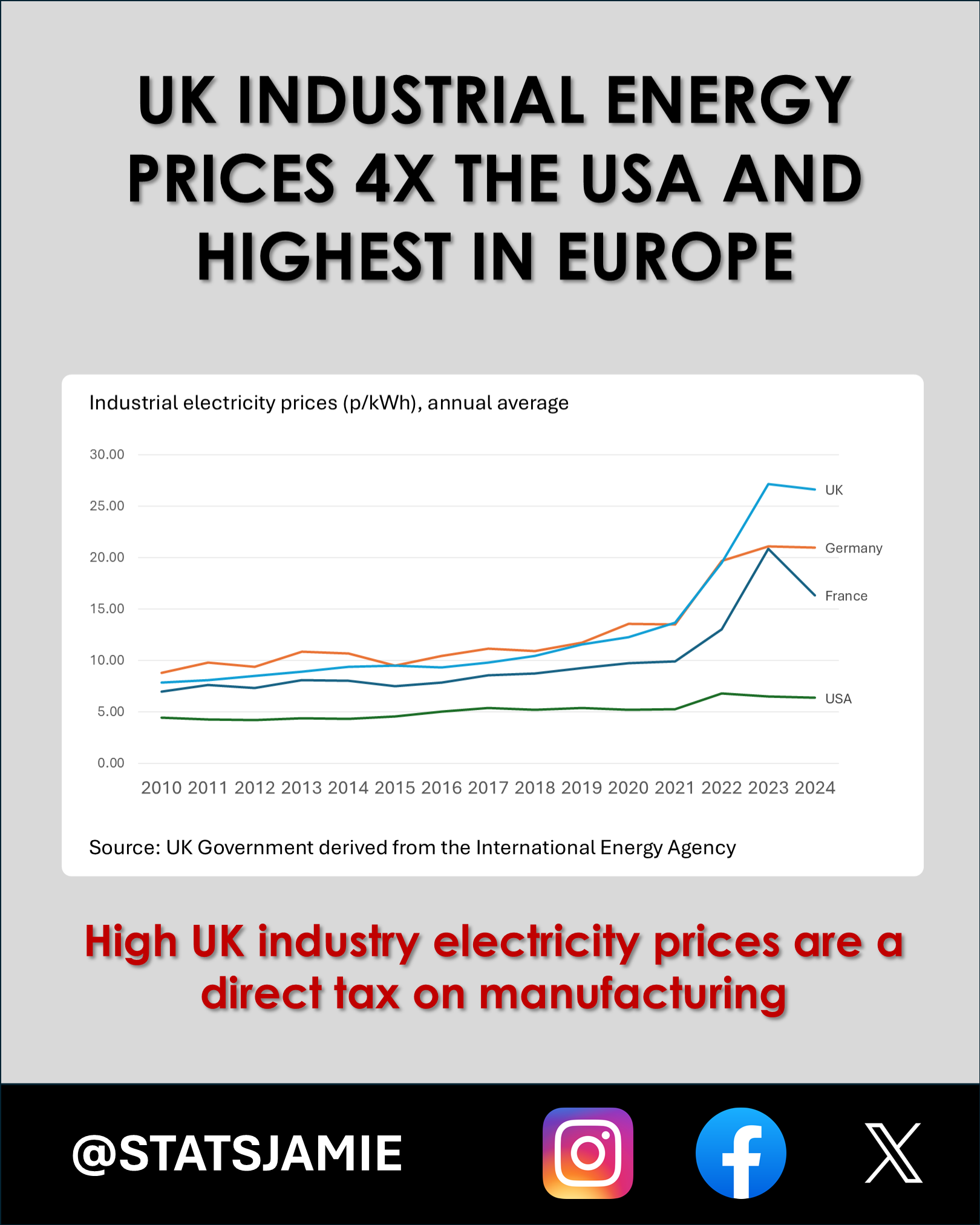
That is not a small difference. It is a massive competitive disadvantage.
Because AI infrastructure can be located almost anywhere in the world. If companies are deciding where to build large data centres, they will naturally gravitate towards locations where energy is cheap and reliable.
And right now, the United States has a huge advantage. Cheap power, abundant energy supply and lower industrial electricity costs make it a far more attractive place to run power-intensive technologies.
Which means Britain faces a simple reality: You cannot build an AI superpower while charging some of the highest industrial electricity prices in the developed world.
Until that changes, talk of Britain leading the global AI race risks sounding more like a slogan than a strategy.
🔁 The Chancellor Keeps Repeating The Same Line
This is the real problem. Rachel Reeves keeps repeating that her economic plan is the right one. But the macro picture keeps refusing to back her up.
Britain ended 2025 with two consecutive quarterly falls in GDP per head. January brought no growth again. And the Chancellor is still reaching for modelled Brexit counterfactuals while the real-world economy on her watch remains weak.
So forgive me if this starts to sound repetitive to regular Stat of the Nation readers. But I am only repeating myself because the Chancellor is. She keeps repeating the same line about the plan working. I keep having to point out the same awkward problem: the numbers do not support it.
Final Thought
A serious growth strategy would start with the basics.
Real growth.
Higher output per person.
Cheaper energy.
Better infrastructure.
A tax and investment environment that actually rewards growth.
Instead, we are being offered a familiar mix of alignment talk, future ambition and political excuses. That may sound like a plan. But Britain’s broken growth model is still there in plain sight. And until that changes, Rachel Reeves’ broken record will keep colliding with economic reality.
✍️ Jamie Jenkins
Stats Jamie | Stats, Facts & Opinions
📢 Call to Action
If this helped cut through the noise, share it and subscribe free by entering your email in the box below and get the stats before the spin, straight to your inbox (no algorithms).
📚 If you found this useful, you might also want to read:
Britain Downgraded. Taxes Up. Welfare Up. Who Exactly Is Reeves’ “Plan” For?

Keir Starmer told voters Labour wouldn’t increase taxes on working people. Rachel Reeves keeps telling us she’s on “the right economic plan”.
📲 Follow me here for more daily updates:
It's nothing to do with Brexit. Covid and the inept mismanagement by the Tories with further exacerbation by this illiterate government is why we are where we are.
We need more people like you and Liam Halligan calling out these dunces. The Mike Graham Show is a great and growing vehicle for this.
This government simply wants us to rejoin the EU, come what may. Any excuse will do.