

Every summer, we hear the same phrase: “record temperatures”. That needs context. A record is only a record within the dataset being used. The UK-wide comparable temperature series goes back to 1884, while the much longer Central England Temperature record stretches back to 1659 but covers only part of the country rather than the whole UK.
That does not mean heat is harmless, or that modern records are unimportant. It means we should be precise about what “record” actually means. And if the temperatures we are seeing are now being presented as the new normal, Britain needs to start behaving as though they are.
Instead, schools are closing or shortening their hours, parents are scrambling for childcare and public services are preparing for disruption. We are not at official “heat lockdowns”, but normal life is already being suspended because too many buildings cannot cope.
That is not adaptation. It is managed disruption.
You Can Go To The Supermarket. Why Can’t You Go To School?
This is the basic question.
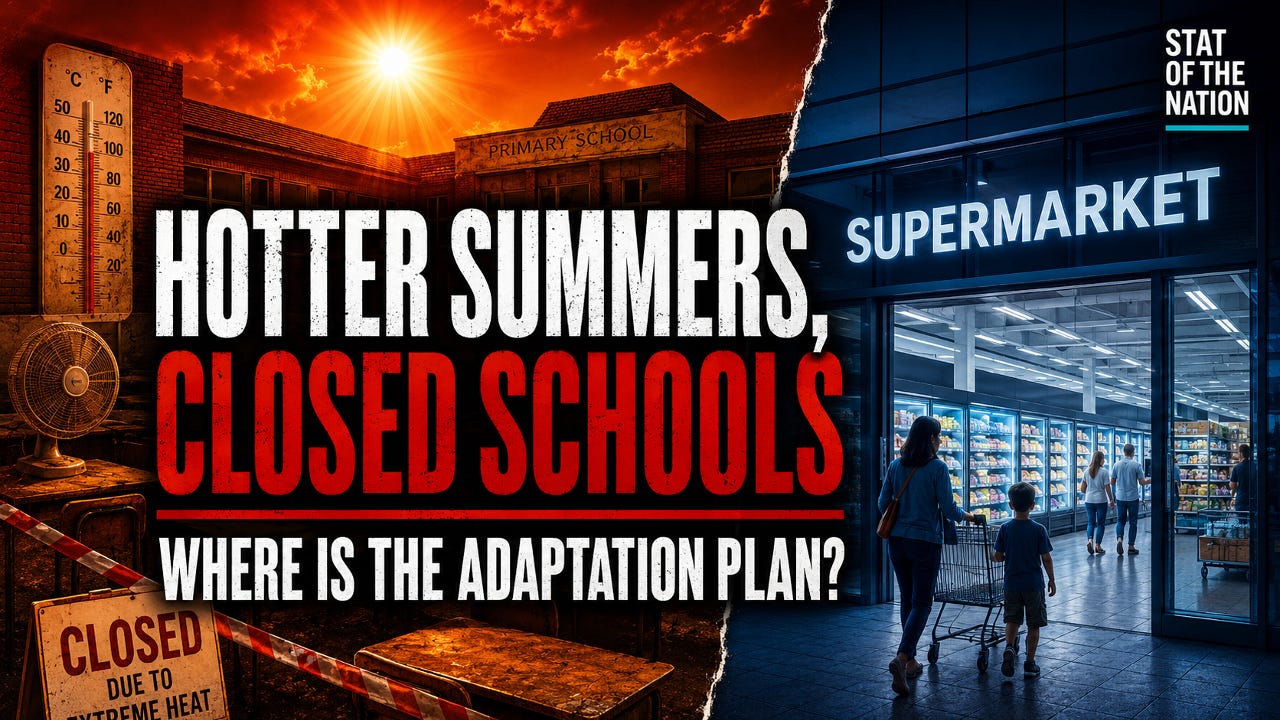
On a hot day, you can walk into Aldi, Lidl, Tesco, a shopping centre, restaurant, cinema or modern office and expect the building to be cool enough to function. But children are being sent home from school because classrooms are too hot.
Parents are being asked to rearrange work. Lessons are disrupted. Outdoor activities are cancelled. Uniform rules are relaxed. Some schools are shortening the day or closing entirely because their buildings cannot cope.
That should not be normal.
If a discount supermarket can keep customers and staff comfortable enough to shop, why are so many schools unable to keep children comfortable enough to learn?
The answer is not that schools do not care. It is that many school buildings were never designed for hotter summers, and successive governments have not treated overheating as a serious national resilience problem.
Too many classrooms have poor ventilation, little external shade, ageing buildings, temporary units and large windows that trap heat. We have known about this for years. Yet when temperatures rise, the country does not adapt. It retreats.
When Schools Close, The Damage Spreads
A school closure is not simply an education story. It is a childcare story, a workforce story, an NHS story and a productivity story.
When pupils are sent home early, parents have to find someone to look after them. Some can work from home, but many cannot. NHS staff, care workers, retail workers, transport staff, hospitality workers and people in countless other jobs may suddenly be trying to rearrange shifts or take emergency leave.
A child being sent home early can become a staffing problem in a hospital ward, a cancelled appointment, a care home struggling to fill a rota, or a parent losing pay because they have no option but to miss work. In many cases, the fallback is grandparents, often the very people most vulnerable to heat themselves.
That is why this is not merely a schools issue. It is a public-services issue, a workforce issue and a resilience issue. If Britain is going to experience hotter summers more often, it needs to understand that the cost of inaction spreads far beyond the school gates.
Britain Keeps Treating Heat As A Surprise
The oddest part is that none of this should be surprising. Every year, ministers and public-health bodies warn that hotter summers are becoming more likely. Every year, people are told to close curtains, drink water, avoid the hottest part of the day and check on vulnerable relatives.
All sensible advice. But it is not an adaptation strategy.
A proper adaptation strategy would ask a much more practical question: how do we keep normal life going when temperatures rise?
That means making sure schools can stay open, care homes can keep residents cool, hospital wards are safe and workable, and homes are designed to keep heat out rather than trap it in. At the moment, Britain seems to have accepted a strange model: the weather changes, so everyday life has to stop.
That is not how a resilient country should operate.
Adaptation Does Not Mean Air Conditioning Everywhere
This is not an argument for turning every British building into an airport terminal. There are plenty of practical ways to make buildings cooler before relying on air conditioning: external shading, blinds, shutters, awnings, better ventilation, window film, reflective roofs, tree cover around school grounds and building designs that keep heat out before it becomes a problem.
Many of these measures are cheaper than repeatedly dealing with closures, missed lessons and workplace disruption. But there will also be places where active cooling is necessary: care homes, hospitals, schools with vulnerable children, high-rise flats, social housing and buildings with poor ventilation and no shade.
If temperatures are genuinely becoming more extreme, it is not ideological to say these places need proper cooling. It is common sense.
The Government Knows The Problem
The Government has already acknowledged that overheating is a growing risk for schools and public buildings. Its own climate-risk material says high temperatures can affect concentration and learning, and identifies adapting the education estate as critical to reducing lost learning and lower attainment.
So the problem is not that ministers do not know.
The problem is that they have not turned that knowledge into visible action.
Where is the national programme for cooling overheated classrooms? Where is the targeted support for care homes to install shading and cooling? Where is the serious retrofit plan for vulnerable homes? Where is the practical resilience programme that says: if hot summers are coming, Britain will be ready?
Instead, we get warnings and closures.
Billions For Net Zero — But Where Is The Adaptation Budget?
Government is willing to commit billions to long-term net-zero projects: carbon capture, offshore wind, solar, grid upgrades and home-energy schemes.
But even if the UK reached net zero tomorrow, it would not alter Britain’s weather on its own. Climate is global, and the UK is only one small part of total global emissions.
That is not an argument against reducing emissions. It is an argument for recognising what Britain can do immediately.
If hotter summers are becoming more common, why is there not a comparable national effort to adapt?
Where is the funding to shade overheated classrooms, cool care homes, upgrade hospital wards and help vulnerable households keep their homes liveable?
A child in a 35°C classroom cannot wait for a distant target. A care-home resident cannot wait for the next climate summit.
If ministers are serious about heat as a risk, adaptation cannot remain the forgotten half of climate policy.
Britain Cannot Control The Weather — But It Can Adapt To It
The climate debate becomes abstract very quickly: targets, summits, models and promises for decades from now. But ordinary people experience the issue through the buildings around them.
Can their child stay in school? Can their elderly parent remain safe in a care home? Can they get to work? Can an NHS ward cope? Can their home remain liveable?
Those are the questions that matter when the heat arrives.
Britain cannot control the world’s weather on its own. But it can control whether its schools, hospitals, care homes and homes are capable of coping with the weather it has. And right now, too many are not.
If hotter summers are the new normal, then closing schools and telling parents to make do is not a plan. It is an admission that we have failed to adapt.
A country that can keep a supermarket cool should be able to keep a classroom open.
✍️ Jamie Jenkins
Stats Jamie | Stats, Facts & Opinions
📢 Call to Action
If this helped cut through the noise, share it and subscribe free by entering your email in the box below and get the stats before the spin, straight to your inbox (no algorithms).
📚 If you found this useful, you might also want to read:
Borrowing Surges — Would Burnham Make It Worse?

Markets do not vote in by-elections. But they do react to what those by-elections mean.
📲 Follow me here for more daily updates:
I think they should fit air conditioning in schools, for the teachers more than the pupils. Everyone works better when they are comfortable. It would be better to install air conditioning instead of solar panels on the roof.
Edit: I just posted this, turned over to GB news and there's a report that councils are calling on people to remove air conditioning units - because of global warming of course - Jeez!
Back in 1976 when we had that hot summer and a drought they appointed a minister for drought. He did a great job because it started raining almost right away so perhaps they should appoint a minister of heat. Makes sense.