

This weekly roundup on Stat of the Nation, we take a brief look back at some of the key lessons from 2025, reflect on what the past week has revealed, and look ahead to what 2026 is likely to bring.
Across borders, public finances, civil liberties, and trust in government, one theme keeps reappearing: the widening gap between what we’re told and what the data actually shows.
🔙 2025: The Year the Data Fought Back
If 2025 taught us anything, it’s that the gap between Westminster rhetoric and British reality has rarely been wider.
While ministers spent the year dealing in narratives, we dealt in numbers — and the books didn’t balance.
We exposed the £92 billion black hole in the public finances, not the one Rachel Reeves claimed to inherit, but the one created on her watch. We tracked how record tax receipts coexisted with record borrowing, showing that rising revenues were being absorbed by an expanding state rather than delivering meaningful reform.
We didn’t just count the cost on paper; we counted the impact at home. While the government touted “growth,” we exposed the Generation Labour Forgot, revealing that 77,000 young people aged 16–24 had lost payroll jobs since the election. The response was a £1.5 billion scheme to create 50,000 apprenticeships. Even if every place is filled, Britain remains 27,000 youth jobs worse off, after spending billions to fix a problem created by the government’s own tax and employment policies.
We also refused to let history be rewritten on the pandemic. While officials attempted a quiet revisionism, we published data showing lockdown policy was often driven less by “following the science” and more by international groupthink and political fear.
The verdict was unavoidable: the bad news of 2025 could not be buried, because the evidence would not stay buried. In 2026, the spin will get louder, but so will the statistics.
🚤 41,472 Illegal Crossings — When Promises Meet Reality
The government’s pledge to “stop the boats” was supposed to mark a turning point. Instead, 2025 delivered another record.
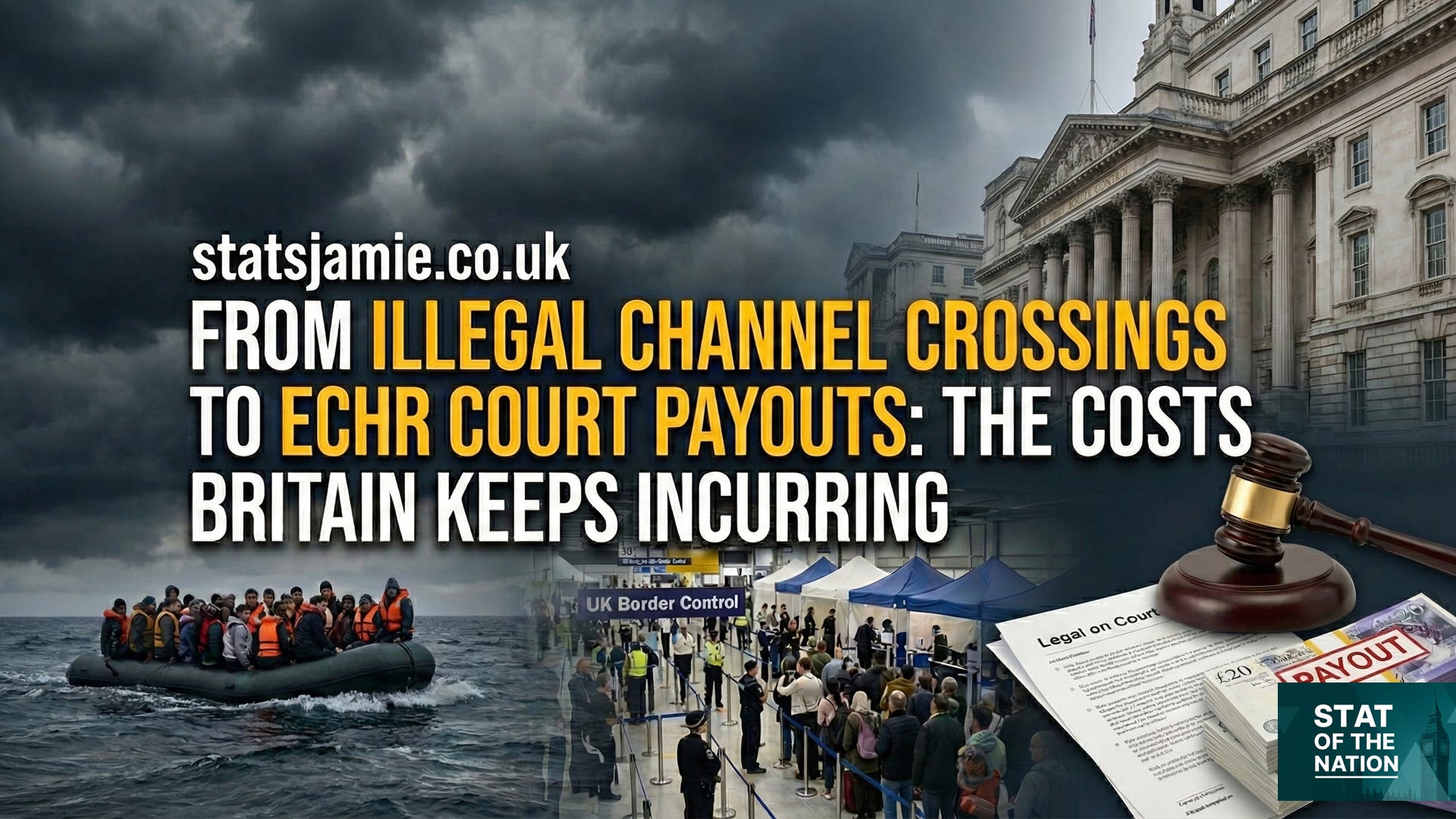
A total of 41,472 people crossed the Channel illegally, representing a 13% increase from 2024, bringing the cumulative total since 2018 to 192,610. Around 85% of those arriving were adult men.
This is not a rounding error; it is a policy failure. The much-publicised “one in, one out” arrangement with France has not altered incentives or outcomes, and Britain continues to accept far more arrivals than it removes.
Illegal crossings cannot be deterred by press releases. Without enforcement, the flow continues.

🪪 ID Cards: The Public Is No Longer Buying It
Against that backdrop, ministers continue to push digital ID as a solution for migration, illegal working, and access to services. The public, however, is no longer convinced.
Polling now shows that more Britons oppose ID cards than support them, with opposition hardening as costs and risks have become clearer. Support was always soft and conditional, and it has deteriorated further under scrutiny.
This matters because digital ID is being sold as a fix for illegal migration and illegal working. Yet countries across Europe already operate digital ID systems, and none have solved illegal migration through ID cards.
Despite that evidence, Britain is pressing ahead with a scheme expected to cost at least £1.8 billion, at a time when borrowing remains high and public finances are repeatedly described as tight. If the policy fails, the cost still falls with the taxpayer.
⚖️ When Human Rights Collide with Common Sense
That tension between policy, cost, and reality came into focus this week in a case involving Fuad Awale, who is serving a life sentence for shooting two men in the head during a drugs dispute in 2011. While in custody, he later helped take a prison officer hostage, after which prison authorities moved him to a specialist unit for dangerous prisoners.
Following that incident, officers restricted his contact with other inmates and placed him in segregation. This was not an arbitrary punishment but an operational decision taken to protect prison staff and other prisoners, and to maintain control within a high-risk custodial environment.
The legal claim was brought under Article 8 of the Human Rights Act — the right to respect for private and family life — arguing that cell-sharing and subsequent segregation breached that right. The court found in his favour.
The judgment was handed down in September, but the full cost to the taxpayer has only now come into the spotlight. That cost amounts to £7,500 in compensation and £234,000 in legal costs. The legal costs will not go to the prisoner; the overwhelming majority will go to lawyers.
The principle at stake is straightforward. If you are convicted of murder and sent to prison, you lose your right to a private life. Prison is not a private environment by design, and incarceration necessarily involves the removal of freedoms. Extending privacy rights into custodial settings in this way creates higher costs, legal precedent, and incentives that prioritise litigation risk over public safety.
That is the wider concern — and it is one the taxpayer ultimately pays for.
🔮 2026: What Happens Next
2026 will bring louder claims, bigger announcements, and sharper political language. It will also bring elections across Wales and Scotland, alongside hundreds of local elections in England, assuming they are not postponed or cancelled.
That matters because elections force narratives to collide with lived reality. Voters do not assess press releases; they assess outcomes, particularly on local services, taxation, migration, policing, and trust in government.
What happens politically in 2026 is uncertain. What is not is this: whatever the year brings, Stat of the Nation will be all over it, tracking the data, testing the claims, and publishing the results.
Spin changes quickly. The numbers do not.
✍️ Jamie Jenkins
Stats Jamie | Stats, Facts & Opinions
📢 Call to Action
If this helped cut through the noise, share it and subscribe for free — get the stats before the spin, straight to your inbox (no algorithms).
📚 If you found this useful, you might also want to read:

📲 Follow me here for more daily updates:
The sole purpose of the so called government today is oppression . They give nothing freely but will take/tax you to achieve their controlling agenda.
Try joining the dots without using the MSM.
I don't give a sh*it how many lies Liebour come up with -
I will STILL be voting REFORM !