

As regular readers know, I’ve spent several months relentlessly laying out the facts — and the flaws — behind Labour’s digital ID push: from the claim it will “stop the boats”, to mounting security concerns and soaring costs.
Now the data has caught up. In YouGov’s biannual tracker, opposition to national identity cards has surged to 47%, overtaking support at 38% for the first time since October 2019. Strip out the “don’t knows”, and the shift is starker still: 55% of those with a view now oppose the policy, versus 44% who support it — a clear flip in public sentiment.
📊 From vague idea to backlash
YouGov has tracked this question biannually since 2019. Back then, support sat at about 59%, reflecting a low-salience, abstract idea rather than a concrete policy.
That changed on 26 September 2025, when Keir Starmer’s government announced a new digital ID scheme, with digital ID becoming mandatory for Right to Work checks by the end of the Parliament.
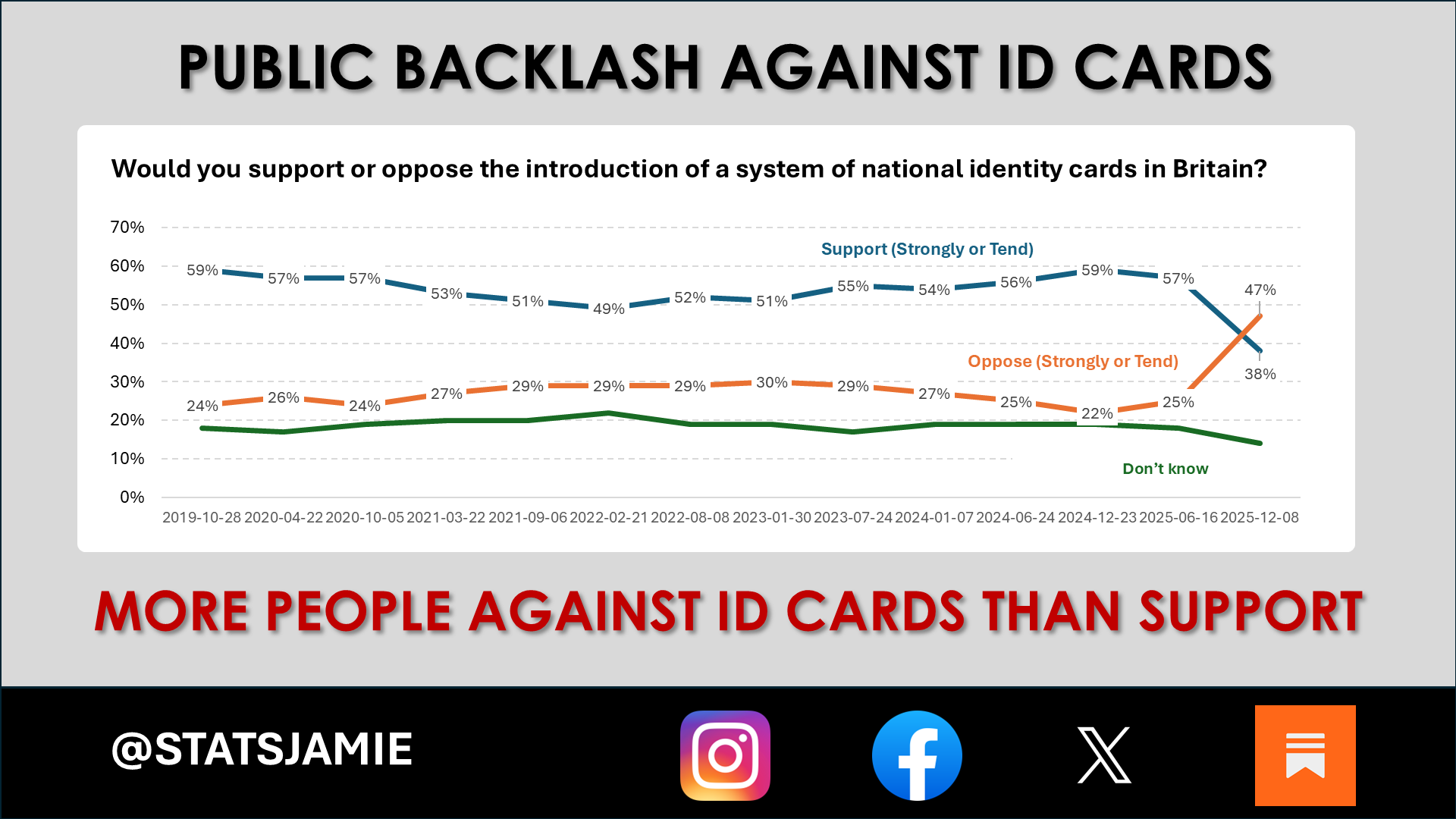
Once digital ID moved from abstraction to implementation, public awareness surged — and so did resistance. In the latest YouGov wave, “strongly oppose” rises to 31% (from 12% in June 2025), becoming the largest single response category, with total opposition now exceeding support outright.
🧩 When an abstract idea becomes state infrastructure
For years, people had been discussing the concept of identity cards in theory. Now they are responding to what digital ID would actually mean in practice.
A centralised system.
Mandatory use.
Smartphone dependency.
Permanent data collection.
This polling shift doesn’t suggest people suddenly became more ideological. It suggests they became better informed — and once informed, many recoiled.
📉 Strip out the uncertainty, and the verdict is clear
The cleanest way to read this is to remove uncertainty and focus on people who actually hold a view.
Among those with an opinion:
55% oppose
44% support
And crucially, the opposition isn’t mild: “strongly oppose” is now the single biggest bucket.
🗳️ Where the backlash is really coming from
Looking across party preference, the picture is not a simple party revolt. Among people who say they voted Conservative, Labour or Liberal Democrat, support still narrowly outweighs opposition in each group.
The sharpest backlash comes from people who didn’t vote — where opposition is highest, and uncertainty is also much higher. That matters politically: a policy sold as improving trust and compliance is proving least popular among the group already most disengaged from politics. Digital ID risks deepening alienation, not rebuilding consent.
🗳️ No manifesto mandate, no public consent
This is where the democratic problem crystallises.
The introduction of a national digital ID scheme was not in Labour’s 2024 manifesto. Yet it is now being pushed as major state infrastructure — with mandatory implications for work checks.
Governments can withstand criticism. They struggle when the public concludes: we didn’t vote for this.
🧠 The Blair Institute was ready. The public wasn’t.
This didn’t come out of nowhere. The Tony Blair Institute has been one of the most prominent advocates of digital ID — making the case that it should become a core tool of modern government.
However, think-tank pressure is not equivalent to democratic consent. And the YouGov trend suggests that once people realised the policy had “real bite”, attitudes hardened fast.
💷 £1.8 billion — during “tight public finances”?
At the same time, the public is told money is tight, the scheme is now being discussed with a headline cost of £1.8bn over the next three years, according to OBR estimates.
Ask the obvious question: how many government IT programmes arrive on time, on budget, and without mission creep?
Even if you support digital ID in principle, it’s fair to ask whether this government can deliver a system this sensitive without spiralling cost, complexity, and risk.
🚤 “It’ll stop the boats” — the evidence says otherwise
We’re also told digital ID is about illegal migration - it isn’t.
Across Europe, countries with national ID systems still face illegal migration, people-smuggling, and asylum backlogs. ID cards do not stop small boats. They do not prevent overstaying. They do not fix border enforcement failures.

This claim has been repeated often and supported by evidence never.
🔐 Then came the whistleblowers
As if the political and financial case wasn’t weak enough, whistleblowers recently contacted ITV, warning of serious security risks in the proposed digital ID system.

At that point, the question becomes unavoidable: Do you trust this government with a centralised database containing your personal data?
I don’t. And judging by the polling, a growing majority of people don’t either.
✍️ Jamie Jenkins
Stats Jamie | Stats, Facts & Opinions
📢 Call to Action
If this helped cut through the noise, share it and subscribe for free — get the stats before the spin, straight to your inbox (no algorithms).
📚 If you found this useful, you might also want to read:

📲 Follow me here for more daily updates:
It is the admission that these DIGITAL IDs can lead to “access to your own bank accounts” that has turned every thinking person off the idea of state controls
.
However when did the public opinion ever matter to a totalitarian communist regime?