

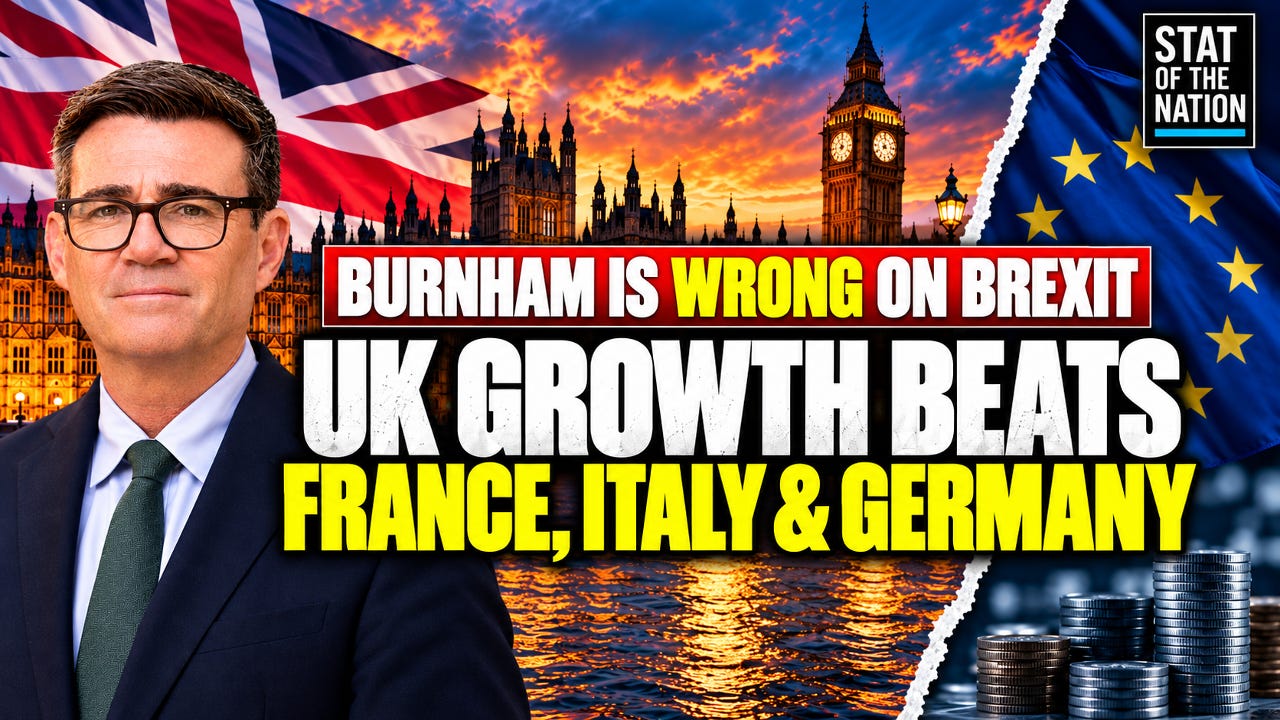
“Brexit has done more harm than good.”
That was Andy Burnham’s verdict at Labour Party conference. He argued that Britain had lost some control over its economy since leaving the EU, pointed to a decade of weak growth and promised to set out options for a new long-term relationship with Europe.
Burnham also announced changes to the state pension triple lock from 2030 and promised a National Care Service that would be “fully funded, and not through borrowing.”
Three big claims. So what do the numbers tell us?
How Has Britain Actually Grown Since the Referendum?
There is no perfect way of measuring the economic impact of Brexit. We know what happened after the referendum, but we can never observe the alternative history in which exactly the same UK economy remained inside the European Union.
What we can do is compare Britain’s actual economic performance with other large European economies.
Using real GDP, which strips out changes caused by inflation, and comparing Q2 2016, the quarter of the referendum, with Q2 2026, the UK economy has grown by 13.2%.
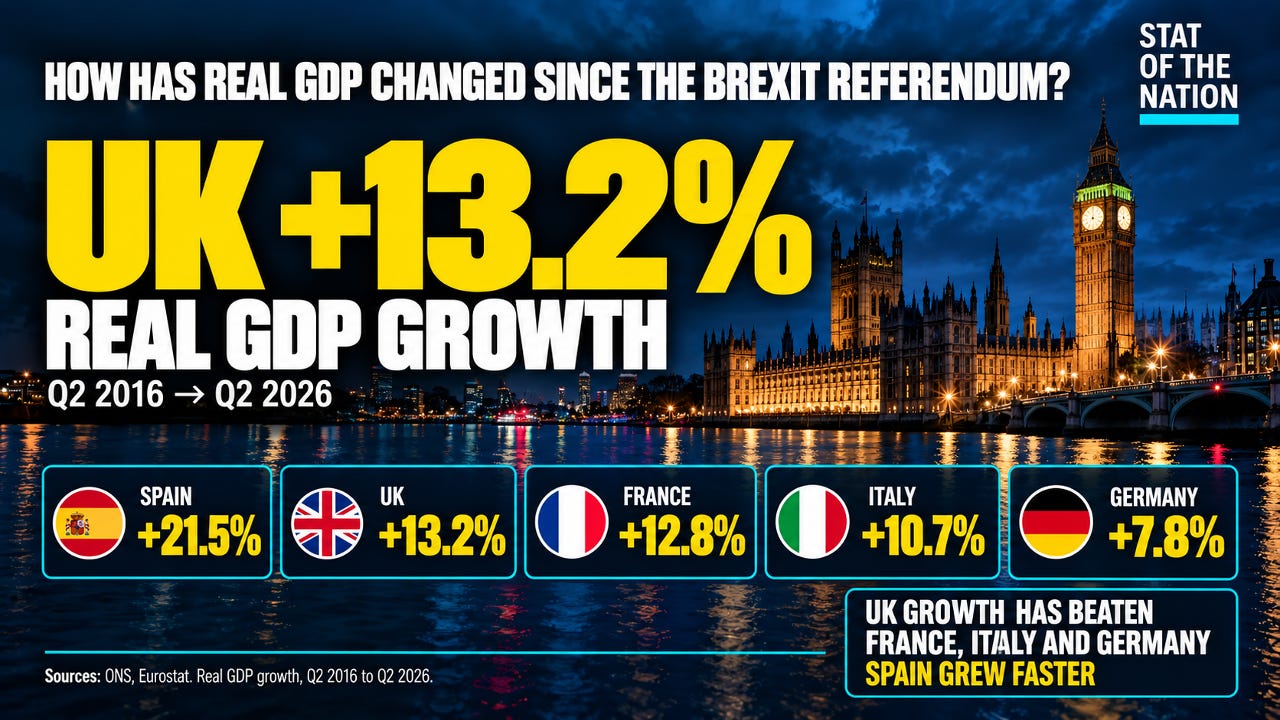
Spain has clearly outperformed Britain, growing by 21.5%. But UK real GDP growth has also exceeded France at 12.8%, Italy at 10.7% and Germany at 7.8%.
That does not tell us exactly what would have happened had Britain voted Remain, because there is no alternative UK economy for us to observe.
But the actual international comparison does tell us something important. Britain’s weak growth over the past decade has not been unique among Europe’s major economies.
Germany and Italy remained inside the EU and have grown more slowly, while France has grown at almost exactly the same rate.
So when Burnham links Britain’s decade of weak growth to Brexit, the story is more complicated. Brexit alone cannot explain Britain’s growth problem when several comparable EU economies have performed no better, or worse.
The Triple Lock Does Need Reform. But What Happens to the Savings?
Burnham’s second major announcement was reform of the state pension triple lock from April 2030.
Currently, the state pension rises each year by whichever is highest: average earnings growth, inflation or 2.5%.
The problem is fairly simple. If pensions rise faster than wages in one year, that higher pension level can become permanently baked in. Future increases then start from that higher base, which can push pension spending progressively higher relative to earnings.
Burnham’s proposal would still guarantee increases of at least inflation or 2.5%, while adding a longer-term link to earnings. The Institute for Fiscal Studies says this removes the most problematic part of the existing triple lock and puts state pensions on a more sustainable path.
The government estimates the change would reduce state pension spending by around £15bn a year by the end of the 2030s, rising further over subsequent decades.
So there is a reasonable fiscal case for reform.
But Burnham doesn’t intend simply to bank those savings. He wants them to help pay for his National Care Service.
And that raises a much bigger question about Britain’s public finances.
What Does “Fully Funded” Actually Mean?
Burnham promised that the National Care Service would be “fully funded, and not through borrowing.” The government says the service will be expanded gradually as savings from the pension changes increase.
Technically, there is nothing contradictory about calling an individual policy fully funded. A government can identify permanent savings or additional revenue and use them to finance new expenditure.
But Britain isn’t starting from a balanced budget.
The latest ONS figures estimate that the public sector borrowed £134.3bn in the financial year ending March 2026.
That changes how we should think about any saving.
Suppose government eventually finds £18bn of permanent savings. It could spend that £18bn on new services, or it could borrow £18bn less than it otherwise would.
If it chooses to spend the money, the new programme can legitimately be described as funded. But the £18bn hasn’t suddenly become free money.
Every pound of savings spent on a new commitment is also a pound that cannot be used to reduce the deficit.
Ultimately, government has choices. It can raise taxes, reduce spending elsewhere, including potentially parts of the welfare budget, borrow more, or limit the generosity of new commitments.
There is no option where additional spending has no trade-off.
A National Care Service, But Not the Whole Care-Home Bill
This is perhaps the most important detail in the announcement.
Burnham compared his new National Care Service with the creation of the NHS and said it would provide peace of mind for people worried about their care needs, homes and savings.
But the government’s own announcement makes clear that what is being offered is free personal care for older people, based on need rather than ability to pay. That includes help with things such as eating, bathing and using the toilet.
It does not mean the entire cost of living in a residential care home becomes free.
The government explicitly states that the National Care Service “will not cover bed and board”. Existing means-tested council support will continue for those accommodation and living costs.
That is a major distinction.
If somebody is admitted to an NHS hospital, they don’t receive the doctor and nurse for free but then get a separate bill for the hospital bed and their meals.
Under the proposed National Care Service, residential accommodation and living costs will remain outside the universal offer.
So despite the NHS comparison, this is not a system in which the state picks up the entire residential-care bill. It is a commitment to provide the personal-care element free, while potentially very substantial accommodation and living costs remain.
That matters both for families judging what the policy actually offers and for anyone assessing claims about how much a National Care Service will cost.
The Numbers Behind Burnham’s Speech
There are significant ideas in Burnham’s conference speech. Reforming the triple lock addresses a genuine weakness in the existing system, and Britain’s social care system clearly needs a sustainable long-term settlement.
But the numbers provide important context.
Burnham says Brexit has done more harm than good. Yet since the referendum, UK real GDP has grown 13.2%, ahead of France, Italy and Germany, although Spain has performed considerably better.
He says the National Care Service will be fully funded, but Britain is already borrowing more than £130bn a year. Savings used to finance new spending cannot simultaneously be used to reduce that deficit.
And while the policy is being compared with the NHS, the government has now confirmed that bed and board in residential care will not be free.
That leaves us with the questions that matter.
What will the National Care Service ultimately cost? How much of the triple-lock saving will pay for it? What will families still have to pay themselves? And if Britain continues to run large deficits, what spending will government prioritise, and what will it cut?
Burnham’s speech sets out the ambition.
The numbers reveal the trade-offs.
✍️ Jamie Jenkins
Stats Jamie | Stats, Facts & Opinions
If you found this analysis useful, please share it and subscribe for more.
📲 Follow me here for more daily updates:
I'm convinced that the present urge to take Britain back into the EU has nothing to do with economics. It is entirely political. The economic argument is a red herring which I'm sure they know. It is interesting to watch the arguments about Canada getting associate membership of the EU. That is all political and has nothing to do with economics.