

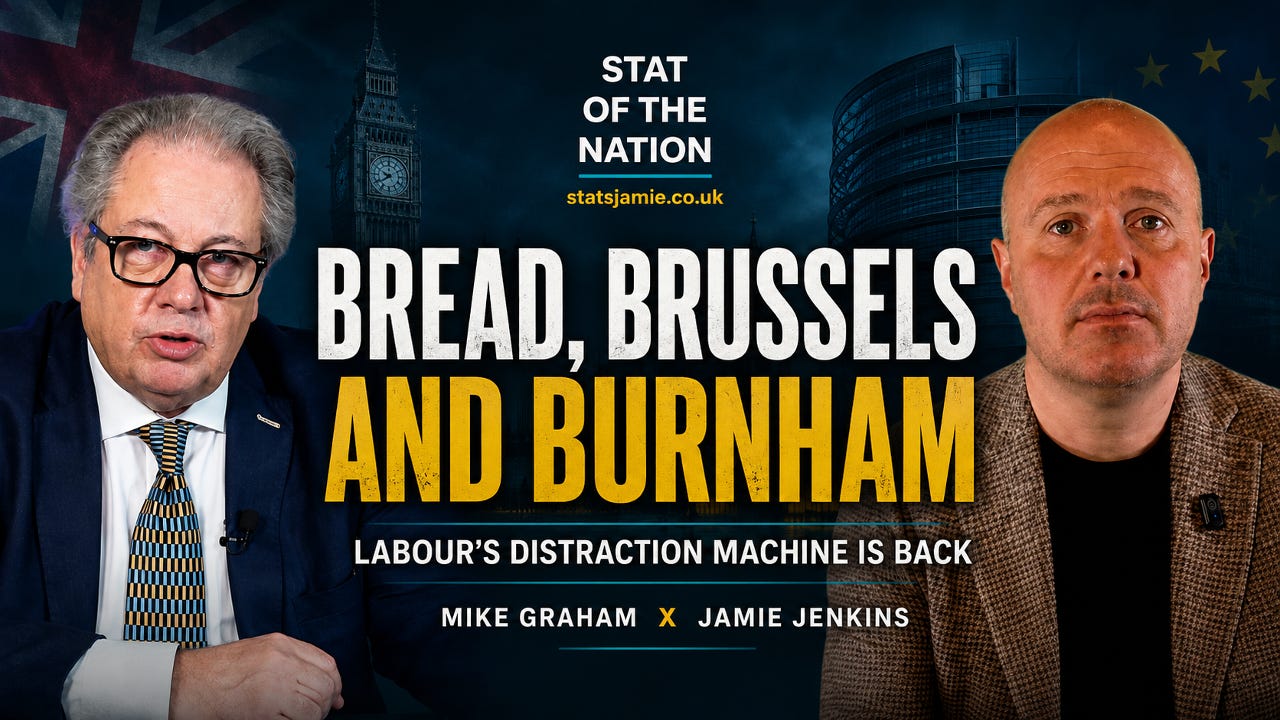
This week I joined Mike Graham on the The Mike Graham Show to talk through the latest numbers, but the bigger theme was not just the economy. It was the distraction machine around it.
When households are still being squeezed, businesses are under pressure, young people are struggling to get work and fuel prices are biting again, what does the political class reach for? Supermarket price caps. Another round of Brexit blame. Leadership gossip around Andy Burnham. And more talk of drifting back towards Brussels.
None of it answers the basic question: why does Britain still feel so expensive, stagnant and badly run?
Price Cap Talk Is Back — And That Should Worry Everyone
One of the more revealing stories this week was not that the Government had formally brought back 1970s-style price controls. It has not. But the Treasury was reportedly pushing large supermarkets to consider voluntary caps on key groceries, while ministers were reported to have ruled out mandatory food price caps and encouraged voluntary freezes instead.
That distinction matters because a voluntary cap is not the same as the state legally fixing prices, but the instinct is still revealing. When politicians start talking about holding down the price of bread, milk and eggs, it usually means they want to be seen doing something visible while avoiding the harder question of why costs have risen so sharply in the first place.
Food prices matter because everyone notices the weekly shop. But price cap talk does not fix the cost structure beneath it: energy, transport, rents, business rates, wages, borrowing costs and taxes. The danger is that it gives the impression of action while ducking the larger problem.
Price cap talk is what politicians reach for when they want to look busy without fixing the thing that made prices rise. That was the point I made to Mike. If the Government really wanted to put money back into people’s pockets, it would not start with a symbolic row over a basket of supermarket staples. It would look at the big household pressures: energy, fuel, housing, tax and the cost of doing business.
Because if families are paying hundreds or thousands more each year for the basics of life, a supermarket stunt is not a serious cost-of-living strategy. At that point, it starts to look less like help and more like political theatre.
Prices Are Still Rising — Whatever The Headline Inflation Rate Says
There was also plenty of noise this week about inflation “coming down”. And yes, the headline rate has fallen. The Consumer Prices Index rose by 2.8% in the 12 months to April 2026, down from 3.3% in March. But that does not mean prices are falling. On a monthly basis, CPI still rose by 0.7% in April 2026.
This distinction matters because when politicians say inflation is down, many people hear that prices are coming down. They are not. It means prices are still rising, just more slowly than they were before.
For households, that is not much comfort. The damage from previous price rises is still baked into the weekly shop, the energy bill, the mortgage payment, the rent, the train fare and the cost of filling up the car.
Fuel is a particularly painful example. The ONS said motor fuel prices rose by 23.0% in the 12 months to April 2026, the largest annual increase since September 2022. Diesel prices rose sharply in April, with the average price reaching 190.0p per litre, the highest since July 2022.
So when people say they do not feel inflation is “coming down”, they are not being stupid. They are describing their lived reality: they are still paying more.
And the Government’s big fuel duty announcement hardly changes that. Rachel Reeves was not announcing a major cut to help motorists. She was effectively announcing that the Government would not make things even worse by adding further tax at the pump. That is where we are now: households are expected to be grateful when the state merely pauses the next hit.
The Jobs Market Is The Warning Sign
The economy still matters in this piece, but it is best understood as the warning light behind all the political distraction.
The labour market is weakening. The early estimate for April 2026 showed payrolled employees down 210,000 over the year and down 100,000 in a single month, to around 30.2 million. The ONS warns that early estimates can be revised, especially at the start of the tax year, but the direction of travel is not encouraging.
PAYE data is one of the clearest near-real-time signals we have for employee jobs, and it is moving the wrong way. That matters because the cost-of-living squeeze is not happening in isolation. It is happening at the same time as employers face higher costs, weaker demand and less confidence.

When businesses are hit by higher National Insurance costs, higher wage bills and cautious consumers, they become more careful. They delay hiring. They cut shifts. They postpone expansion. And the people who suffer first are often the young, the inexperienced and those trying to get their first proper step into work.
That is why the political response feels so inadequate. Free bus travel for young people might make a decent press release, but a bus pass is not a substitute for a job. The real issue is whether there are enough businesses confident enough to hire young people in the first place.
If the economic plan is “working”, as Rachel Reeves keeps saying, then the obvious question is: working for whom?
Hospitality Shows The Squeeze In Real Life
You can see the pressure most clearly in hospitality.
Everyone has had the same experience. You go out for a fairly ordinary meal, nothing fancy, and the bill lands like a small utility statement. Fish and chips, a family chain restaurant, a quick lunch — all of it feels more expensive than it used to.
That changes behaviour. People cut back. They go out less. They skip dessert, avoid drinks, choose cheaper places, or just stay home. For hospitality businesses, that creates a brutal squeeze. Customers are more cautious, while costs keep rising: wages, energy, ingredients, rents, taxes, borrowing costs and business rates.
Margins were already tight. Now many firms are being asked to absorb higher costs while customers have less money to spend. That wider caution also showed up in the latest retail sales figures, with ONS data showing retail sales volumes falling by 1.3% in April 2026, with fuel sales dropping sharply.
This is what the cost-of-living crisis looks like in the real economy. It is not just a number in an ONS spreadsheet. It is fewer meals out, fewer shifts, fewer vacancies and fewer young people getting that first job.
Hospitality is where household pressure turns into labour market pressure.
Brussels And Burnham Are Not A Growth Plan
Then, as usual, when the domestic picture looks uncomfortable, parts of the political class reach for the same comfort blanket: Europe.
This week brought more talk of closer EU ties, more Brexit blame, and more positioning from senior Labour figures. Andy Burnham and Wes Streeting helped drag the issue back into view during the discussion, while Keir Starmer has leaned into the idea that Brexit made Britain poorer.
But the lazy version of this argument does not survive serious scrutiny. Britain has plenty of problems, but they are not all sitting at the border. They are in energy policy, tax policy, planning failure, weak productivity, poor infrastructure delivery, public sector performance and the rising cost of doing business.
Brussels is not a growth plan. At this point, it looks more like a political comfort blanket.
If the European Union were the magic answer, Germany would not be struggling with its own economic problems. Britain should trade well with Europe, of course. We should cooperate where it makes sense. But drifting back into the EU’s orbit by stealth will not fix the underlying domestic failures making Britain expensive, sluggish and overtaxed.
The Burnham chatter fits the same pattern. Labour is already looking around for another answer because the Starmer project feels managerial, exhausted and directionless. But changing the salesman does not change the product, and that is the problem with the Burnham chatter.
Andy Burnham may be more charismatic than Keir Starmer. That is not exactly a high bar. The serious question is whether he has a credible answer to the problems facing the country: high costs, weak jobs growth, squeezed households, expensive energy and businesses losing confidence.
If Andy Burnham is the answer, the question must be: how do we rebrand the same failed model with a different accent?

The Bottom Line
This week told us a lot about where British politics is heading.
Price cap talk will not fix the cost-of-living crisis. EU nostalgia will not create growth. Burnham gossip will not create jobs. And pretending that lower inflation means prices are falling will not fool households paying the bills.
The problem is not that Britain lacks political announcements. It is that too many of them are distractions from the basic failure to make the country cheaper to live in, easier to work in, and better to do business in.
That is the real Stat of the Nation.
Labour says the plan is working. The country can see the bills, the jobs market and the empty restaurants — and it is entitled to ask: working for whom?
✍️ Jamie Jenkins
Stats Jamie | Stats, Facts & Opinions
📢 Call to Action
If this helped cut through the noise, share it and subscribe free by entering your email in the box below and get the stats before the spin, straight to your inbox (no algorithms).
📚 If you found this useful, you might also want to read:
Vaccinated Under False Pretences. How Public Trust Was Eroded.

The Covid inquiry says trust in vaccines must now be rebuilt. But trust was not broken by accident. It was broken by exaggerated claims, moral pressure, broken promises, and a culture that punished doubt while rewarding bad information from the right people.
📲 Follow me here for more daily updates:
To make the country cheaper to live in and all that would actually be quite easy! Get rid of the whole political class! Absolutely every problem is caused by politics. Expensive unicorn poo energy policy stopping BP from finding fossil fuel in the UK? Expensive petrol because of Russians? Youth unemployment because of rules and regulations? Working at least 3 months a year just to pay your tax bill? Trains, water, education, health service all pretty crap? A rule and a tax for everything? All down to politicians. Weak, useless, stupid people in jobs they can't do supported by useless agenda driven civil servants who have jobs and pensions for life.