

When Keir Starmer came into office, he promised a reset. No more slogans. No more chaos. Just results. The phrase was blunt: “smash the gangs.”
It was meant to signal seriousness — that something fundamental would change. Not just in tone, but in outcomes. Fewer boats. Fewer crossings. Less pressure on communities and the taxpayer.
So after a full calendar year in charge, the only question that really matters is a simple one: Did anything actually change?
To answer that, you have to put politics to one side and follow the numbers — calmly, end to end.
📊 The First Full Calendar Year — And the Numbers That Matter
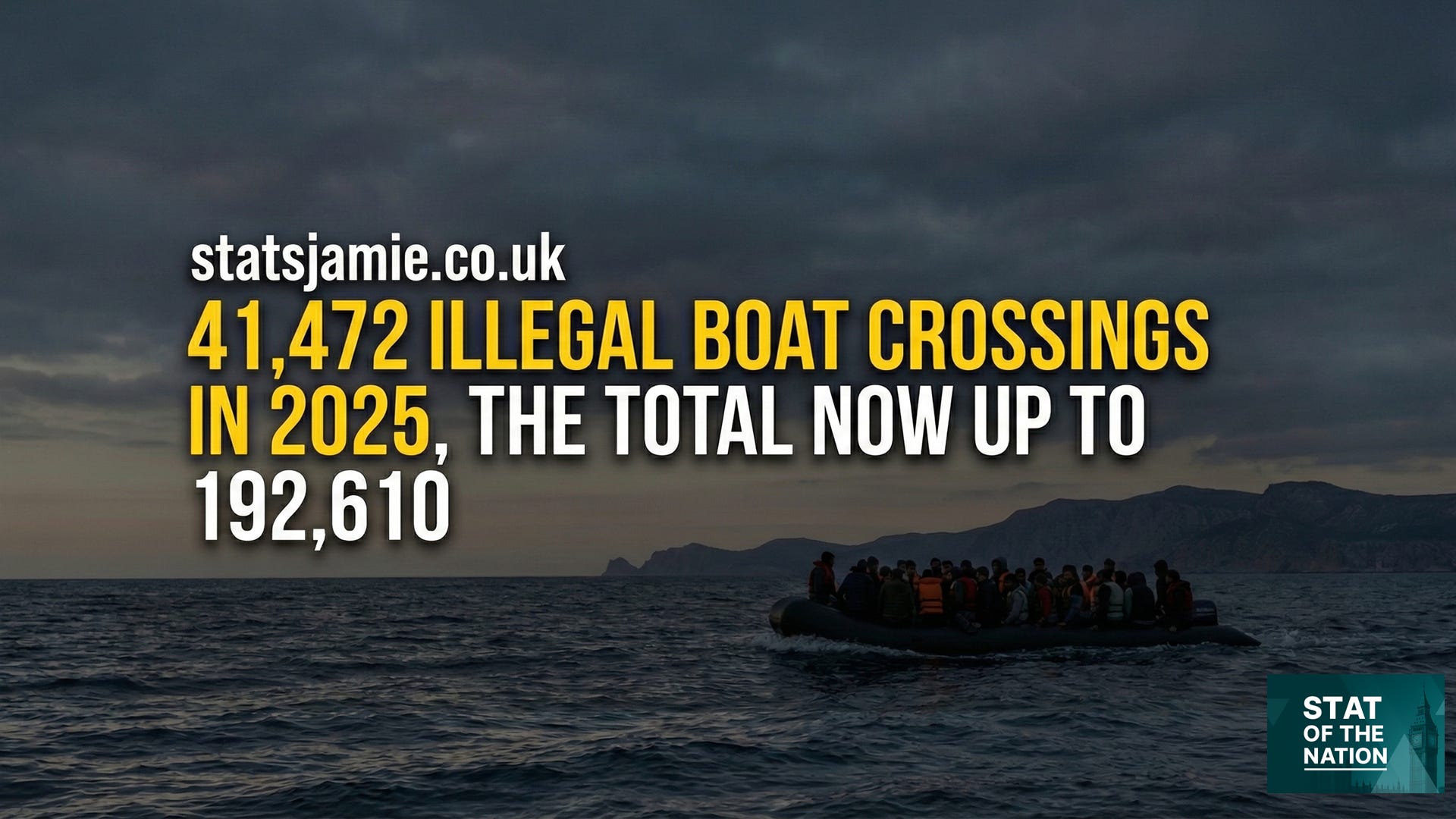
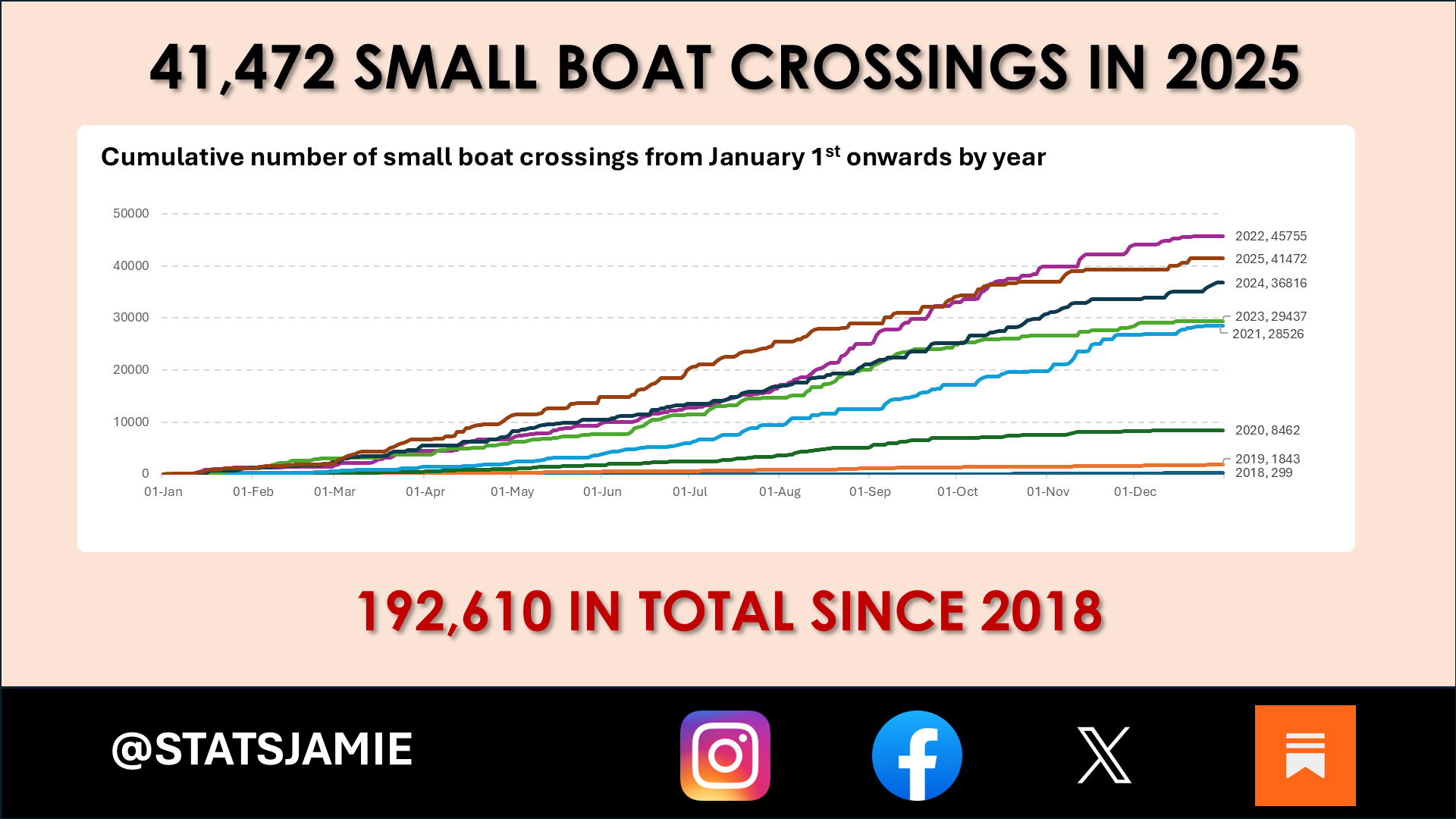
In 2025, 41,472 people crossed the Channel in small boats.
That makes it:
the second-highest year on record
13% higher than 2024
This wasn’t a transition year or a period of bedding in. It was Starmer’s first full calendar year — and the numbers went up, not down.
So what? Because when a government promises to “smash the gangs”, rising arrivals tell you something very clear:
The model wasn’t broken — and the gangs kept operating.
From the smugglers’ point of view, nothing fundamental changed. And when outcomes don’t change, behaviour doesn’t either.
🧭 Promise Meets Reality — A System That Never Resets
Zoom out further, and the scale becomes unavoidable. Since 2018, around 193,000 people have crossed the Channel in small boats.
What started as a marginal route has now become a permanent migration channel, operating year after year at scale.
So what? This is no longer about reacting to a crisis. It’s about managing a system — one that has been allowed to entrench itself.
And systems like this don’t shrink on goodwill or rhetoric. They shrink only when incentives change.
💷 More People In Means More Money Out
Here’s the part that often gets skipped.
Every additional arrival feeds directly into spending — accommodation, processing, appeals, legal costs, and support. Official forecasts now put asylum system spending in 2024–25 at around £4.9 billion.
That isn’t a temporary overshoot. It isn’t an accounting quirk. It’s the price of running the current model at current volumes.
So what? When crossings rise, the bill rises automatically. This isn’t abstract policy failure — it’s a direct, recurring cost to the taxpayer.
If numbers don’t fall, neither does the spending.
👥 Who the System Is Actually Serving — And What Labour Ministers Say Instead
Listen to UK Labour ministers, and you would be forgiven for thinking the Channel is now dominated by families fleeing with small children.
That framing has been pushed repeatedly from the top of government — most starkly by Treasury Minister Darren Jones, who told a television audience:
“When you’re there on the site, seeing these things put together by organised criminal gangs… when you see that the majority of the people in these boats are children, babies and women.”
It is a striking image. And it is not what the data shows.
What the data actually records
Across the full Home Office dataset — covering every year since 2018 — small-boat arrivals are:
Around 85% adults
Around 85% men
Heavily concentrated in the 18–39 age range
Children do arrive. Women do arrive. But they are not the majority — not in any year of the data.
The dominant profile is not families with young children. It is young, working-age men.
A route dominated by young adult men behaves very differently from a humanitarian evacuation corridor. It responds to incentives, probabilities, delays and outcomes — not to moral signalling.
Another myth is that small-boat arrivals are driven by whichever global crisis happens to dominate the headlines.
The long-run data show something far more stable.
Since records began in 2018, a small number of nationalities consistently dominate the route. In cumulative terms, the top nationalities, in order, are:
Iran, Afghanistan, Iraq, Eritrea and Somalia.
These five alone account for a disproportionate share of all arrivals over the entire period.
So what? Because this is not randomness — it is entrenchment. Once a nationality establishes itself on the Channel route, networks form, information spreads, and the flow sustains itself.
That is why the same patterns keep reappearing year after year.
🔁 ‘One In, One Out’ — A Gimmick That Was Never a Deterrent
Labour’s flagship response to small boats has been the so-called “one in, one out” returns deal with France.
It was sold as a deterrent. It was always a gimmick.
We learnt in December that 193 migrants had been sent back to France, while 195 migrants had arrived in the UK under the scheme. So even on its own terms, the deal was already net-positive.
I said from the start this would be a pointless gimmick — and the numbers proved it.
The scheme has since been criticised as “no deterrent at all”, particularly after cases emerged of two migrants returning to the UK after being removed to France under the deal. They were later deported again, underlining just how circular and ineffective the process had become.
So what? Against 41,472 arrivals in 2025, returning under 200 people does not change incentives or behaviour.
From the smugglers’ point of view, this was never a threat. It was background noise.
🔚 The Bottom Line — What This All Means
Put it all together, and the picture is clear.
In his first full calendar year, Keir Starmer promised to smash the gangs — yet more people crossed, costs rose, and the same routes, nationalities and networks remained firmly in place.
This isn’t a failure of effort. It’s a failure of design.
A system that delivers entry, accommodation and long processing times will continue to attract people, no matter how many slogans are rolled out alongside it.
Until the government changes what actually happens after arrival, nothing fundamental will move.
Not the numbers. Not the cost. And certainly not the gangs.
Because right now, the strongest force shaping small-boat crossings isn’t government action.
It’s the weather in the Channel itself.
✍️ Jamie Jenkins
Stats Jamie | Stats, Facts & Opinions
📢 Call to Action
If this helped cut through the noise, share it and subscribe for free — get the stats before the spin, straight to your inbox (no algorithms).
📚 If you found this useful, you might also want to read:

📲 Follow me here for more daily updates:
It seems to many people that British Governments have no intention of stopping the boats. Do you think that's right and if so why?
192,610... Thats quite an undercover army right there. Their leaders just need to give the order..Scared!