

Labour promised growth.
But the latest jobs data tells a very different story.
I joined Martin Daubney on GB News to discuss the latest labour market figures, and the warning signs are now difficult to ignore. Payroll employment is falling. Vacancies are drying up. Private sector pay growth is weak. Self-employment has been hammered. And young people are being hit just as they try to get on the first rung of the jobs ladder.
This is not just a set of dry labour market statistics. It is about whether young people can find work, whether small firms can afford to hire, and whether Labour’s so-called “growth mission” is already running into the real-world consequences of taxing employment.
🚨 The Jobs Market Is Flashing Red
The early estimate from HMRC Pay As You Earn Real Time Information shows 30.2 million payrolled employees in April 2026, down from 30.4 million a year earlier.
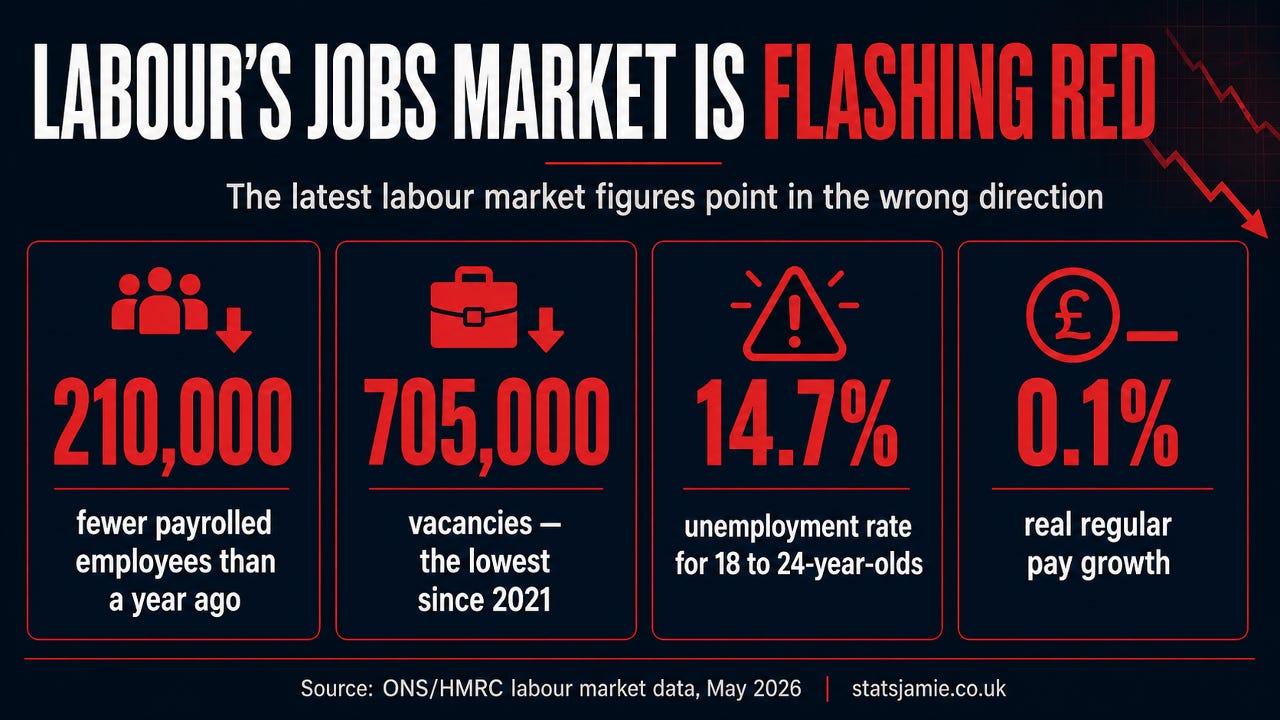
That is a fall of around 210,000 payrolled employees over the year, and around 100,000 in a single month. The ONS rightly warns that April is an early estimate and more likely to be revised, but the direction is not pretty.
And this is not one isolated indicator.
Vacancies fell to 705,000 in February to April 2026. That is down 28,000 on the quarter, down 54,000 on the year, and the lowest level since February to April 2021.
So the basic picture is clear.
There are fewer people on payroll. There are fewer vacancies available. And employers appear to be pulling back from hiring.
That matters because this is exactly what businesses warned about when Rachel Reeves increased the cost of employing people.
You cannot make hiring more expensive and then act surprised when hiring slows.
This is what taxing jobs looks like.
🧑🎓 Young Workers Are Being Hit First
The most politically damaging part of the story is youth unemployment.
Young people are often the first to feel a weakening labour market. They have less experience, fewer contacts, and are more likely to rely on entry-level roles in retail, hospitality and local services.
Those are precisely the kinds of jobs that become vulnerable when employers face higher costs.
For 18 to 24-year-olds, unemployment now stands at around 590,000, with an unemployment rate of 14.7%. That is up 91,000 over the year, with the rate up 1.9 percentage points.
Among 16 to 17-year-olds, unemployment stands at around 140,000, with an unemployment rate of 29.5%. That is up 19,000 over the year, with the rate up 2.7 percentage points.
If the first rung of the jobs ladder starts disappearing, the damage is not just one missed payslip. It is lost experience, lost confidence, lost skills and lost momentum.
Labour talks constantly about opportunity. But opportunity starts with work.
And if young people cannot get that first proper job, the promise starts to fall apart.
🏪 Retail, Hospitality And Small Firms Are Under Pressure
This is where the “jobs tax” argument becomes real.
Raising employer National Insurance does not land in theory. It lands in cafés, shops, restaurants, warehouses, salons, garages, construction firms and small local businesses.
Larger organisations may be able to absorb some of the cost.
Small firms often cannot.
The vacancy data shows the pressure clearly. The largest quarterly fall in vacancies was among businesses with 1 to 9 employees, where vacancies fell by 19,000.
Over the year, vacancies were down 26,000 among businesses with 10 to 49 employees, and down 21,000 among businesses with 1 to 9 employees.
That is the real economy pulling back.
A small employer facing higher wage bills, higher National Insurance, higher energy costs, higher rent and weak consumer demand has limited options.
They can hire fewer people. They can cut hours. They can delay recruitment. They can raise prices. Or they can try to do more with fewer staff.
None of that looks like a serious growth strategy.
💷 Private Sector Pay Is Weakening
Labour can point to wage growth and claim workers are still seeing pay rises.
But the detail is far less flattering.
Annual growth in average earnings was 3.4% for regular pay and 4.1% for total pay in January to March 2026. Once inflation is taken into account using CPIH, real regular pay growth was just 0.1%.
In other words, regular pay was barely moving in real terms.
The private sector picture is weaker still.
Regular earnings growth was 3.0% in the private sector, compared with 4.8% in the public sector. The last time private sector regular earnings growth was lower than 3.0% was August to October 2020.
That split matters.
The danger is obvious: the state-funded economy keeps growing while the taxpaying economy weakens.
The private sector is the part of the economy that has to generate the wealth, productivity and tax base to pay for everything else. If that side of the economy is being squeezed, Britain’s growth model becomes even more dependent on government spending, debt and higher taxes.
Workers do not experience the economy through ministerial slogans.
They experience it through pay packets, job security, bills and opportunities.
Right now, the labour market is saying something very different from Labour’s growth rhetoric.
🎓 The Broken Promise To Young People
There is a bigger issue here than one month of data.
For years, young people have been told to take on debt, go to university, build skills and prepare for a better future.
But what happens if the jobs market waiting for them is weaker, more expensive and less willing to hire?
A degree is not a guarantee of opportunity. Training only matters if the economy can absorb people into decent work. Skills policy is pointless if the businesses expected to hire young workers are being punished with higher employment costs at the same time.
Young people were told education would buy opportunity.
But that promise breaks down if the jobs market waiting for them is shrinking.
That is why youth unemployment hitting an 11-year high should be treated as a serious warning. It is not just an economic indicator. It is a signal that too many young people are being left at the starting line.
📊 The Numbers Tell The Story
Taken together, the latest labour market data points in one direction:
around 210,000 fewer payrolled employees over the year in the early April PAYE estimate;
around 100,000 fewer payrolled employees in a single month;
705,000 vacancies, the lowest since early 2021;
54,000 fewer vacancies than a year ago;
18 to 24 unemployment at 14.7%, up 91,000 over the year;
real regular pay growth of just 0.1%;
private sector regular pay growth of 3.0%, compared with 4.8% in the public sector;
That is not a growth story.
It is a warning sign.
Labour promised growth, opportunity and stability. But the data now shows a labour market under pressure: fewer payroll jobs, fewer vacancies, weak real pay growth, falling self-employment and rising youth unemployment.
This is the danger of taxing work.
Businesses do not absorb higher employment costs in a vacuum. They hire less, delay recruitment, cut hours, raise prices or squeeze wages.
Rachel Reeves called it a plan for growth.
For young workers, small firms and the private sector, it increasingly looks like the bill arriving.
This is what taxing jobs looks like.
✍️ Jamie Jenkins
Stats Jamie | Stats, Facts & Opinions
📢 Call to Action
If this helped cut through the noise, share it and subscribe free by entering your email in the box below and get the stats before the spin, straight to your inbox (no algorithms).
📚 If you found this useful, you might also want to read:
Starmer’s Big Answer Is More Europe — No Wonder Voters Are Walking Away

Keir Starmer stood up yesterday to save his premiership. What he delivered was a speech that showed exactly why it is collapsing.
📲 Follow me here for more daily updates:
Idiots