

Britain can keep building more and more wind farms. We can put turbines across our countryside and out at sea, but there’s one rather important thing that no government can control: the weather.
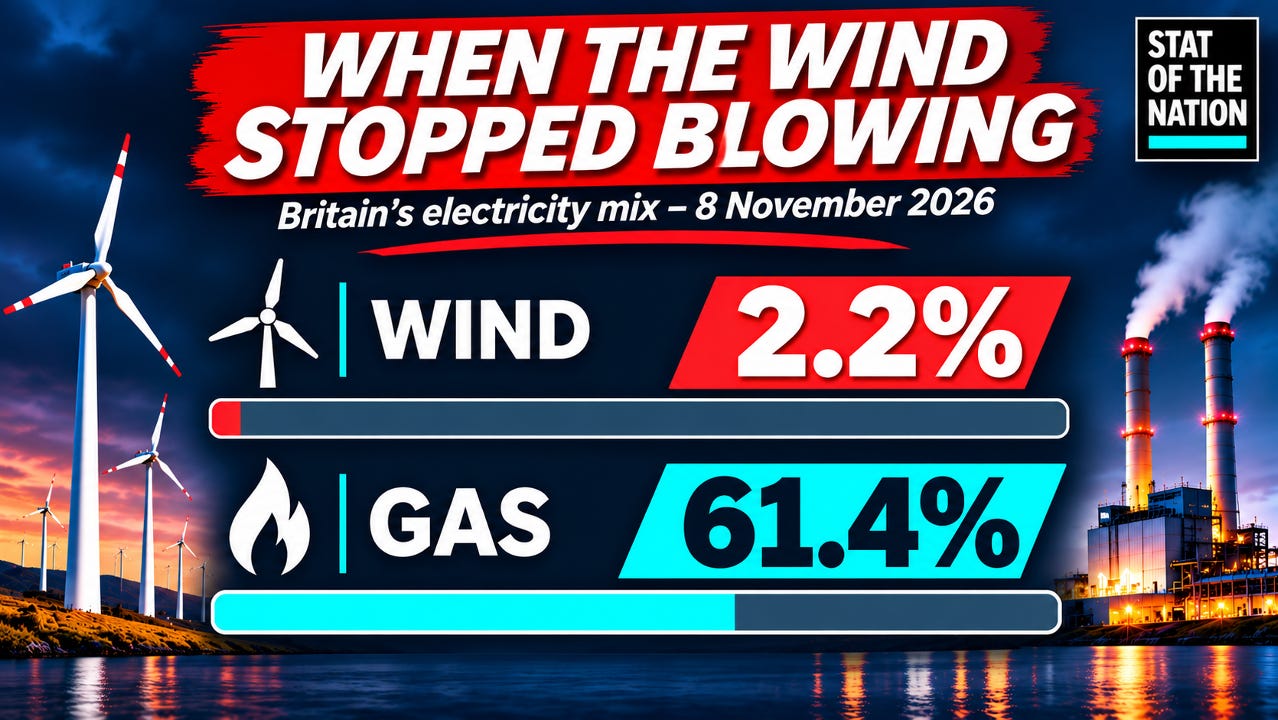
Over the past few days, we’ve had a striking reminder of what happens when the wind doesn’t blow. On Sunday 8 November, wind supplied just 2.2% of Britain’s electricity, while gas-fired power stations provided more than 61%. Then came a warning from the electricity system operator, calling for additional spare generating capacity.
It raises a fundamental question. We can keep building more wind turbines, but when the wind doesn’t blow, where is our electricity supposed to come from? And how much will households pay to ensure it remains available, whatever the weather?
When Britain’s Wind Power Collapsed
The latest electricity generation figures tell a remarkable story. On Monday 2 November, wind accounted for 30.5% of Great Britain’s electricity mix. By Friday, that had fallen to 8.9%, and by Sunday, just 2.2%.
Meanwhile, gas generation moved in the opposite direction, rising from 32.3% to 61.4%. Solar contributed just 2.6% on Sunday, leaving Britain heavily reliant on other sources of electricity.
Then came something particularly noteworthy. On Sunday evening, the National Energy System Operator (NESO) issued an Electricity Margin Notice for Monday morning, initially identifying a 1,388 megawatt shortfall against its required spare-capacity margin. In simple terms, the operator wanted more generating capacity available to ensure sufficient reserves.
The warning was cancelled on Monday morning after the position improved. Importantly, this wasn’t a warning that blackouts were imminent, and electricity supplies continued. Indeed, NESO’s Winter Outlook forecasts sufficient capacity for the months ahead.
Nevertheless, the incident highlighted why dependable backup generation remains so important. When the wind stops blowing, electricity demand doesn’t disappear, and the country still needs sufficient power to keep homes, hospitals and businesses running.
You Can Build More Turbines, But You Cannot Control the Weather
Under the Government’s Clean Power 2030 Action Plan, Britain is targeting between 43 and 50 gigawatts of offshore wind capacity and another 27 to 29 gigawatts of onshore wind by the end of the decade.
That’s an enormous expansion, but there’s a fundamental difference between having the capacity to generate electricity and producing it when we need it.
You can double the number of wind turbines, but if wind speeds are extremely low across the country, electricity output can still be very limited. More turbines can generate more electricity at relatively low wind speeds, and spreading them across different locations helps reduce weather-related risks. However, widespread periods of calm remain an unavoidable challenge.
Electricity isn’t something we can simply stop using until the weather improves. Hospitals, businesses, factories, transport systems and millions of homes all depend on reliable supplies around the clock, particularly during cold winter weather.
Wind generation has genuine advantages. When conditions are favourable, it reduces gas consumption, cuts emissions and limits exposure to international fuel prices. But generating a large proportion of electricity over an entire year is very different from guaranteeing enough during the coldest, stillest days of winter.
Energy policy has to work when conditions are at their worst, not just when they’re at their best.
Britain’s Energy Security Still Depends on Backup Power
The Government argues that expanding homegrown renewable electricity will improve Britain’s energy security by reducing dependence on imported fossil fuels. There’s logic to that argument, because generating more electricity from domestic wind resources reduces the amount of gas Britain needs to import and burn.
But energy independence and security of supply aren’t quite the same thing. Generating more of our own electricity over a year doesn’t automatically guarantee that we can meet demand at every moment. What happens during several consecutive days of freezing temperatures, limited sunshine and very little wind?
We still need dependable electricity from somewhere, whether that’s gas-fired power stations, nuclear generation, electricity imports or energy storage. Each option has limitations. Gas requires fuel, imports depend on supplies elsewhere, and conventional batteries generally provide electricity for hours rather than several consecutive days.
Meanwhile, Britain has been dismantling its old coal-fired infrastructure. The last coal-fired power station, Ratcliffe-on-Soar, closed in September 2024, with demolition plans progressing. At Fiddler’s Ferry, four cooling towers were demolished in December 2023, with further work continuing.
Coal’s phase-out has brought environmental benefits, while ageing power stations would have required investment to maintain. Nevertheless, their closure raises questions about how Britain replaces dependable generating capacity.
And here’s perhaps the most revealing statistic in the Government’s strategy. Despite its enormous planned expansion of wind and solar power, the Clean Power 2030 Action Plan still expects Britain to retain around 35 gigawatts of gas-fired generating capacity. That’s almost identical to the 35.6 gigawatts included in its 2024 starting point.
Britain is investing substantially in wind farms, solar panels, storage and electricity networks while expecting to retain almost its entire existing gas-generating capacity. Those stations would run less frequently as renewables expand, reducing fuel consumption and emissions, but they still need to be maintained and financially viable.
And that comes at a cost, even when they aren’t generating electricity. It doesn’t mean we’re paying the full running costs of two systems simultaneously, but maintaining dependable backup must form part of any assessment of the overall economics.
The Government wants at least 95% of electricity generation to come from clean sources in a typical weather year by 2030. But an annual target doesn’t guarantee sufficient clean generation during every hour. Energy security ultimately depends on reliable electricity being available when it’s needed, regardless of the weather.
When the Wind Blows, Why Are We Paying Turbines to Stop?
There’s another problem worth examining. We’ve seen what happens when there isn’t enough wind, but what happens when there’s plenty?
Remarkably, Britain sometimes pays wind farms to reduce their electricity generation. This isn’t simply because it’s too windy, but because the electricity network cannot always transport all the power being generated to where it’s needed.
Large amounts of wind electricity are generated in Scotland, while much of Britain’s demand is further south. When transmission lines cannot carry all that electricity, NESO may pay wind farms to reduce output while paying other generators, often gas-fired stations, to increase production elsewhere.
According to NESO’s latest analysis, published on 9 November, wind farms were paid a little under £500 million during 2025/26 to reduce their output. The operator also reported that approximately 13% of potential wind generation was curtailed because of electricity-system constraints.
That’s electricity which could have been generated but which the network couldn’t accommodate. These payments form part of the wider costs of balancing Britain’s electricity system, which ultimately feed through to consumers.
Wind generation still reduces overall gas consumption, while expanding electricity networks could substantially reduce curtailment. But that infrastructure also requires investment, and those costs must be considered alongside the benefits.
When there isn’t enough wind, Britain needs dependable backup power. When there is plenty, parts of the network sometimes cannot handle the electricity produced. Both situations have costs that consumers deserve to understand.
What Does This Mean for Your Household Energy Bills?
Ultimately, this isn’t just a debate about turbines, power stations and electricity networks. It’s about what households and businesses pay for energy, and whether Britain’s strategy can deliver affordable electricity.
There’s an important finding in a recent House of Commons Energy Security and Net Zero Committee report. Gas generation continues to determine Britain’s wholesale electricity price most of the time. Even more revealingly, the Government estimates gas will still set electricity prices around half the time in 2030, despite ambitions for at least 95% of annual generation to come from clean sources.
That’s because the generator setting the wholesale price isn’t necessarily producing most of the electricity consumed. Even with substantially more renewable generation, gas could continue influencing prices for significant periods.
Meanwhile, households face another potential increase in energy bills. According to MoneySavingExpert’s forecast, updated on 10 November, the annualised energy price cap for a typical dual-fuel household could rise from £1,723 to £2,182 in January 2027. That’s a potential increase of £459 a year, or almost 27%.
This remains a forecast, not a confirmed increase. It covers household gas and electricity and reflects wider market pressures, particularly international gas prices. It would be misleading to attribute the projected rise to a few days of low wind or payments made to wind farms.
But it reinforces why consumers deserve answers about affordability. Renewable electricity can reduce fuel costs and dependence on imported gas, yet the complete system also requires investment in networks, storage, backup generation and balancing supply and demand.
The Government’s analysis suggests the transition could deliver electricity-system costs similar to today’s, with potential savings under some scenarios. The challenge is demonstrating that those benefits will outweigh the additional costs and reach consumers.
Households don’t just need electricity when the wind blows. They need reliable, affordable power every hour of the year, and that means considering the cost of the entire system rather than generation alone.
The Question the Government Needs to Answer
Britain needs an electricity system delivering three things: energy independence, security of supply and affordability. Expanding renewables can reduce dependence on imported fossil fuels, but cannot alone guarantee supplies during prolonged periods of low wind and sunshine.
The Government acknowledges this by retaining around 35 gigawatts of gas-fired capacity alongside substantial investment in renewables, storage and electricity networks. Meanwhile, consumers are also helping fund payments to reduce wind generation when the network cannot accommodate it.
So the questions for Energy Secretary Miatta Fahnbulleh are straightforward. How much will the complete electricity system cost, including backup capacity when renewables aren’t generating enough? How will Britain guarantee supplies during prolonged periods of unfavourable weather, and why are wind farms being paid to reduce generation while other stations are brought online elsewhere?
Perhaps most importantly, when will households see the promised benefits reflected in cheaper electricity? These aren’t arguments for abandoning wind power, but questions about the reliability, affordability and value for money of the entire strategy.
Britain can build all the wind farms it wants, but when the wind doesn’t blow, we still need to keep the lights on. And when it does blow, we need a system capable of using the electricity produced.
Ultimately, consumers deserve to know what making both of those things possible is going to cost them.
✍️ Thanks for reading Stat of the Nation. If you find my analysis useful, please share or subscribe to support my work.
✍️ Jamie Jenkins
Stats Jamie | Stats, Facts & Opinions
📲 Follow me here for more daily updates:
Yes, I keep my eye on Gridwatch which shows where our electricity comes from and two days ago I could see that 70% was being generated by gas, 7% from wind and solar. As you say, it was much the same over a few days. If you tell this to a climate activist you get told that we just need more batteries but a little simple maths shows that that is not a viable option. The ignorance and stupidity of some MPs about this is staggering.