

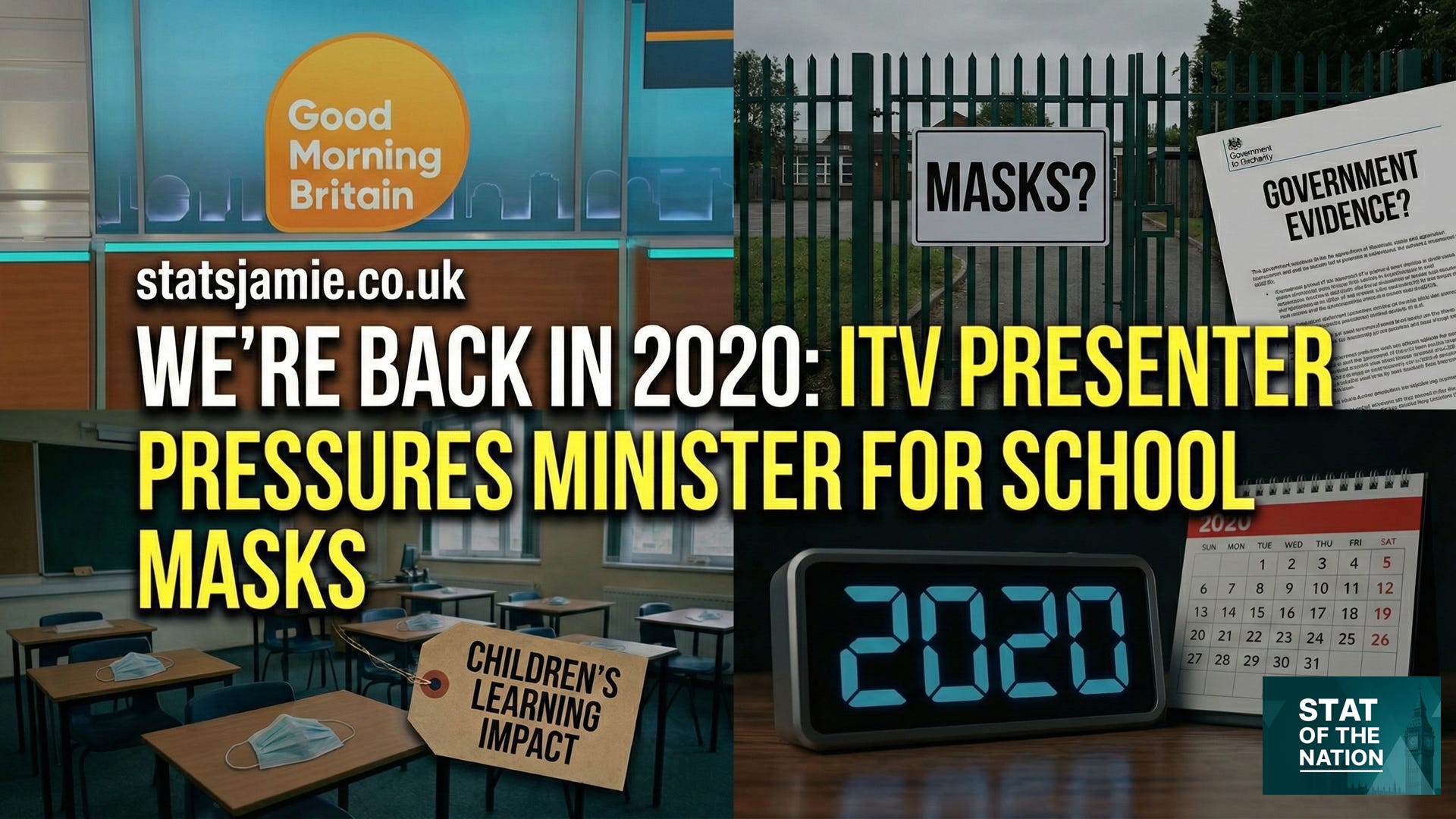
Over the last week, it’s felt like someone pressed rewind on British public life.
Winter illness arrives (as it always does), the media mood hardens, and suddenly we’re back in the 2020/21 playbook: urgency, alarm, and the familiar demand that ministers must “do something” — even if nobody can clearly explain what that “something” achieves.
During the pandemic, a lot of people supported masks in schools in good faith. It felt like a sensible precaution.
But the uncomfortable truth is that a lot of what was imposed on the public — and on children — arrived without robust, real-world evidence in schools, and without a clear understanding of the classroom trade-offs. Now we’ve lived through it, and we have data on the downsides, it’s not good enough to pretend we’re still operating in the dark.
📺 ITV: Kate Garraway pushes masks back into classrooms
On Good Morning Britain, Kate Garraway repeatedly pressed the Schools Minister on masks in schools — first asking, “Are you considering face masks in school?” and then pushing further: “Why not have face masks in school?”
That framing matters. It assumes masking is the obvious default — and that the minister must justify not imposing it.
In this instance, the government’s instinct looks like the sensible one: don’t announce sweeping measures for children on the back of studio pressure. If you’re going to impose something that affects learning and communication in classrooms, the burden is on the people calling for it to show robust evidence of a meaningful benefit — not on everyone else to explain why they’re not rushing back to 2020/21.
📌 What the Department for Education actually found
DfE’s own school analysis found no statistically meaningful difference in absence between schools reporting face coverings and those that didn’t — and it explicitly says it cannot prove cause and effect.
The “masking” group was small (only 123 schools), masking was self-reported, and the data didn’t clearly separate classroom masking from communal areas.
Nearly four years on, if classroom masking delivered a meaningful benefit, the evidence would be robust and obvious — not something being dragged back into policy by a breakfast TV “why not?” push.
🧠 The harms: DfE documented them — and they’re not small
This is the part that tends to vanish in TV debates.
DfE also summarised evidence on how face coverings affected pupils and staff inside education settings — and it paints a clear picture of friction in the classroom.
In pupil surveys, 80% said face coverings made communication difficult, and 55% said they made learning more difficult.
In teacher/leader surveys, 94% said face coverings made communication between teachers and students more difficult.
DfE flags particular concerns for children with hearing loss, and the need for flexibility/mitigations.
So we’re not talking about a harmless gesture.
We’re talking about an intervention the government’s own evidence links to real barriers to teaching and learning, while the “benefit” case was never clearly demonstrated at scale.
🎯 Why the Garraway exchange matters
This is why the interview was so frustrating.
The tone of “why not masks?” implies that masks are a proven fix — and ministers are reckless if they hesitate. But the government’s own evidence summary doesn’t support that framing.
It describes no clear difference in absence; it can’t show cause-and-effect, and it documents substantial classroom downsides. In other words, the burden of proof is on the person pushing the imposition, not on everyone else to justify resisting it.
🗞️ The wider pattern: media pressure and policy-by-headline
During 2020 and 2021, this became a recurring dynamic: broadcasters demanding tougher restrictions, and politicians reacting to avoid hostile headlines.
The problem is that “doing something” becomes the goal — even if the evidence is weak and the trade-offs fall on the public, and on children most of all.
That’s why the media should tread carefully before reviving classroom masking as a default answer to seasonal illness. Scrutiny is one thing. Pushing ministers toward restrictions without solid evidence is another.
📌 The BBC clip: certainty-first messaging is back
In a BBC segment, viewers were told the flu jab “crucially helps prevent” children passing the virus to vulnerable people. That wording implies a high level of confidence — and it quietly turns a probability into a near-guarantee.
The risk is obvious: it nudges parents into thinking that if your child isn’t vaccinated, you’re endangering others. That’s a heavy moral implication to load into a TV soundbite — especially when flu vaccine performance can vary year to year depending on strain match.
✅ Bottom line
If the case for masking children in classrooms is strong, it should be easy to show, with robust evidence, that the benefits outweigh the costs.
But the government’s own evidence summary doesn’t read like a slam dunk. It reads like uncertainty about benefits—and clarity about harms.
So no: it’s not the role of breakfast television to pressure ministers toward restrictions on children based on implication, urgency, or studio vibes.
If we’re going to revisit 2020-era interventions, we should start with 2020-era basics:
Evidence first. Trade-offs stated. And children are not used as the easy lever to pull.
✍️ Jamie Jenkins
Stats Jamie | Stats, Facts & Opinions
📢 Call to Action
If this helped cut through the noise, share it and subscribe for free — get the stats before the spin, straight to your inbox (no algorithms).
📚 If you found this useful, you might also want to read:

📲 Follow me here for more daily updates: