

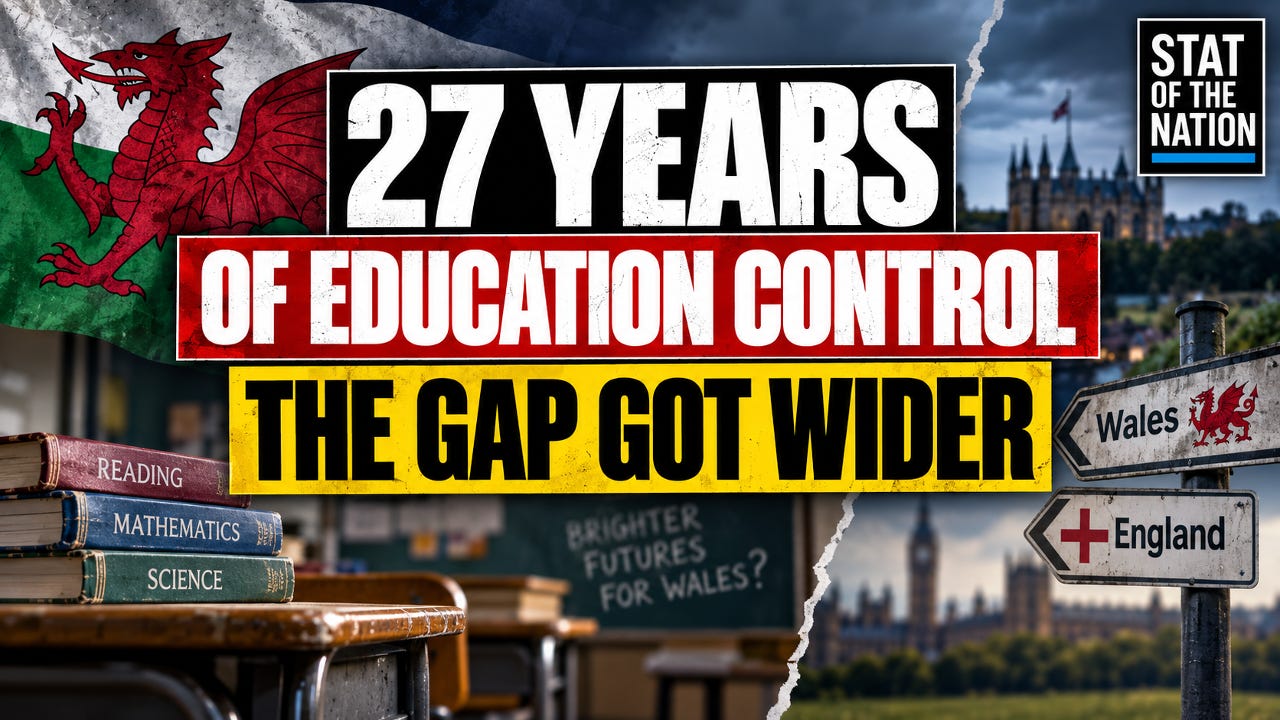
Education has been devolved in Wales since 1999.
That gave Wales the freedom to make different choices from England — on assessment, qualifications, accountability and ultimately the curriculum itself.
But there is another important fact when judging what followed.
From the creation of devolution in 1999 until May this year, every Welsh Government was Labour-led.
Different coalition and governing arrangements came and went, but Labour remained the constant at the centre of government until the change of administration in May 2026.
So when we ask what 27 years of devolved education has delivered, we also have to ask what 27 years of Labour-led government has delivered.
And the numbers are difficult to defend.
The Gap With England Has Widened Sharply
We cannot compare PISA all the way back to the start of devolution because Wales first participated separately in 2006.
PISA is the OECD’s international assessment of 15-year-olds, testing how well pupils can apply their knowledge in maths, reading and science.
What has happened since Wales first took part separately is striking.
In 2006, Wales was already behind England — but the gaps were relatively small.
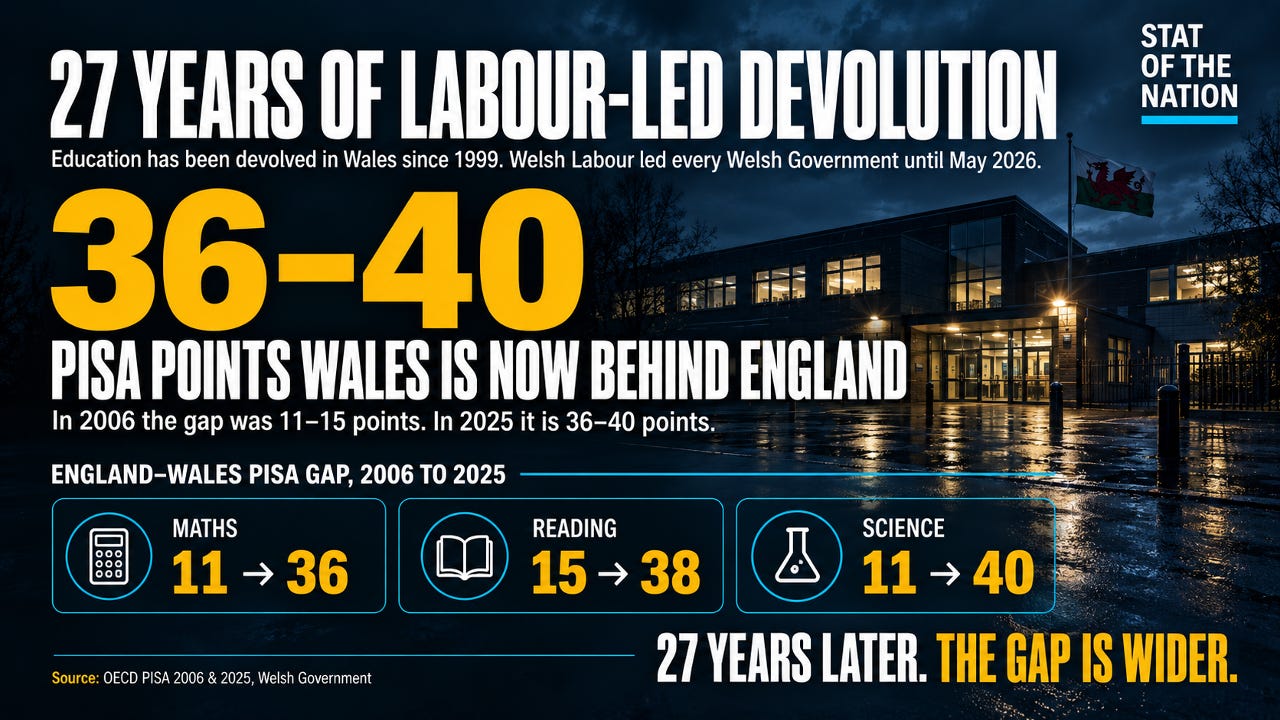
England was:
11 points ahead in maths
15 points ahead in reading
11 points ahead in science
By 2025, those gaps had become:
36 points in maths
38 points in reading
40 points in science
That is the key statistic in this story.
The two education systems have not moved closer together.
They have moved much further apart.
That does not prove that devolution itself caused poorer educational outcomes. There are plenty of other factors at play — deprivation, attendance, demographics, funding and the disruption caused by Covid.
But devolution gave Wales responsibility for education policy.
And for almost all of that period, that responsibility sat with a Labour-led Welsh Government.
Responsibility has to mean accountability for the results as well as credit for the successes.
Wales Is Bottom of the UK
The latest PISA results make the current position even clearer.
Around 3,400 pupils from 113 Welsh schools took part in the 2025 assessment.
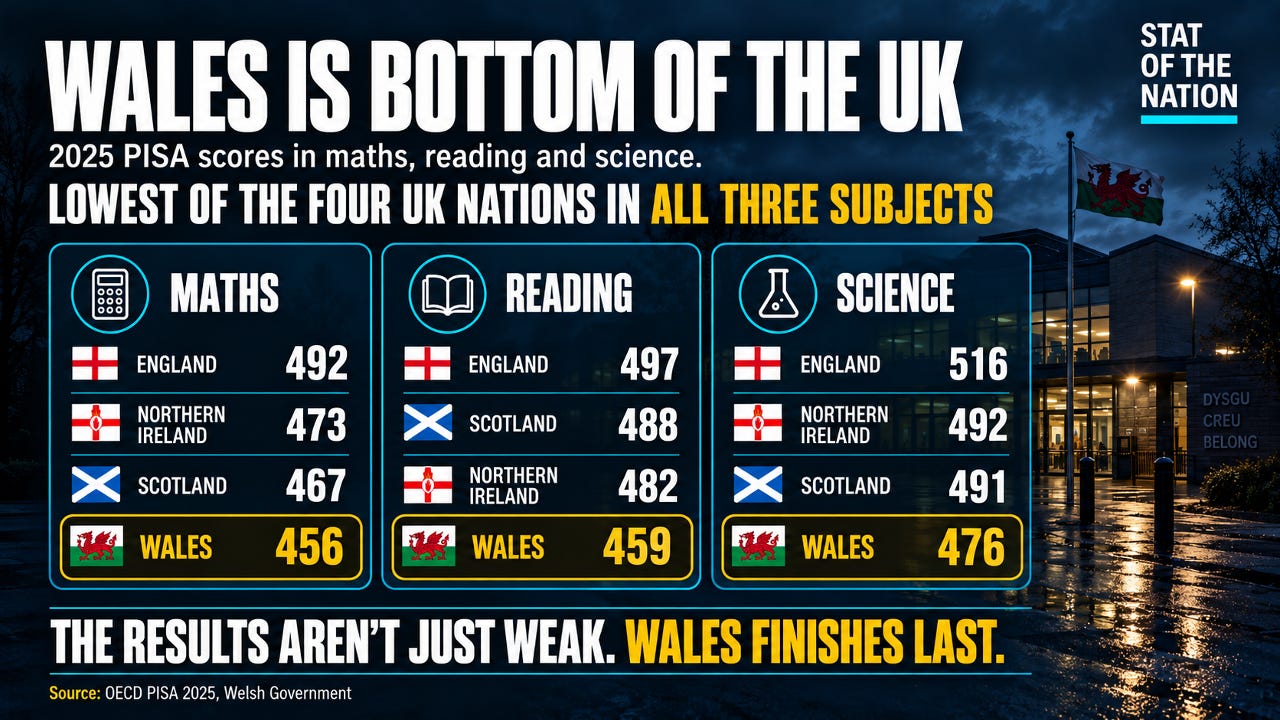
And Wales recorded the lowest average score of the four UK nations in all three subjects.
In maths, Wales scored 456, compared with 492 in England.
In reading, Wales scored 459, compared with 497 in England.
And in science, Wales scored 476, compared with 516 in England.
It wasn’t simply England outperforming Wales either.
Wales finished behind England, Scotland and Northern Ireland in maths, reading and science.
The longer-term Welsh trend is not encouraging either.
Compared with 2018:
Mathematics has fallen from 487 to 456
Reading has fallen from 483 to 459
Science has fallen from 488 to 476
But for me, the bigger story is not simply that Welsh scores have fallen.
It is that after decades of controlling its own education system, Wales has fallen considerably further behind England.
Labour Had the Time — And the Power
This is where political accountability matters.
Welsh Labour did not briefly inherit the education system before these results.
It led the government of Wales for nearly 27 years.
There were periods of coalition and cooperation with other parties. Between 2016 and 2021, for example, Liberal Democrat Kirsty Williams served as Education Minister within a Labour-led administration.
But that does not change the wider picture.
From 1999 until May 2026, Welsh Labour was the continuous governing force.
If a party wants the credit for the choices made under devolution, it also has to accept scrutiny when the outcomes are poor.
And education was one of the biggest areas where Wales chose to diverge.
Wales Chose a Different Path
Welsh governments changed large parts of the education system.
SATs at Key Stages 1, 2 and 3 were ended. Wales moved away from publishing school-level performance used for league tables, introduced the Foundation Phase, created the Welsh Baccalaureate, developed a separate qualifications system and, most recently, introduced the Curriculum for Wales.
That is exactly what devolution was supposed to allow.
Wales was free to try something different.
But eventually different has to be judged against better.
And after more than a quarter of a century, where is the evidence that the different approach delivered better educational outcomes?
Reform After Reform — But Where Are the Results?
Poor educational performance in Wales is not a new discovery.
After the 2009 PISA results, then-Education Minister Leighton Andrews described them as a “wake-up call” and evidence of “systemic failure.”
That was followed by further reform — a renewed focus on literacy and numeracy, changes to accountability and a new regional school-improvement system.
The OECD was brought in to advise Wales.
Further reforms followed, including another major overhaul of the curriculum.
So this is not a story about governments doing nothing.
Wales has had repeated strategies, repeated reforms and repeated attempts to raise standards.
The question is whether they worked.
And on this internationally comparable measure, the gap with England is wider now than when the Welsh PISA series began.
What About Covid?
Covid clearly matters.
Educational attainment fell across much of the developed world after the pandemic, and Wales was no exception.
There had also been some encouraging progress before it. Wales improved across all three PISA subjects between 2015 and 2018 before falling sharply in 2022.
But Covid cannot explain the whole story.
By 2018, before the pandemic, England was already:
17 points ahead in maths
22 points ahead in reading
19 points ahead in science
Those gaps have since widened further.
England experienced Covid too. So did Scotland and Northern Ireland.
The pandemic is part of the explanation.
It does not explain why the long-term gap between Wales and England has become so much wider.
The New Government Cannot Be Blamed for These Results
There is one political distinction that matters.
The current Welsh Government only took office after the May 2026 Senedd election.
The PISA assessments were taken in 2025.
So these results plainly cannot be blamed on a government that had not yet taken office.
Nor are they a definitive judgement on the new Curriculum for Wales. The pupils tested had not been educated throughout under that curriculum, so future PISA rounds will provide a better test of whether the latest reforms improve performance.
PISA is not perfect either.
No single measure tells you everything about an education system.
But it is particularly useful here because England, Wales, Scotland and Northern Ireland increasingly operate different education systems.
PISA gives us a common international benchmark.
And on that benchmark, Wales now records the lowest scores in the UK in maths, reading and science.
More importantly, these results give us something else:
a final international benchmark of the education system inherited after nearly 27 years of Labour-led government.
And that record deserves serious scrutiny.
So What Did 27 Years Deliver?
Devolution allowed Wales to build its own education system.
Labour had almost 27 years leading the Welsh Government in which to shape that system.
It had the time.
It had the power.
And it repeatedly argued that doing things differently would deliver better outcomes for Wales.
So look at the results.
When Wales first appears separately in the comparable PISA series in 2006, it was 11 to 15 points behind England across maths, reading and science.
Today it is 36 to 40 points behind.
That is not proof that every policy pursued by Welsh Labour caused those results.
But after nearly three decades in charge, political accountability cannot simply be passed somewhere else.
Welsh Labour led the government. Welsh Labour oversaw the system. And this is the education record it left behind.
Devolution gave Wales the freedom to do things differently.
After 27 years, the gap with England is considerably wider than it was.
So the question is no longer simply whether Wales did things differently.
It is why, after nearly three decades of Labour-led government, different did not deliver better.
✍️ Jamie Jenkins
Stats Jamie | Stats, Facts & Opinions
If you found this analysis useful, please share it and subscribe for more.
📲 Follow me here for more daily updates:
Thanks for detailed and speedy response. Makes your excellent post even more concerning.
Very interesting, would be good to know what the ££ per pupil was in each of the UK areas, if the Welsh were under funded could explain help the abysmal results?