


Welsh independence has suddenly become much more than a campaign on the fringes of Welsh politics.
For the first time, Wales has a First Minister from a party committed to independence. On Saturday, Rhun ap Iorwerth told thousands of supporters at a march in Aberystwyth that Wales was on a constitutional journey with “no turning back”. Around 8,000 people were estimated to have attended.
So put the flags and speeches to one side for a moment. What do the numbers actually tell us?
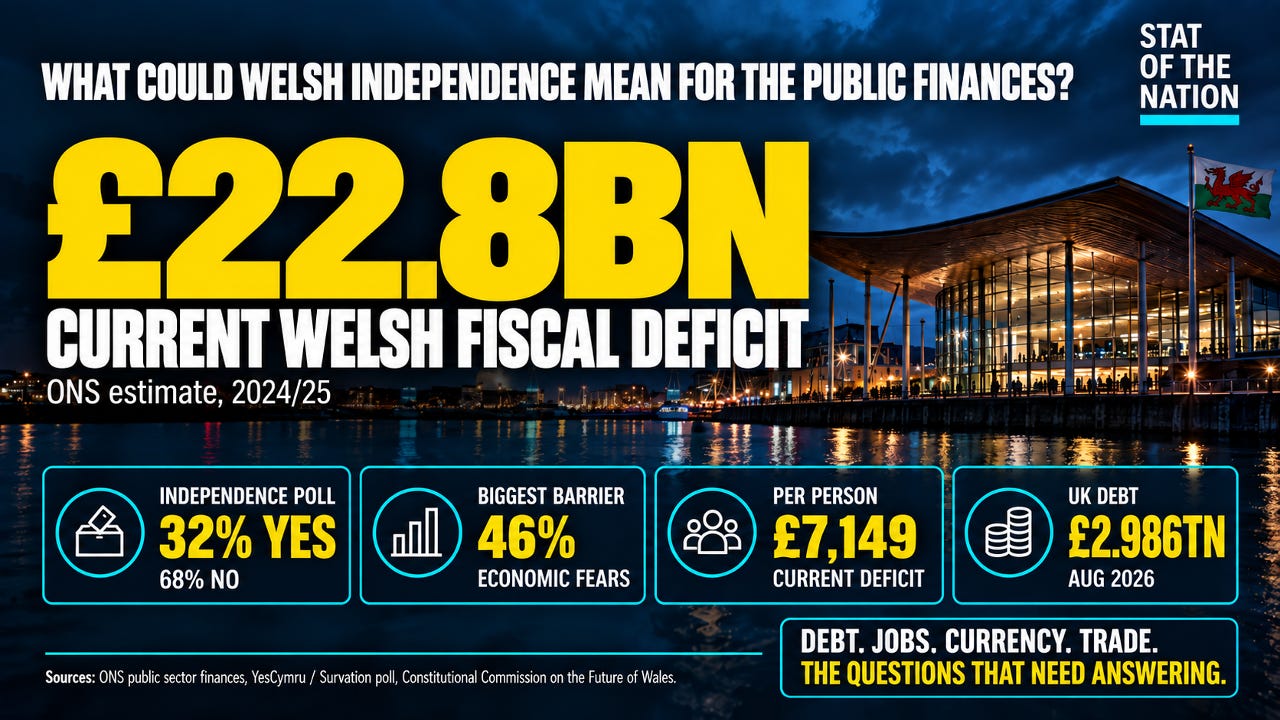
Four immediately stand out:
32% Yes
68% No
46% say economic fears are the biggest barrier
£22.8 billion current Welsh fiscal deficit
That last number helps explain why the third matters so much.
What Does Wales Actually Think?
The latest Survation poll was commissioned by YesCymru, which is worth making clear upfront. Among likely voters, after undecided and refused responses were removed, 32% said they would vote Yes to independence and 68% said No.
YesCymru also highlighted a separate question where 54% placed themselves at five or above on a zero-to-ten independence scale. But 20% chose exactly five, the midpoint, while only 34% chose six to ten. That is rather different from saying 54% would vote for independence.
For me, the more interesting finding is what people said was holding independence back. Some 46% identified economic fears as the biggest barrier, compared with just 5% who chose British identity and 5% who cited public opposition or a lack of desire for independence.
So let’s look at the economics.
The £22.8 Billion Question
The latest Office for National Statistics figures cover the 2024/25 financial year and estimate public-sector revenues, expenditure and the resulting fiscal balance across the countries and regions of the UK.
For Wales, the net fiscal balance was a deficit of £22.781 billion.
That’s around £22.8 billion in a single year, equivalent to £7,149 for every person in Wales.
These figures aren’t simply comparing Welsh Government spending with the relatively small number of taxes devolved to Cardiff Bay. The ONS exercise allocates public revenues, including centrally collected taxes, and public expenditure across each country and region.
In simple terms, considerably more public spending is currently attributed to Wales than revenue.
That is a pretty important starting point.
Would Independence Inherit That £22.8 Billion?
Not exactly. The £22.8 billion describes Wales’s fiscal position within the United Kingdom today, rather than being an ONS forecast of what the finances of an independent Wales would look like.
Taxes could change, spending could change and economic performance could change. There would also need to be negotiations around pensions, defence, currency, debt and how spending currently undertaken at UK level was treated.
But the current fiscal position still matters. The Independent Commission on the Constitutional Future of Wales concluded there would be a significant fiscal challenge, with the inherited deficit requiring hard choices in the short to medium term. It also pointed to Wales’s low-wage, low-productivity economy as an important reason for relatively low tax revenues.
So the key question is what policies would substantially close that gap between revenue and spending.
Then There Is The Debt, And The Jobs
The annual fiscal position is only part of the picture.
UK public sector net debt stood at £2.986 trillion at the end of August 2026. An independence settlement would therefore have to address what, if any, share of UK sovereign debt was allocated to Wales, alongside the division of assets and decisions around pensions and currency.
There is no agreed formula for doing that. But just to illustrate the scale, dividing today’s debt broadly according to Wales’s share of the UK population would produce a figure of around £137 billion. That isn’t a prediction of what Wales would actually inherit, and assets would have to be considered too, but it shows the size of the numbers that could be involved.
Then there are the jobs.
Wales currently has around 35,000 UK civil servants, more than its population share would suggest. The DVLA employs more than 6,000 people at its Swansea headquarters, the Office for National Statistics has around 3,000 staff in Newport, while Companies House is headquartered in Cardiff.
An independent Wales would obviously need people to take on functions currently carried out by the UK Government. Tax collection, benefits administration, borders, regulation and foreign affairs don’t disappear because the constitutional arrangements change.
But there is another side to that equation. The Welsh constitutional commission said it was likely that Westminster would relocate UK-wide functions currently based in Wales, and concluded that jobs created to manage the functions of a new Welsh state could be balanced by the loss of existing UK Government jobs.
It also highlighted the cost of setting up new institutions. Social Security Scotland, for example, saw projected implementation costs rise from £308 million to £658 million as Scotland built its own capacity to administer devolved benefits.
So independence could create different jobs and institutions in Wales, but it would also mean replacing services currently provided across the UK and potentially losing UK-wide jobs already located here.
Leave the UK, Then Rejoin the EU?
There is another part of Plaid Cymru’s position that deserves scrutiny.
Plaid wants Wales to become independent from the United Kingdom. Its constitution describes its aim as securing “independence for Wales in Europe”, while its current policy says Wales’s interests are best served by returning to full membership of the European Union.
The UK and EU are clearly very different arrangements. The European Union doesn’t operate anything approaching the UK’s shared Treasury, welfare system or level of fiscal transfers.
But it still raises questions that would have to be answered. If the argument is that more decisions affecting Wales should be made in Wales rather than Westminster, which powers would subsequently be exercised jointly through European institutions?
There is also the practical question of Wales’s relationship with the rest of the UK. Independence followed by an application for EU membership would bring questions around trade, regulation, borders and currency into the negotiations.
Those aren’t constitutional footnotes. They could have significant economic consequences.
The Bottom Line
Plaid Cymru now has something the Welsh independence movement has never had before: a Welsh Government led by a party unequivocally committed to independence.
That gives it a much bigger platform from which to make its case. But YesCymru’s own polling currently has 32% saying Yes and 68% saying No, with economic fears comfortably the biggest barrier.
The marches and speeches will continue.
The numbers tell us the questions that still need answering.
✍️ Jamie Jenkins
Stats Jamie | Stats, Facts & Opinions
If you found this analysis useful, please share it and subscribe for more.
📲 Follow me here for more daily updates: