

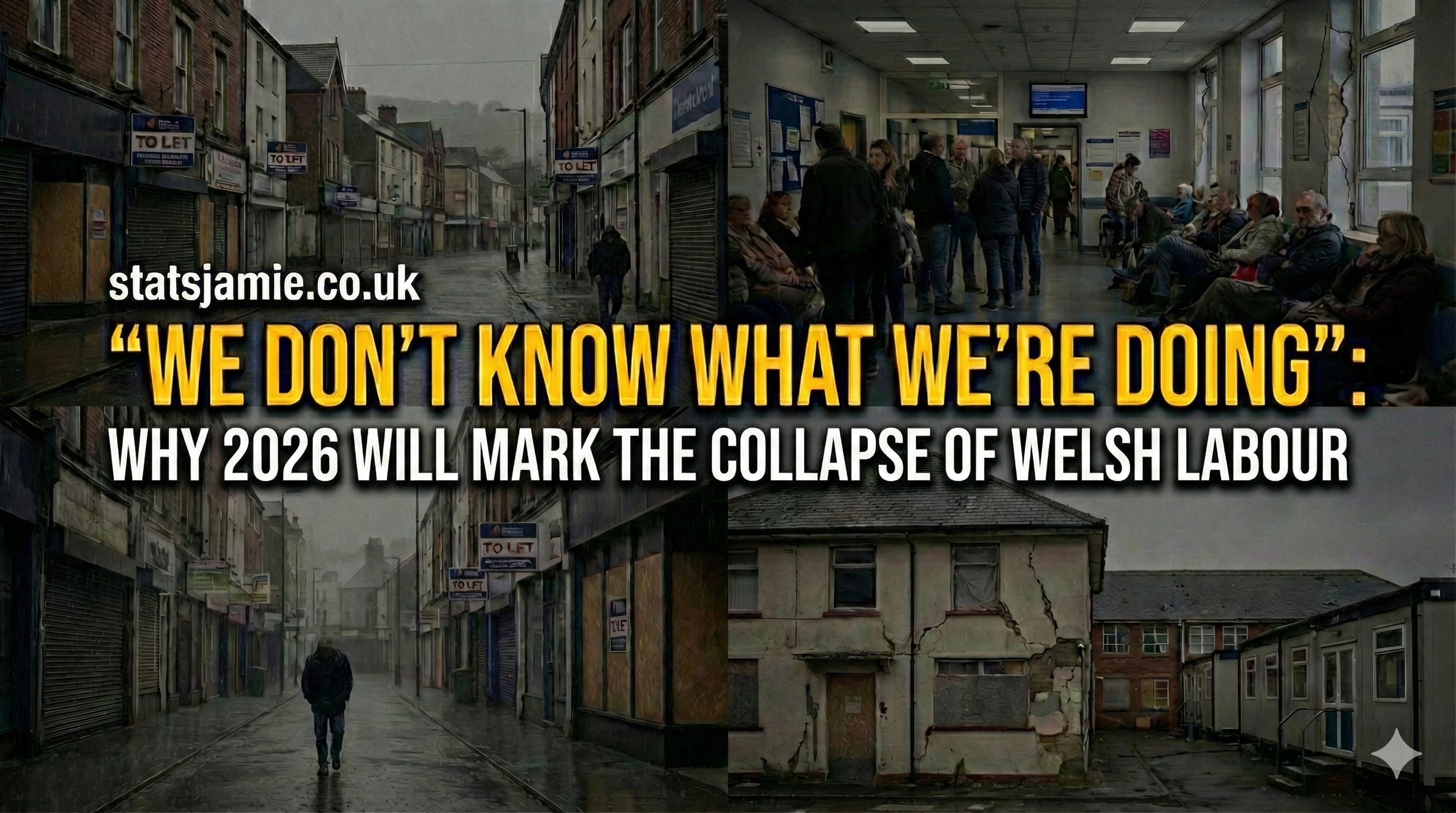
In 2019, Lee Waters, then Welsh Labour’s deputy economy minister, said the quiet part out loud:
“For 20 years we’ve pretended we know what we’re doing on the economy — and the truth is we don’t really know what we’re doing.”
At the time, it was dismissed as a gaffe. In 2026, it reads like an epitaph.
For over a quarter of a century, Welsh Labour has governed Cardiff Bay by default — shielded by a fragmented opposition and a loyalty that, for years, looked unbreakable. But as we enter 2026, the data is pointing in one direction. The inevitable has become the improbable.
Welsh Labour’s era of dominance is ending.
📊 From governing party to fourth place: the numbers
At the 2021 Senedd election, Welsh Labour secured around 40% of the constituency vote, translating into 30 of the 60 seats and control of the Welsh Government.
At the 2024 UK general election, Labour’s vote share in Wales stood at around 37%. That result reflected a Westminster contest shaped by the collapse of Conservative support, tactical voting, and the fact that Plaid Cymru traditionally performs far less strongly at UK general elections than at the Senedd level.
But what matters is what happened next.
Since Labour returned to power, polling has moved sharply against the party. The latest Senedd voting-intention polls now place Welsh Labour at around 10%, behind Plaid Cymru, Reform UK and the Greens. That represents an unprecedented fall from governing party to fourth place — and it has happened after voters had the chance to judge Labour in power at every level.
The Caerphilly by-election in 2025 illustrated the scale of the shift. Labour fell from 46% in 2021 to just 11%, finishing third. There were clearly elements of tactical voting that accelerated Labour’s collapse in that contest — but crucially, Labour has not recovered since. Subsequent polls continue to show the party stuck around the same low-teens level.
One poll does not determine an election. But when every measure points in the same direction, the trend matters.
🏥📚🚗 Delivery failures that broke trust
After a quarter century of devolved control, Welsh voters increasingly judge Labour on outcomes rather than intentions. On several fronts, those outcomes have undermined confidence.
Health remains the most visible example. NHS Wales continues to struggle with long waiting lists and weak performance relative to England, despite health being fully devolved for more than two decades. For many voters, this has become the clearest symbol of a system that has not improved with time.
Education tells a similar story. Wales now sits at the bottom of the UK league tables in international PISA assessments, with declining performance in literacy, numeracy and science. Education was meant to be one of the long-term dividends of devolution. Instead, outcomes have deteriorated.
20mph became the lightning rod. Whatever its intentions, the policy triggered the largest petition in Welsh political history, drew opposition across urban and rural Wales, and came to symbolise a style of government seen as remote and dismissive of public opinion. Importantly, this policy was not unique to Labour alone — it was also supported by Plaid Cymru — reinforcing the sense among many voters that there was little real challenge to the direction of travel in Cardiff Bay.
💷 The economy: when Labour’s own words came back to haunt it
Just last week, First Minister Eluned Morgan acknowledged that her own finance secretary — and former First Minister — Mark Drakeford had an “interest [that] has never been in the economy”, despite now overseeing Wales’ £25bn budget and tax regime.
That admission matters because it reinforces what Welsh Labour has effectively told voters for years: that economic growth was never treated as a central priority.
And this is where it’s worth returning to Lee Waters’ line from 2019. If you govern for decades while admitting you don’t really know what you’re doing on the economy, you shouldn’t be surprised when voters eventually decide to try something else.
🏛️ The UK Labour brand effect
It would also be a mistake to ignore the impact of the wider Labour brand. Welsh Labour no longer operates in isolation from Westminster, and perceptions of the UK Labour leadership increasingly influence how devolved governments are judged.
Since Labour returned to power nationally under Keir Starmer, the party’s brand has become more centralised, managerial and establishment-coded. For some voters — particularly those in traditional Labour heartlands — that has reinforced, rather than offset, concerns about a political class that feels distant from everyday pressures.
The timing matters. Welsh Labour’s polling collapse has come after Labour took power at every level, not before. That has made it harder for the party in Wales to separate its record in Cardiff Bay from the direction of travel in Westminster.
🔁 Where the votes are moving — and the Plaid Cymru reality check
Welsh Labour’s decline has not flowed in one direction — it has fractured.
A significant number of former Labour voters have moved to Reform UK, particularly as Reform’s support established itself in Wales in the run-up to the 2024 general election and has remained a major force since. Labour’s coalition has splintered: different voters are leaving for different reasons, and Labour is paying the price.
Plaid Cymru is polling strongly too, but voters should be clear-eyed about what that does — and doesn’t — represent. Plaid Cymru has repeatedly supported Labour governments in the Senedd through cooperation agreements, budget backing and confidence arrangements. It has helped keep the same model in place — and it backed major policies that triggered public backlash, including the 20mph default speed limit.
For voters who believe Wales needs a decisive break from how it has been governed, that record matters. Changing the label on the door is not the same as changing the model of government inside.
⚠️ The bigger picture: why this matters in 2026
All of this points to one conclusion: 2026 is shaping up to mark the end of Welsh Labour as the dominant party in Wales.
After 26 years in charge, voters are no longer willing to accept the argument that more state intervention, higher spending and progressive regulation are answers in themselves. A politics built around an ever-larger state has not delivered the step-change in living standards, productivity or opportunity that devolution promised.
That lesson matters beyond Wales. Socialism is not the answer — and neither is Plaid Cymru. The threat of Welsh independence would be economic suicide for Wales: higher uncertainty, weaker investment, and a constitutional upheaval that Wales can’t afford. We’ll write more on that as the election campaign ramps up.
Wales needs a model that helps people get on — rewarding work, backing enterprise, lowering burdens where possible, and focusing relentlessly on delivery. After 26 years, the numbers suggest voters have reached their own conclusion. An era is ending — and Welsh politics is on the brink of fundamental change.
✍️ Jamie Jenkins
Stats Jamie | Stats, Facts & Opinions
📢 Call to Action
If this helped cut through the noise, share it and subscribe free at statsjamie.co.uk — get the stats before the spin, straight to your inbox (no algorithms).
📚 If you found this useful, you might also want to read:
Plaid Cymru vs Reform: Welsh Politics Is Entering a New Era

For most of the devolution era, Welsh politics followed a familiar pattern: Labour dominance, opposition parties competing underneath, and outcomes that rarely surprised.
📲 Follow me here for more daily updates:
Plaid Cymru IS a centre - left//left - left party !
If we vote LIEBOUR out in the May Elections and vote in Plaid Cymru we are literally voting Liebour out for ANOTHER Liebour party !
DO THE RIGHT THING !
VOTE REFORM PARTY !
I live in Shropshire close to the Welsh Border. My family still lives in Wales. There was an item in the local newspapers recently saying that the Powis Health Trust was asking English hospitals to delay consultancy and treatment for Welsh patients referred to English Hospitals. There are no large hospitals in Mid Wales so they rely on Shrewsbury Hospital and Hereford Hospital. But wait times are far shorter in these English hospitals than the ones in Wales. Therefore Powis was asking English Hospitals to delay treatment of Welsh People to match those in Wales. This was apparently a money saving policy.