

Last week, the Green Party’s wider direction came into focus with reports of a proposed 55mph speed limit on major roads, alongside higher costs for drivers, fewer parking spaces and tighter restrictions on car use. This week, with the Senedd election approaching, we have had their Wales-specific manifesto: softer in tone, more carefully packaged, and focused on devolved powers. But scratch beneath the surface, and the same instincts are still there. The Welsh pitch is gentler. The agenda is not.
That matters because the Greens are no longer just a fringe protest outfit. YouGov’s first Senedd MRP for ITV Cymru Wales put Plaid Cymru on 43 seats and the Greens on 10, which would be enough for a Plaid-Green majority in the new 96-seat chamber. And at Westminster level, YouGov’s latest voting intention poll has the Greens on 16%, level with Labour. These are no longer background numbers. They point to a party with real political space and, in Wales, a plausible route to influence if Plaid falls short of governing alone.
🚗 A Softer Welsh Mask Over A Harder Agenda
The Welsh manifesto does not explicitly repeat the reported 55mph proposal. But it would be a serious mistake to treat the Welsh document as some fundamentally different project. The instinct is the same: make driving less central, make alternatives politically favoured, and reshape how people travel from the top down.
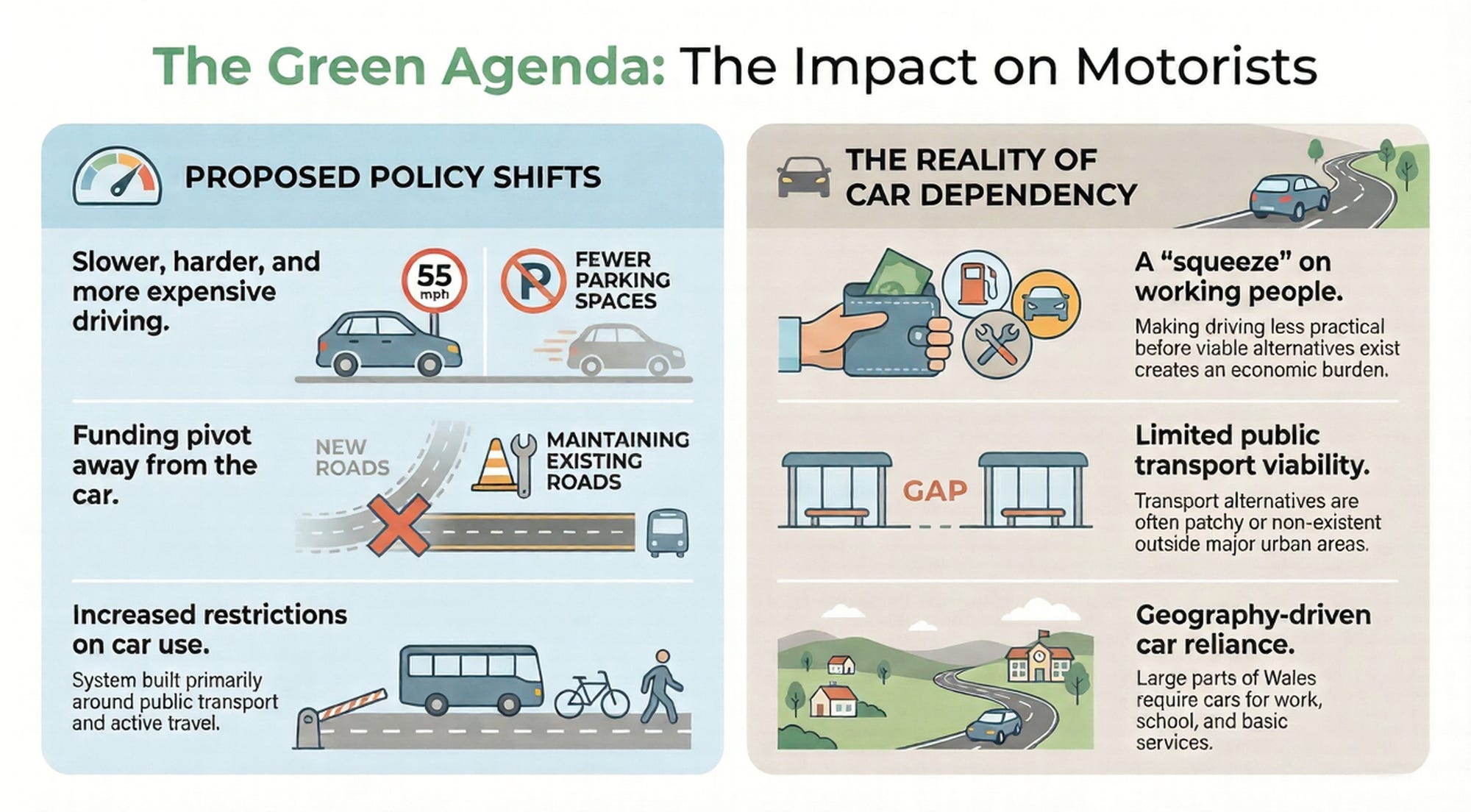
The manifesto promises £1 bus fares, free travel for under-22s, a target to double the proportion of journeys made by walking, wheeling, cycling and public transport by 2030, a requirement that at least 10% of the transport budget be spent on active travel, and a roads policy that says maintaining existing roads must come before building new ones. It also backs community car-sharing and says public subsidy for Cardiff Airport should end by the close of the Senedd term.
On paper, that can be sold as a rebalance. In practice, it reflects the same anti-motorist instinct that surfaced nationally last week. The reported wider package included a 55mph limit on major roads, repeated driving tests every five years, incremental fuel tax rises and steadily reduced parking spaces. You do not need every one of those lines to appear in the Welsh manifesto to see the direction of travel. It is already there.
📉 Wales Still Runs On Cars
This is where Green theory collides with Welsh reality.
Wales is not a compact, metro-based economy where most people can swap a car for a tram, tube or frequent rail service. Large parts of the country still rely on cars every day for commuting, school runs, caring responsibilities, and basic services. Even the Green manifesto admits many communities have been left without reliable alternatives to the car after decades of underinvestment in public transport.
That is not ideology. It is geography.
If you make driving slower, pricier, and less practical before alternatives are properly in place, you do not create a smooth green transition. You create a squeeze on working people. Shift workers in the valleys, parents juggling childcare, carers helping elderly relatives and tradesmen moving between sites are not abstract units in a transport model. They are people whose lives still depend on getting from A to B reliably. Wales cannot be run on a fantasy rail map and a bicycle.
💷 Promise Everything, Cost Nothing
The financial problem is just as serious.
The manifesto promises to scrap council tax and replace it with a land value tax. It promises a one-year rent freeze followed by rent controls. It promises to build 60,000 affordable homes over 10 years, with most of them social housing. It promises £1 bus fares, free travel for under-22s and universal childcare from nine months. It also promises a Green Transformation Fund, a National Green Jobs Plan, more community ownership, more public intervention and a long list of new legal duties, frameworks and programmes.
Some of those promises will sound attractive on first reading. That is the point. But serious politics is not a list of things people would like to have. Serious politics is about trade-offs, constraints and delivery. And that is the hole at the centre of this manifesto.
It is full of things the Greens want to spend, cap, freeze, subsidise, build or regulate. It is much thinner on what gets dropped, where the money comes from, how quickly the Welsh state could realistically deliver it, and what happens when the theory collides with the budget. The document calls for greater Welsh borrowing powers and tax reform, including replacing council tax and business rates with land value-based systems, but that is still a very long way from a credible explanation of how the whole package adds up.
This is the classic Green problem. They promise Scandinavian-style provision with no serious reckoning with the bill.
⚡ Lower Bills, But No Nuclear
The energy section exposes another contradiction.
The Greens say they want to cut bills and drive a rapid low-carbon transition. They want 100% of Wales’s electricity demand to be met by renewable energy by 2035, backed by at least 17GW of renewable generation, including 5GW of solar power and 10GW of battery storage. They also want new homes built with rooftop solar and fossil-free heating, such as heat pumps.
At the same time, the manifesto says plainly that the Green Party opposes nuclear power, including small modular reactors.
That is not a minor detail. It is a serious contradiction. They want more electric heating, more electric transport and more electrification across the economy, but they rule out one of the few firm low-carbon sources that can keep the system stable when renewable output drops. If you want lower bills, higher resilience and less fossil fuel use, taking nuclear off the table makes the challenge harder, not easier. Ambition without realism is not a plan.
🌾 Farmers Backed — Then Buried In Frameworks
The Greens are careful in how they talk about farming. The language is softer than many people might expect. They say farmers must be “properly rewarded”, they promise to simplify some agricultural regulations, and they talk about viability and a just transition.
But the broader direction is still unmistakable: a national land-use framework, national minimum environmental standards, targets on soil, pesticides and pollution, a stronger Sustainable Farming Scheme, more metrics, more strategic direction over how land is used, and a wider shift toward the Green view of how food, climate and nature policy should be integrated.
That may be attractive to policy professionals. It is less obvious that it will be attractive to farmers already dealing with unstable markets, rising costs and constant uncertainty. The Greens say they are backing farmers. Too often, what they are really offering is to manage them.
🏛️ The Bigger Picture
Step back from the individual policies, and a broader pattern appears.
Across transport, housing, energy, food, land and the economy, the answer is almost always the same: more state direction, more regulation, more public bodies, more targets, more frameworks, more intervention. The manifesto talks a lot about fairness, climate and community, but much less about productivity, wealth creation and the basic question of how Wales grows strongly enough to support all the promises being made.
That is why the title fits. This really is war on motorists, fantasy on finance.
On the transport side, the party’s instinct is to make driving less attractive in a country that still depends heavily on the car. On the economic side, it offers a long catalogue of attractive-sounding commitments without anything like the same seriousness on cost, trade-offs or delivery.
📊 Why This Matters Now
For years, it was easy to shrug off Green manifestos as a kind of moral wishlist: interesting in theory, irrelevant in practice. That is no longer good enough.
The latest Senedd polling says Plaid could be the largest party, but still short of a majority. The same projection gives the Greens 10 seats and points to a Plaid-Green arrangement as one plausible route to stable government. Anthony Slaughter has already said collaboration is “in the DNA” of his party and that the Greens are open to negotiations with Plaid Cymru. This is no longer about mocking fringe proposals. It is about looking seriously at what influence these ideas could have if the Greens end up holding the balance of power.
⚠️ The Bottom Line
The Green Party’s Wales manifesto is written in softer language than the national headlines that broke last week. But the underlying worldview is the same. It is suspicious of cars, comfortable with control, hostile to nuclear, heavy on intervention and remarkably relaxed about cost.
That does not make it evil. It does make it unserious.
Wales needs better transport, more homes, cheaper energy and stronger public services. But it also needs realism. It needs a government that understands how people actually live, how the economy actually works and how much policy failure costs when ministers start from ideology rather than reality.
The Greens are offering a vision of Wales that sounds compassionate on paper. In practice, it risks being slower, poorer and more tightly controlled. And if they do end up holding the balance of power in the next Senedd, that will stop being a theory very quickly.
✍️ Jamie Jenkins
Stats Jamie | Stats, Facts & Opinions
📢 Call to Action
If this helped cut through the noise, share it and subscribe for free by entering your email in the box below and get the stats before the spin, straight to your inbox (no algorithms).
📚 If you found this useful, you might also want to read:
The Final Days Of Welsh Labour. Now Plaid And Reform Battle For Wales

For 27 years, Welsh Labour has been the default party of power in Cardiff Bay. But the final FMQs before the May election did not feel like a government closing strongly. They felt like a machine running on fumes.
📲 Follow me here for more daily updates:
The general public don't generally read manifestos, they rely on the media and the wannabe politicians to tell them the plans. So people will hear the nonsense about unicorns and fairy dust and think that all sounds good. In Wales they will no doubt hear the anti Westminster/anti English rhetoric and nod approvingly. They won't think about how any of this would be implemented or how much it would cost. Who is keen to vote for the Green Party? My guess is that it is still students, trustafarians and hippy boomers. Wales has plenty of them - the Escaped From The Rat Race crowd. Do the descendants of miners in the Valleys even bother to vote any more now that nobody represents them or cares what happens to them?
More control! Over the people!