

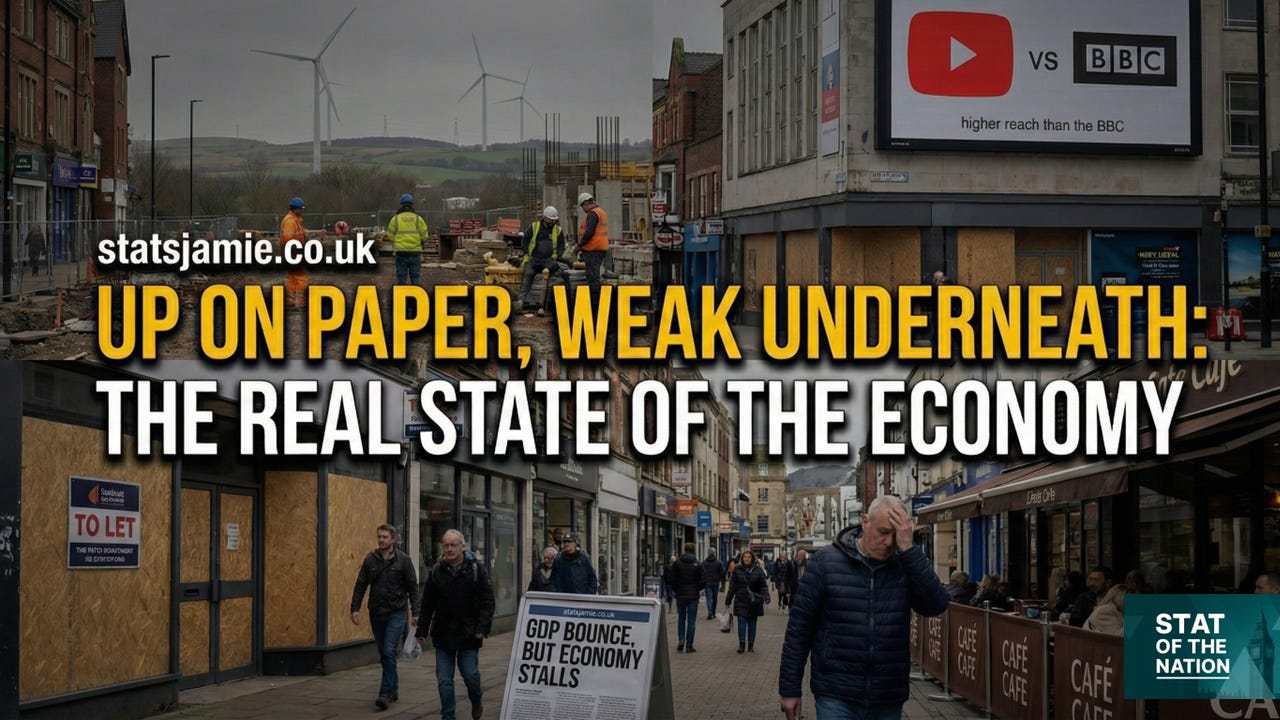
This week on Stat Of The Nation, the headlines tried to sound upbeat — but the underlying picture is still fragile. GDP bounced in November, yet the economy has barely grown since spring, and the sectors people actually feel day-to-day (construction, housing-related activity, hospitality) remain under pressure.
At the same time, the Governor of the Bank of England has warned that net zero policy choices are acting as a headwind against growth — while politically we saw the Digital ID mandate dropped even as the wider system remains in motion, and the BBC licence fee model looks weaker as YouTube overtakes the BBC on reach and the corporation is reportedly preparing “YouTube-first” programmes.
📊 GDP: The Bounce That Doesn’t Feel Like a Recovery
The headline number looks encouraging: GDP rose 0.3% in November after a fall in October.
But zoom out, and the story is still grim. The economy has barely moved for months — GDP is up only ~0.2% since March. That’s not a recovery. That’s stall-speed.
What powered the bounce
This wasn’t a consumer-led surge. The lift came mainly from the office-and-tech economy — professional services and IT/digital activity — sectors that can pick up even while household budgets stay tight.
What’s still dragging
The “everyday economy” remains weak: hospitality fell again, real estate pulled down growth, and construction dropped sharply. That’s why GDP can tick up on paper while many people still feel like nothing is improving.
What the country needs
One decent month doesn’t fix stagnation. The UK needs a steady run of positive figures — month after month — so confidence, investment and hiring can return. Until growth is consistent and broad-based, this is just a bounce.
🌬️ Bailey’s Warning: Climate Policy Is Now a Growth Headwind — And Britain Made It Harder Than It Needed To
Andrew Bailey — the Governor of the Bank of England — has now explicitly put climate policy in the box of growth headwinds, alongside weak productivity, ageing populations and higher defence spending. In his latest speech, he points to “climate-related economic shocks and the consequences of the policies chosen” as one of the forces weighing on growth.
And this is where the political class needs to be called out.
Because Britain’s expensive energy isn’t just “global forces”. It’s the result of choices made by successive governments — and now doubled down on under Ed Miliband:
loading bills with levies and policy costs
making reliable domestic supply harder, slower or politically toxic
pushing electrification (heat pumps, EVs, “all-electric”) while electricity stays structurally pricey
That combination hits living standards first, then industry, then growth — and it helps explain why we can’t generate a steady stream of strong GDP numbers.
Bottom line: net zero is sold as a moral mission — but the economics are real, and households are paying the premium.
📲 Digital ID: The Mandate Is Dropped — But The Machinery Remains
The government's decision to step back from mandatory Digital ID is the right move.
But dropping compulsion doesn’t remove the bigger risk: once the infrastructure exists, mission creep becomes the default setting.
You don’t build a national ID system and then hope nobody expands how it’s used. Today, it’s sold as border control or illegal working. Tomorrow, it’s access to services, housing, benefits, banking, and eventually the quiet creep into everyday life.
Bottom line: Dropping the mandate is a win. Building the machine is the danger.

📺 The BBC vs YouTube: The “TV Tax” Identity Crisis
This week delivered a symbolic turning point: YouTube now reaches more people in the UK than the BBC on BARB’s monthly “reach” measure.
The BBC has pushed back on the methodology — but the direction of travel is the point: audiences are moving to platforms, and YouTube is now a mainstream “TV” destination.
Then came the next twist: reports the BBC is close to a deal where some programmes could premiere first on YouTube, then appear later on iPlayer and BBC Sounds. That’s the licence fee problem in one sentence: a compulsory TV tax funding content that can be watched free on a US tech platform.
This is exactly why I argued the licence fee is running out of road. The BBC needs a new model — subscription, advertising, or a hybrid — and it needs to compete like everyone else.

✅ This week’s takeaway
If there’s one message from this week, it’s that Britain is being asked to believe in “recovery” while the underlying numbers still point to fragility — near-zero growth, rising policy costs, and institutions scrambling to adapt to a country that’s already moved on.
And we’re not done. Coming up this week, we get the latest jobs, inflation and public sector borrowing figures — the real scoreboard for living standards and the state of the public finances. Stick with Stat Of The Nation, and I’ll tell you, in plain English, exactly what’s going on — before the spin merchants get to it.
✍️ Jamie Jenkins
Stats Jamie | Stats, Facts & Opinions
📢 Call to Action
If this helped cut through the noise, share it and subscribe free at statsjamie.co.uk — get the stats before the spin, straight to your inbox (no algorithms).
Thanks for reading Stat of the Nation! Subscribe for free to receive new posts and support my work.
📚 If you found this useful, you might also want to read:

📲 Follow me here for more daily updates:
Thank you. My impression is that only the public sector is growing which makes the growth figures worse. Do you think that's right?