

Keir Starmer says his under-16 social-media ban will give children their childhood back. It may also require millions of adults to prove their age before they can participate online.
That is the unresolved trade-off behind one of the biggest interventions in Britain’s digital life.
From as early as spring 2027, social-media companies will be expected to prevent children under 16 from holding accounts. The government also plans tighter restrictions on livestreaming, stranger contact, gaming services, addictive design features and artificial-intelligence chatbots.
The Prime Minister described the decision as “a huge step for our country” and “a statement of our values”. It is certainly a huge step, but the government still has to prove it is the right one.
The Harms From Social Media Are Real
It would be wrong to dismiss concerns about children and social media as another moral panic. Social-media platforms can bring real benefits, helping young people communicate, learn, create, access support and maintain friendships.
Starmer acknowledged this, saying he would not pretend the ban was “cost-free” or that social media had brought no benefits to young people. But the risks are substantial.
Children can encounter:
Cyberbullying and harassment
Sexual contact and grooming
Violent, sexual or self-harm content
Unrealistic beauty standards
Anonymous contact from adult strangers
Addictive design, excessive use and disrupted sleep
Some algorithms do not merely allow children to find harmful material. They repeatedly recommend it once a young person has shown an interest or vulnerability.
Campaigners and bereaved families deserve to be heard. Esther Ghey, whose daughter Brianna was murdered in 2023, has called for much stronger restrictions after describing how harmful online content intensified Brianna’s mental-health difficulties, eating disorder and self-harm.
The government is therefore responding to a genuine problem. But even among prominent online-safety campaigners, there is no agreement that a blanket ban is the answer.
Ian Russell, whose daughter Molly took her own life after viewing large amounts of harmful material online, opposes the government’s approach. His concern is that excluding under-16s could leave the dangerous digital environment itself largely unchanged.
This is not an argument between people who care about children and people who do not. The disagreement is about how best to protect them.
The Consultation Did Not Clearly Back a Blanket Ban
The government says its policy is supported by “nine in ten parents”. That figure is accurate, but it needs context.
More than 116,000 responses were submitted through open questionnaires, campaign emails and separately commissioned representative panels. Among parents who chose to respond to the open consultation, 91% supported setting the social-media age limit at 16.
However, those respondents were self-selecting. They were not designed to represent every parent in Britain.
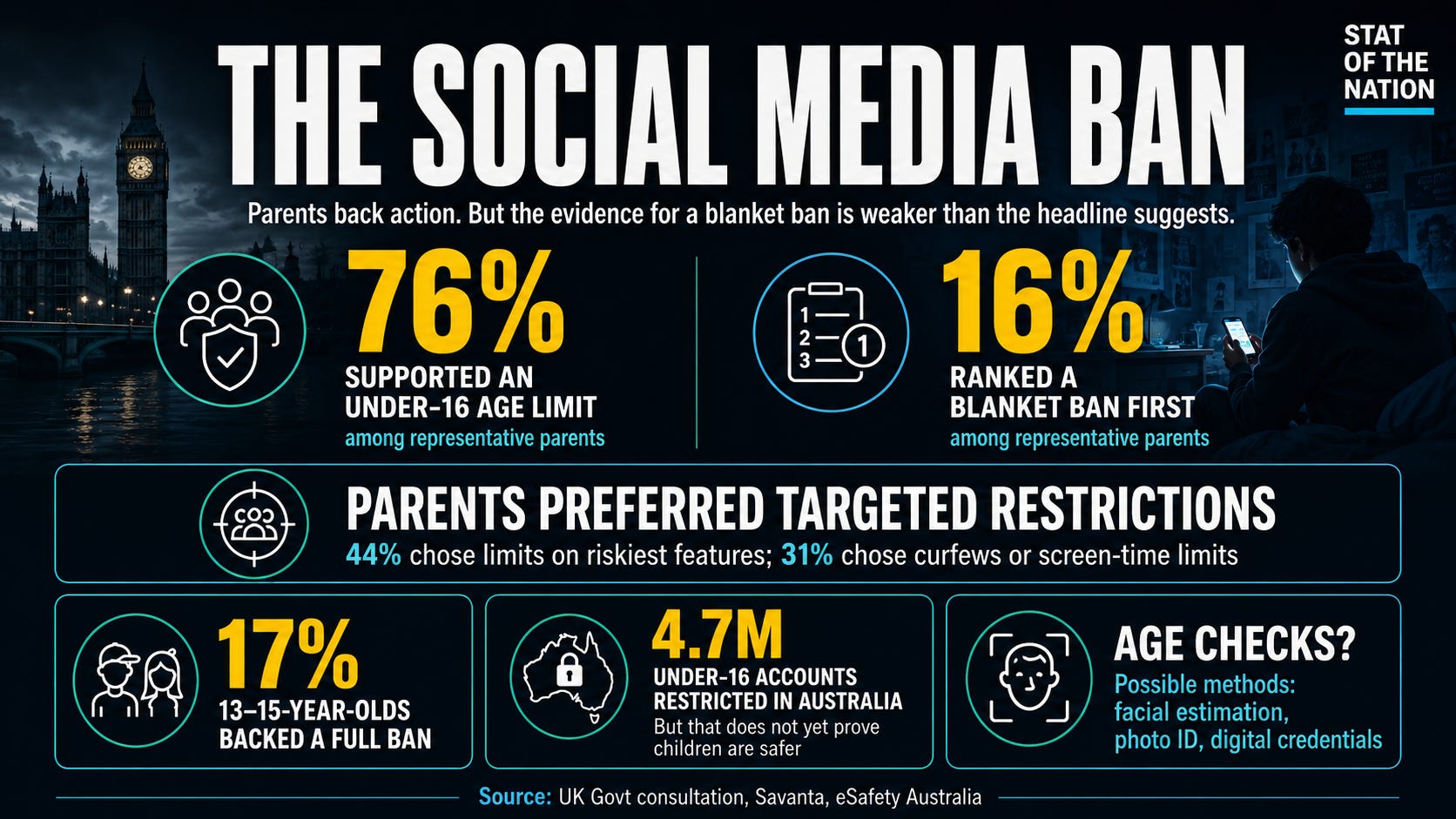
The government therefore commissioned a nationally representative Savanta panel involving more than 5,000 parents. Support for an under-16 age limit was lower, although still substantial, at 76%.
But the more revealing finding came when parents were asked to compare different policy options.
44% put minimum ages on the riskiest functions first
31% preferred curfews or screen-time restrictions
16% chose a complete social-media ban
Parents supported action, but when offered realistic alternatives they were much more likely to favour targeted restrictions than a blanket prohibition.
Young people were more sceptical still. Among the representative panel of people aged 10 to 21, 29% supported banning under-16s from every social-media platform, while 48% preferred allowing access to some platforms but not others. A further 19% supported access to all platforms.
Among those aged 13 to 15—the group most directly affected—only 17% supported the full ban.
The government says two-thirds of young respondents supported preventing under-16s from using “at least some” platforms. But that combines those backing a full ban with those favouring selective restrictions.
It is not evidence that two-thirds support the policy Starmer has announced.
The consultation shows strong support for intervention. It does not show overwhelming support for a blanket ban.
Australia Has Proved Accounts Can Be Removed — Not That Children Are Safer
Britain is drawing heavily on Australia, where social-media age restrictions came into force on 10 December 2025.
Major platforms must take reasonable steps to stop under-16s from creating or retaining accounts. The responsibility falls on companies, rather than children or parents, and that will also be the British approach.
Australia has shown that governments can force platforms to act. Around 4.7 million accounts identified as belonging to under-16s were restricted during the early implementation period.
That is action at scale, but account removals are not the same as proof of improved outcomes.
The number of restricted accounts was much larger than the estimated number of Australian children in the relevant age groups, partly because individuals can hold several accounts. Some teenagers have also retained access, opened replacement accounts or moved towards alternative services.
Starmer accepts that Britain’s ban will not stop every child from logging on. His argument is that teenagers sometimes obtain alcohol, but society does not therefore abandon age restrictions.
That is a fair response to the claim that imperfect enforcement makes legislation pointless. But social media is not one clearly defined product sold across a counter. It covers video, messaging, gaming, educational tools, communities and creative networks.
Australia has had to decide which services fall inside the restrictions and which do not. Britain will face the same problem.
More importantly, Australia has shown that accounts can be removed. It has not yet shown that doing so reduces grooming, bullying, self-harm or poor mental health.
A fall in child accounts is an output. It does not prove that children are safer.
Britain should learn from Australia, not pretend that the experiment has already delivered a definitive verdict.
A Blanket Ban May Target the User, Not the Harm
The deeper problem may not simply be that children under 16 use social media. It may be that the products themselves are unsafe.
Harmful algorithms, stranger contact, livestreaming, addictive design and weak moderation do not disappear when someone turns 16. The government recognises this and plans additional protections for 16 and 17-year-olds.
That raises an obvious question: if the dangerous features are the problem, why is the central policy a blanket ban rather than tougher regulation of those features?
Possible measures could include:
Blocking unsolicited contact from adults
Restricting livestreaming for children
Preventing algorithmic promotion of harmful material
Limiting infinite scrolling and autoplay
Requiring safer default settings
Those measures target the mechanisms creating the risk. A blanket ban targets the user.
If the products remain unchanged, the same harmful environment may simply be waiting when children turn 16. There is also a risk that young people move towards gaming chats, anonymous forums, smaller platforms or services with weaker moderation.
A ban may provide political clarity, but it does not necessarily solve the underlying problem.
Enforcing the Ban Could Mean Age Checks for Every Adult
The most controversial part of the policy may not be the age limit itself. It is how the age limit will be enforced.
To stop every child under 16 from opening or retaining an account, platforms must determine which users are children. In practice, that means checking adults too.
It is not enough to ask users to enter a date of birth. Children have bypassed those checks for years.
Existing Ofcom guidance identifies several possible forms of effective age assurance:
Facial-age estimation
Matching a photograph against official identification
Mobile-network checks
Open-banking or credit-reference checks
Reusable digital-identity services
The government has not announced that its own digital ID will be compulsory for accessing social media. That distinction matters.
There is not enough evidence to claim Starmer is deliberately using the ban to force digital ID on every internet user. But the risk of mission creep is real.
The government is separately developing a national digital-identity system that will allow people to prove characteristics including their age and residency status. At the same time, it is introducing a policy that will require age verification on a vast scale.
A supposedly optional digital credential could become the easiest route, then the expected route, and eventually the only practical route.
Australia has built in an important safeguard. Platforms there cannot force users to provide government-issued identification or use an accredited digital ID as their only means of proving age. Alternative methods must be available.
Britain should make the same guarantee explicit. No adult should be forced to provide a passport, driving licence or government digital ID merely to read political commentary, watch lawful videos or participate in public debate.
Ministers must also answer some basic questions:
Will every adult have to complete an age check?
Who will process and store the data?
Will platforms receive only an over-16 confirmation?
Will government digital ID always remain optional?
What happens when the technology gets someone’s age wrong?
What protections apply after a data breach?
These are not fringe concerns. Age-assurance companies could become custodians of people’s faces, identity documents and verified personal details.
A policy aimed at protecting children should not quietly create routine identity checks for every adult online.
A Major Policy That Still Has To Be Proven
Starmer described the ban as “a huge step for our country”, “a statement of our values” and part of a cultural transformation in how children grow up.
Those are not descriptions of a minor technical regulation. This is a nationwide restriction affecting millions of children and parents, requiring major changes from technology companies and new age-verification systems.
Yet Labour did not explicitly put this policy in its 2024 election manifesto.
The manifesto promised to build on the Online Safety Act and explore further protections for children. It did not promise to prevent every under-16 from holding a social-media account.
Governments must respond to new evidence, but a policy of this scale deserves full parliamentary scrutiny rather than treatment as a routine extension of existing law.
The government is right to confront the damage that can occur online. Parents should not be left to fight some of the largest technology companies in the world on their own.
Platforms have been allowed to design addictive products, recommend damaging material and expose children to strangers while insisting responsibility lies primarily with families. That cannot continue.
But the government has not shown that a blanket ban will work better than targeted restrictions on harmful features.
Its consultation found strong support for action, but parents preferred restrictions on risky functions and excessive use when asked to rank actual policies. Australia has shown that governments can remove millions of accounts, but it has not yet proved that doing so makes children happier, safer or healthier.
Nor has Britain explained how adults will prove their age without normalising identity checks across the internet.
The harms are real, and the platforms have failed children. But the government still has to prove that its chosen solution will work.
Protecting children should not become a blank cheque for poorly tested restrictions, routine identity checks or major social change without proper democratic scrutiny.
Starmer calls this a huge step for the country. He is right.
That is exactly why Parliament and the public deserve more than a powerful headline. They deserve evidence that the policy will make children safer without quietly changing the online freedoms of everyone else.
✍️ Jamie Jenkins
Stats Jamie | Stats, Facts & Opinions
📢 Call to Action
If this helped cut through the noise, share it and subscribe free by entering your email in the box below and get the stats before the spin, straight to your inbox (no algorithms).
📲 Follow me here for more daily updates:
This is how they bring in Digital ID. I still believe this is his job to ensure this happens,
"A statement of our values"
One of Starmer's many naff statements which he likes to make absolutely clear at all times.
Except mostly they are not a statement of our values. Or even his (he appears to change his values more than he changes his shirts). This is merely something that all western governments intend implementing. It's not actually about children. It's about adults holding "the wrong opinions". Every teen with a brain will simply use a VPN. Which is what every adult with a brain will do. Which means Starmer will have pushed kids into totally uncontrollable waters whilst making certain tech companies even richer and ensuring him and his cohorts have no idea what people are saying. Starlink will, presumably, simply expand its coverage of everything. If parents don't want their 10 year olds using social media they don't have to give them the means of doing so - parental choice and parental control and parental responsibilities. Nothing to do with governments.