

The latest ONS workless household tables should set alarm bells ringing.
For this analysis, I have excluded student households throughout. That gives a cleaner picture of worklessness among non-student working-age households, rather than counting young people who may simply be studying before entering the labour market.
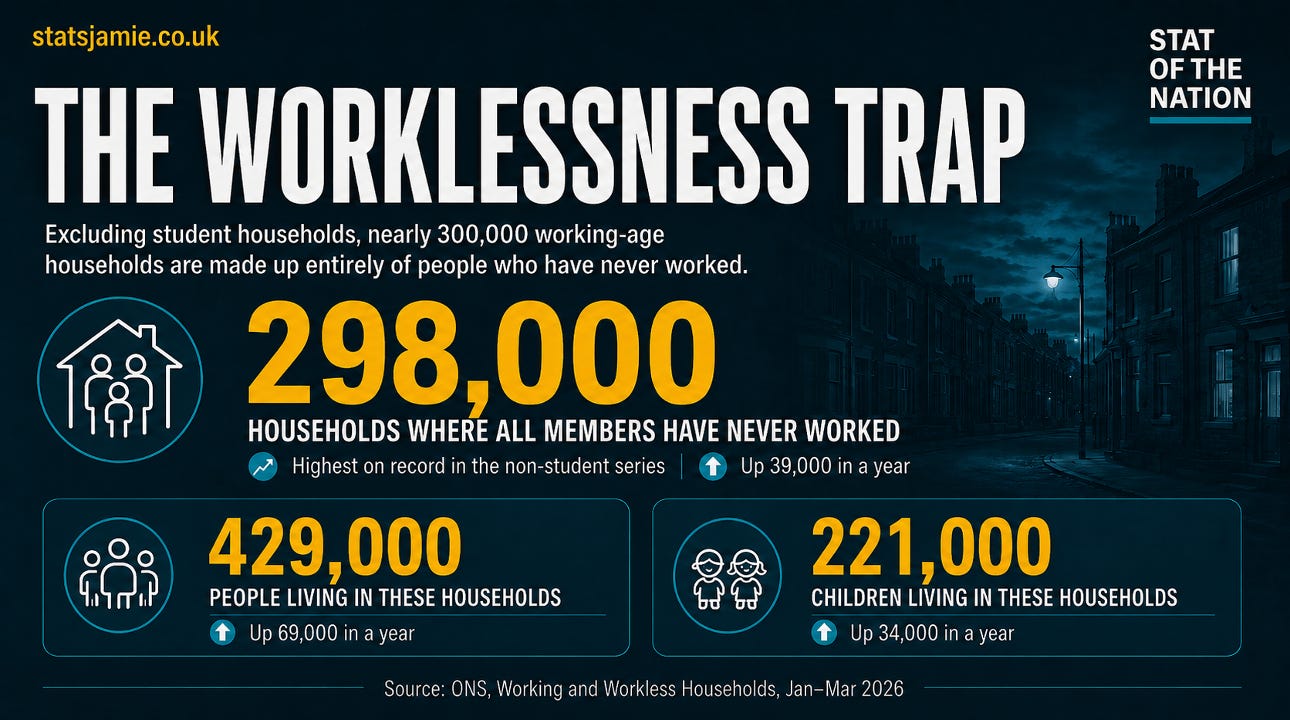
On that basis, 298,000 working-age households are now made up entirely of people who have never worked — up 39,000 in a year and the highest level on record in the non-student series.
But this is not just a household count. It is people.
Those households contain around 429,000 people, excluding student households — up 69,000 in a year.
Let that sink in. Nearly 300,000 households. Around 429,000 people. Not students. Not people between jobs. Not a temporary blip.
Households where work has never been present.
That is not just an economic warning light. It is a national one.
Worklessness Is Bigger Than Unemployment
Politicians like talking about unemployment because it sounds manageable. Someone does not have a job, but they are looking for one.
Worklessness is much deeper.
Even excluding student households, there are around 3.1 million working-age households where nobody is in work. These are homes where employment is absent altogether. Some will include people who have worked before. Some may include people who genuinely want to work. Others will include people facing real barriers such as sickness, disability, caring responsibilities or poor skills.
But the wider picture is impossible to ignore: millions of households have no adult in employment.
This is why the standard unemployment rate no longer tells the full story. It only counts people actively looking for work. It does not tell us whether work exists inside the household. It does not tell us whether children are growing up seeing adults leave the house to earn a living. It does not tell us whether whole households have drifted outside the labour market altogether.
And that is the real problem. Britain does not just need more jobs. It needs to rebuild the route into work.
Why This Should Worry Us
Workless households matter for three reasons.
First, they increase pressure on the taxpayer. When fewer adults are in work, fewer people are paying into the system and more people are likely to need support from it. That is not sustainable.
Second, they weaken growth. Britain cannot build a strong economy while millions of working-age households are outside employment.
Third, they shape what children grow up thinking is normal. A household where nobody works is not just a household with lower income. It is a household where the routines, networks and expectations that come with employment may be missing.
That does not mean everyone in a workless household is to blame. Some people are genuinely too sick to work. Some are disabled. Some are caring for others. Some face barriers that cannot be fixed with a slogan.
But it does mean we should stop pretending worklessness is just another category in an ONS table.
If work is absent from the household, it can become absent from expectations too. And once that happens, the problem becomes much harder to reverse.
That is why the nearly 300,000 non-student households where nobody has ever worked should worry us. It is not just about today’s welfare bill. It is about whether Britain still has a culture that expects, rewards and supports work.
The Real Story Is Inactivity
The most important point in the tables is that this is not mainly an unemployment story.
Of the roughly 3.08 million workless non-student households, around 2.55 million are households where all adults are economically inactive. That means they are not in work, not counted as unemployed, and not actively looking for a job.
That distinction matters.
If someone is unemployed, they are still attached to the labour market. They are looking for work. They may need vacancies, training, confidence, childcare, transport, or a better route into employment.
Economic inactivity is harder. It means people have moved outside the labour market altogether. They may be sick, disabled, caring for family, retired early, lacking skills, lacking confidence, or trapped in a system where work does not feel worthwhile.
This is why “creating jobs” is not enough. Jobs matter, but they do not solve the problem if millions of people are not even looking for one.
The real question is tougher: how do you reconnect people to work when the system has allowed whole households to drift away from it?
The 50 To 64 Problem
The age breakdown changes the story.
When people think about worklessness, they often think about young people. And yes, Britain has a serious youth problem, with more than 1 million 16 to 24-year-olds not in education, employment or training.
But among working-age people living in workless non-student households, the largest group is not the young.
It is older working-age adults.
Around 2.0 million people aged 50 to 64 live in workless non-student households. That is almost half of all working-age people living in these households.
These are people approaching retirement age, but not yet at state pension age. If they leave the labour market early and never return, the consequences are huge: lower tax receipts, higher welfare pressure, reduced household income, and a smaller workforce supporting an ageing population.
The wider labour market data helps explain what is going on. Among economically inactive people aged 50 to 64, the most common reason for inactivity is being sick, injured or disabled, accounting for around 44.7% of economically inactive people in this age group. A further 29.2% say they are retired, 13.8% are looking after home or family, and 12.2% give other reasons.
So this is not simply about people refusing available jobs. It is a mix of ill health, disability, early retirement, caring responsibilities and long-term detachment from work.
That makes the policy challenge much harder. You cannot solve this by pointing at vacancies. You need to ask why people left work, whether they can return, whether the NHS is helping people recover, whether employers are willing to hire older workers, and whether the welfare system supports people back into work or quietly parks them outside it.
Children Are Growing Up Where Work Is Absent
The most worrying part of this story is not just the adults. It is the children.
Excluding student households, around 1.51 million children live in households where nobody works. That is up nearly 78,000 in a year.
Around 1.23 million children live in households where all adults are economically inactive.
And there is an even sharper figure: around 221,000 children live in households where all members have never worked. That is up 34,00 in a year.
These numbers should cut through the political noise.
Children do not just grow up around income levels. They grow up around examples. They absorb routines, expectations and assumptions about adult life.
A child who grows up in a home where work is part of everyday life sees something very different from a child growing up in a home where no adult works.
That does not mean every child in a workless household is destined to repeat the pattern. People can and do break cycles.
But it does mean worklessness is not just an economic issue. It becomes a generational issue.
If work disappears from the household, it can disappear from expectations too
Britain Needs A Work Strategy
This is where the politics becomes unavoidable.
Britain cannot talk seriously about growth while millions of working-age households remain detached from employment.
Labour talks about growth, but you cannot tax your way to prosperity if too many people are outside the labour market. You cannot keep raising the cost of hiring and then wonder why people on the margins struggle to get a foot on the ladder.
Rachel Reeves’ jobs tax makes hiring more expensive. That is the last thing Britain needs when the country already has millions outside employment.
A serious growth strategy has to be a work strategy.
That means helping people with long-term sickness or disability return to work where possible. It means supporting older workers aged 50 to 64 before they drift permanently out of the labour market. It means making childcare and flexible work realistic for parents who face barriers to work. It means fixing the school-to-work pipeline for young people. It means ensuring welfare supports movement into work rather than trapping people outside it. And it means making entry-level hiring easier, not harder.
This is not about pretending everyone can work. Some people genuinely cannot.
But it is also not compassionate to ignore large-scale detachment from the labour market and call it normal.
A country that rewards idleness more than effort will not grow stronger. A country that taxes work, punishes hiring, and expands dependency should not be surprised when work disappears from too many households.
Work matters. Not just for the Treasury, GDP, or politicians chasing growth forecasts. Work matters because it gives people structure, income, purpose, independence and a stake in society.
Conclusion
Britain’s worklessness crisis is deeper than the headline unemployment rate.
Nearly 300,000 non-student working-age households are made up entirely of people who have never worked — the highest level on record in the non-student series. More than 3 million non-student working-age households have nobody in work. Around 1.5 million children live in workless households. And almost half of working-age people living in workless non-student households are aged 50 to 64.
This is not just unemployment. It is inactivity, long-term detachment from work, and in some households, work never having been present at all.
That should be a national alarm bell.
Because if work disappears from the household, it can disappear from expectations too.
And once that happens, the cost is not just economic. It is generational.
✍️ Jamie Jenkins
Stats Jamie | Stats, Facts & Opinions
📢 Call to Action
If this helped cut through the noise, share it and subscribe free by entering your email in the box below and get the stats before the spin, straight to your inbox (no algorithms).
📚 If you found this useful, you might also want to read:

📲 Follow me here for more daily updates:
I live just over the border in Powys. It's a jobs void for the young. Fortunately we've relations in England. My daughter leaves today. It would be interesting to, if you break out the data for Wales, the unemployment rate, the GDP per person, and the Growth rate, for Wales over the 1st quarter of the 21st century. Not good reading I suspect.
Great work as always Jamie do you have a breakdown of the ethnicity of the 300,000 households ?