

Britain is paying more and more for public services that too often feel like they are delivering less.
Higher taxes. Bigger budgets. More spending. Yet the public still faces NHS backlogs, council services under pressure, schools struggling with staffing, policing failures, and a state that too often feels slow, expensive and unaccountable.
The latest figures from the Office for National Statistics add another piece to that puzzle. Across the UK labour market, 148.8 million working days were lost because of sickness or injury in 2025. That works out at 4.4 days lost per worker.
But the real divide is between the public and private sector.
The sickness absence rate was 2.9% for public sector employees, compared with 1.7% for private sector workers. The public sector sickness absence rate has been higher than the private sector for every year on record.
That does not explain every failure in Britain’s public services. But it helps explain something the public can feel: why more money does not always turn into better delivery.
The Public Sector Sickness Gap
The public sector sickness gap is not a small statistical footnote.
It is a delivery problem.
If hospitals are short-staffed, patients wait longer. If schools are short-staffed, children lose consistency. If councils are short-staffed, services get slower. If government departments are short-staffed or badly managed, the public gets delays, excuses and failure.
And taxpayers are left paying the bill.
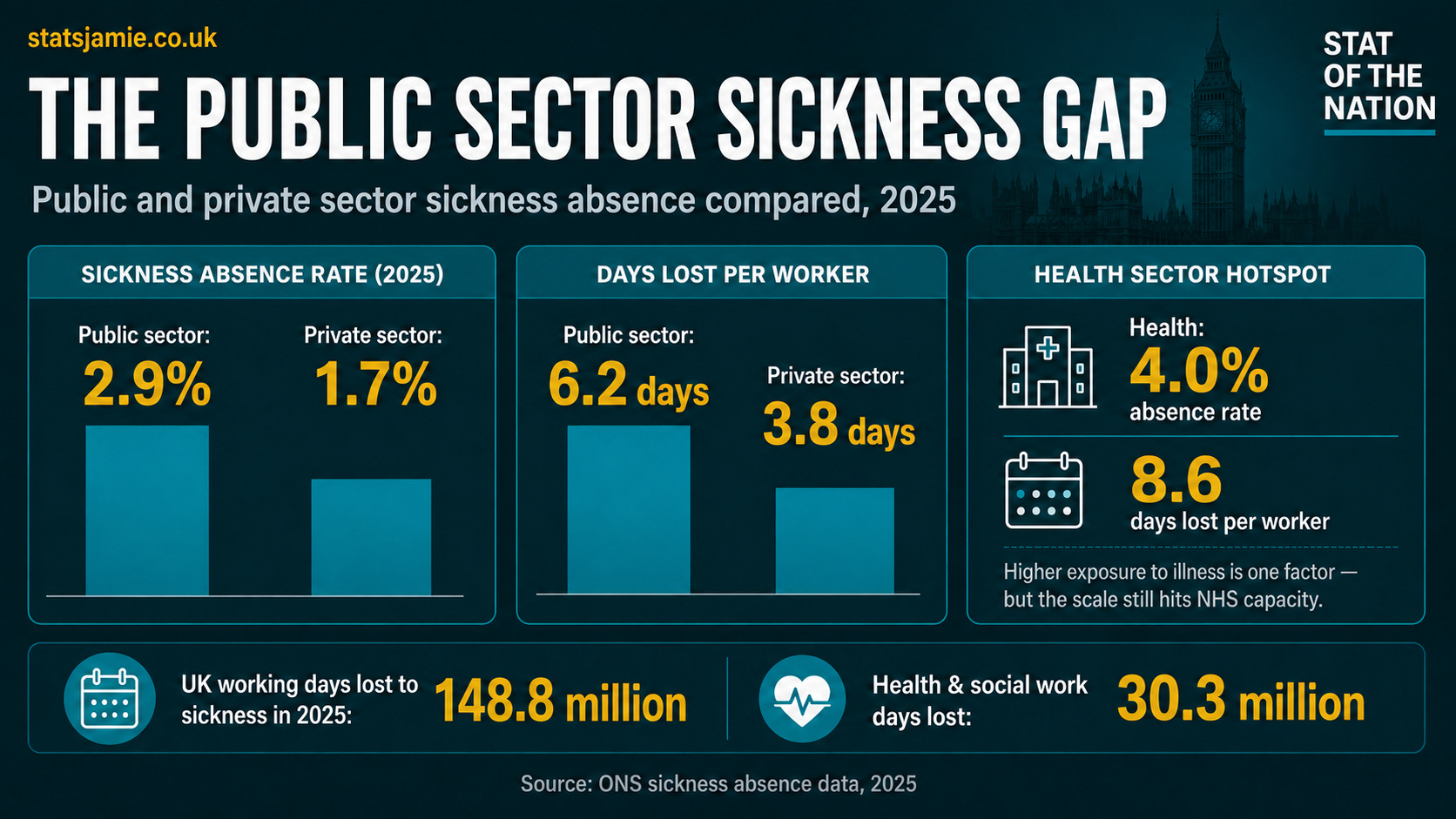
The difference becomes even clearer when you look at days lost per worker. In 2025, public sector workers lost 6.2 days per worker to sickness absence, compared with 3.8 days in the private sector.
Of course, some public sector jobs are difficult. NHS staff, prison officers, police officers, teachers and care workers often deal with stressful, physical and emotionally demanding conditions. But that cannot be the end of the discussion.
The public sector is funded by people who have to get up, go to work, pay their taxes and often wait months or years for the services they have already paid for. They are entitled to ask whether sickness absence is being properly managed.
Health Is The Real Hotspot
The public sector gap is broad, but health stands out.
In 2025, sickness absence among workers in health was 4.0%, compared with 1.7% in the private sector. In days lost per worker, the gap is even clearer: 8.6 days per worker in health, compared with 3.8 days in the private sector.
That is more than double, although there is an important caveat. Health workers are not sitting in ordinary office jobs. Many are working directly with sick patients in hospitals, GP settings, care environments and other frontline roles where exposure to viruses and infections is naturally higher.
So yes, some of this gap will reflect the reality of the job.
But it still does not remove the problem. If the health system is losing 8.6 days per worker to sickness, that directly affects NHS and care capacity. Fewer staff on shift means more pressure on colleagues, longer waits for patients, more cancelled activity, and more strain on a system already struggling to deliver.
Health and social work also lost 30.3 million working days to sickness absence in 2025 — around one fifth of all working days lost across the economy.
The point is not to attack NHS staff. The point is that the NHS cannot solve its waiting list and productivity problems while ignoring workforce sickness inside the system itself.
Big Organisations Absorb Absence — Small Firms Cannot
There is another pattern in the data that matters: sickness absence is higher in larger organisations.
Workers in organisations with fewer than 25 employees lost 3.6 days per worker to sickness absence in 2025. In organisations with 500 or more employees, it was 5.5 days per worker.
That should not surprise us. Small firms cannot carry absence in the same way large organisations can. If someone is off in a small business, everyone feels it immediately. The work still has to be done. The customers still need serving. The bills still need paying.
Large organisations, especially large public sector bodies, can absorb absence more easily. The cost does not disappear. It is simply spread across departments, waiting lists, delayed services and ultimately the taxpayer.
That is the danger.
A big bureaucracy can hide poor performance for far longer than a small business can. In the private sector, persistent absence affects output, customers, colleagues and the bottom line. In the public sector, it affects patients, pupils, victims of crime, taxpayers and every citizen waiting for the state to do its job.
The public should not be fobbed off with “it is complicated”. The public sector is enormous. It is expensive. It is paid for by taxpayers. And it should be held to a high standard.
The Fit Note System Looks Too Weak
This is where the fit note debate matters.
A recent BBC investigation asked more than 5,000 GPs in England about mental health-related fit notes. Of the 752 GPs who replied, 540 said they had never refused such a request, while 162 said they had refused at least one.
That does not mean every request was false. It does not mean every GP is rubber-stamping people off work. But it does raise a serious question: if the system rarely says no, is it really assessing fitness for work — or just recording what the patient asks for?
Reports around the same issue suggest fit notes have more than doubled over the past decade, from around 5.3 million in 2015 to more than 11 million in the latest year. Mental health and behavioural disorders accounted for more than 956,000 fit notes where a reason was recorded, though many fit notes do not specify a reason.
That links directly to the sickness absence data. Mental health conditions accounted for 11.9% of public sector sickness absence occurrences, compared with 7.5% in the private sector.
Again, this does not mean every case is abuse. Mental illness can be real, serious and disabling. But a system that appears reluctant to say no is a system that will be tested.
A fit note should not be the end of the conversation. It should trigger proper questions. What work can this person still do? What adjustments are reasonable? Is this short-term or long-term? Is there a plan to return? Is the employer involved? Is there occupational health support? Is there any evidence of abuse?
Because the current model too often appears to treat being signed off as the default answer.
That is not good enough.
Taxpayers Deserve Accountability
The solution is not complicated in principle.
First, public bodies should publish clear sickness absence data. NHS trusts, councils, police forces, departments and agencies should be expected to show absence rates, trends, short-term absence, long-term absence and how they compare with similar organisations.
If taxpayers are funding the service, taxpayers should be able to see the problem.
Second, repeat absence should be actively managed. Not with vague HR processes that drag on forever, but with proper return-to-work interviews, clear thresholds, documented action plans and managers who are expected to manage.
Third, the fit note system needs tightening. GPs should not be left as the sole gatekeepers for worklessness, especially when many openly say they do not see themselves as policing the system. The process needs to move towards proper work capability, occupational health and return-to-work planning — not simply signing people off and hoping for the best.
Fourth, conflicts of interest need to be taken seriously. I have heard anecdotal examples of NHS staff being signed off sick while allegedly doing private work elsewhere. That does not mean it is widespread, and it certainly does not mean most NHS staff are abusing the system.
But if it happens, the question is obvious: who is checking?
There may be legitimate explanations. Someone may be unfit for one role but capable of different duties. The private work may be less physically demanding, more flexible, or under different conditions. But if a taxpayer-funded service is short-staffed because someone is off sick, while that person is still able to do paid work elsewhere, management should be asking serious questions.
Fifth, public sector managers need to be held accountable for absence. Not blamed for every illness, but held responsible for whether patterns are spotted, processes are followed, and problems are challenged.
Support genuine illness. But stop allowing weak systems, weak management and weak accountability to hide behind compassion.
Conclusion: The Dashboard Is Flashing Red
Nobody serious should pretend every sickness absence is fake.
But nobody serious should pretend the system is working either.
Britain lost nearly 149 million working days to sickness or injury in 2025. The public sector sickness absence rate remains far higher than the private sector. Health is a particular hotspot. Big organisations appear able to absorb absence in a way small firms simply cannot. And the fit note system looks far too weak.
There is also a deeper health problem. Workers with long-term health conditions had a sickness absence rate of 4.0% in 2025, compared with 1.0% for those without long-term health conditions. Older workers also had higher rates, rising from 1.3% among 16 to 24-year-olds to 3.3% among workers aged 65 and over.
That matters because Britain is ageing, public finances are stretched, and the welfare bill is already under pressure. The country needs more people in work, not fewer. It needs more hours worked, not fewer. It needs a public sector that delivers, not one that absorbs more money while producing endless excuses.
That is the issue. Not attacking the genuinely ill. Not pretending difficult jobs are easy. But asking whether Britain’s public sector has become too big, too expensive, too slow, and too weak at holding itself accountable.
The public sector sickness gap is not the whole reason Britain cannot deliver.
But it is another warning light on the dashboard.
And right now, the dashboard is flashing red. 🚨
✍️ Jamie Jenkins
Stats Jamie | Stats, Facts & Opinions
📢 Call to Action
If this helped cut through the noise, share it and subscribe free by entering your email in the box below and get the stats before the spin, straight to your inbox (no algorithms).
📚 If you found this useful, you might also want to read:
The Government Is Spending More, But The Country Feels Broken

This week’s roundup has a simple theme: drift.
📲 Follow me here for more daily updates:
"If taxpayers are funding the service, taxpayers should be able to see the problem."
Taxpayers aren't funding it though, are they? Apart from local issues paid for through council taxes, they aren't funding anything. Ask yourself where taxpayers get money from - they have to get it from somewhere as we can all agree they don't create it themselves. It has to originate somewhere else then, so where can that be? Here's the Bank of England to help out, firstly with where it comes from; ""... Whenever a bank makes a loan, it simultaneously creates a matching deposit in the borrower’s bank account, thereby creating new money." and "... money is made up of bank deposits - which are essentially IOUs from commercial banks to households and companies - and currency - mostly IOUs from the central bank." This is from the PDF available from the BoE's site at https://www.bankofengland.co.uk/quarterly-bulletin/2014/q1/money-creation-in-the-modern-economy where there's also a video explaining how banks create new money when they lend it. The ECB chime in helpfully with their observation that "Fiat money is declared legal tender and issued by a central bank." https://www.ecb.europa.eu/ecb-and-you/explainers/tell-me-more/html/what_is_money.en.html I'll just stress that last, "... money is... issued by the central bank." Now in the UK that central bank is the BoE and it's part of Govt, being owned by the Treasury. We know because it says it is and we have no reason to doubt it "We are wholly-owned by the UK government. The capital of the Bank is held by the Treasury Solicitor on behalf of HM Treasury." https://www.bankofengland.co.uk/explainers/who-owns-the-bank-of-england
Money is Govt IOUs issued by the central bank and created as deposits by back loans which is how come it happens to be handy if we want to spend some at the pub or pay our mortgage.
Nothing about taxpayers in there. Nothing about MMT either; all this is information made freely available by the banks themselves for anyone to see.
It's really time the absurd and irrelevant nonsense based round it being 'taxpayers' money' was left behind. No serious conversations about the economy can be had which include the idea.
The idea of measuring productivity in the public sector seems odd. I can see how it might work in some parts of the system where the output side is clearly measurable such as say mending potholes in the road but for a lot of desk based jobs how do you measure their performance. There is one local authority which reduced the working week from 5 to 4 days and it was claimed that this would improve productivity. They say it actually has actually improved. I have no idea how that works but I wondered why they didn't reduce the week to 3 days or 2 and improve productivity even more.