

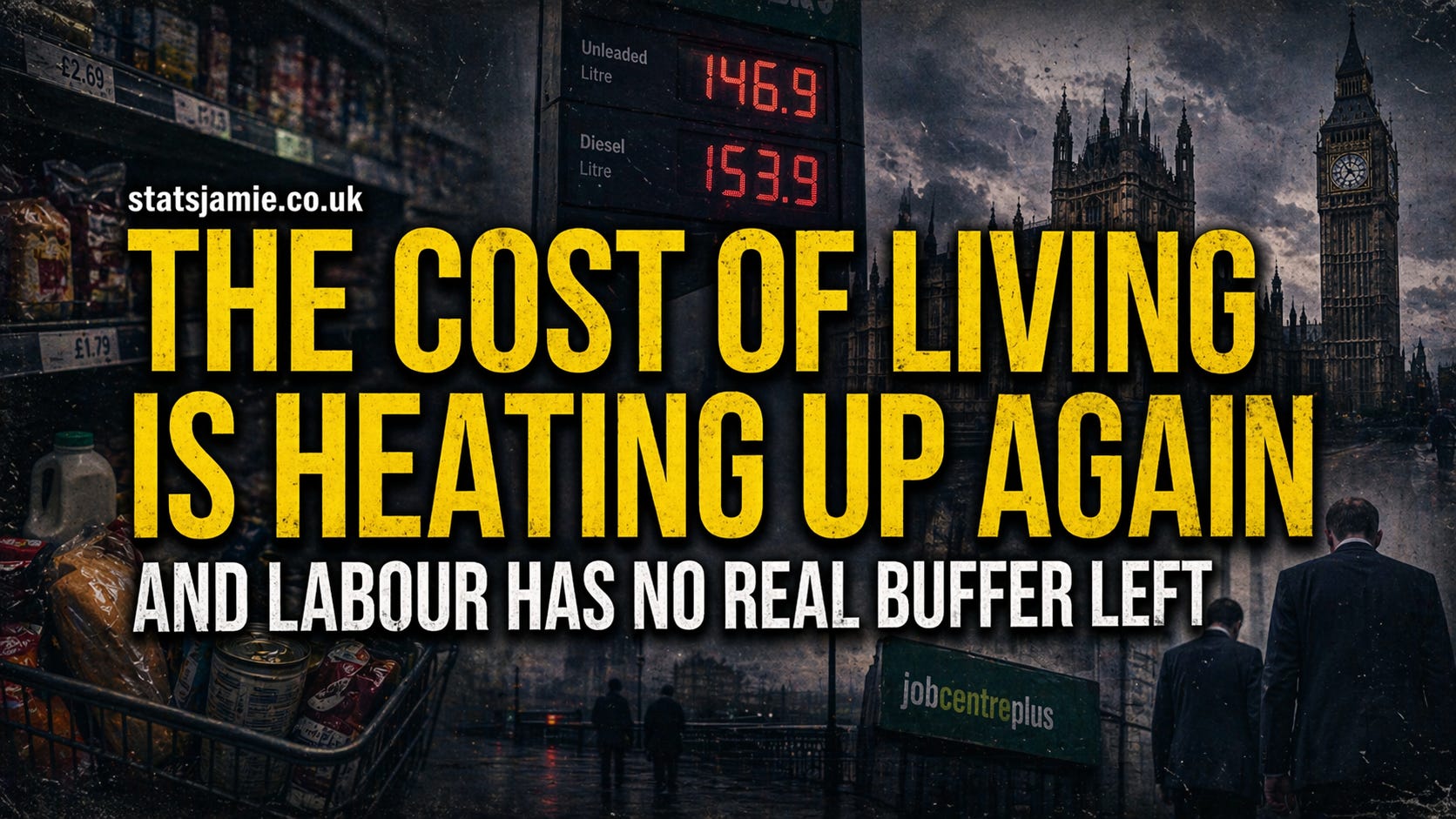
In June 2024, the month before Labour took office, CPI inflation stood at 2.0%. It now stands at 3.3%. So before ministers start blaming wars, oil markets or events abroad, let’s start with the obvious: inflation is higher now than when Labour inherited office. The latest rise was driven above all by transport, with higher fuel costs pushing the headline the wrong way again.
At the same time, the labour market continues to struggle along. Payrolled employment is falling on the year, vacancies have fallen again, and the sharpest job losses are showing up in sectors like retail. This is what makes the latest inflation figures so awkward for ministers: prices are rising again, but the economy underneath still looks weak.
🚗 Transport Knocked Inflation Off Course
This is the key point in the whole release.
Without the surge in transport costs, inflation would have been broadly flat in March rather than rising again. That matters because CPI was supposed to be moving back towards the Bank of England’s 2% target. Instead, transport pushed the headline the wrong way again — and once higher fuel costs start feeding through the economy, the risk is that progress back to target gets delayed again.
The ONS says transport was the main upward driver of the annual rate, while clothing and footwear provided a downward offset. That tells you two things at once: transport did the damage, and without falling clothing prices the headline number would have looked worse still.
But this is not just a forecourt story. Food inflation also rose, from 3.3% to 3.7%. That is what makes this politically dangerous. Food is not an abstract economic concept. It is the weekly shop. It is the price of the basics. It is the part of inflation people feel in everyday life, again and again.
And that is why transport matters so much. Fuel costs do not stop at the pump. They feed into deliveries, haulage, supermarket shelves, service costs and business overheads. Families do not just pay once when they fill the car up. They often pay again at the tills.
⛽ Ministers Had Choices — And More Pressure Is Still Coming
Governments cannot stop every external shock. But they are not powerless either.
A temporary fuel duty cut or targeted tax relief would not have erased the full rise in pump prices, but it could have offset part of it. And part matters. If ministers had taken some of the edge off fuel prices, they could have reduced part of the immediate inflation hit and some of the wider pressure spreading through the economy. That is the point I made in my recent fuel-price piece: government has largely stood by while prices rose, even as the Treasury quietly benefits from higher VAT receipts.
So ministers do not get to pose as helpless bystanders. They had policy levers available and chose not to use them.
And there is every reason to think more inflationary pressure is still on the way. The March figures were already pushed up by transport and fuel, but they may not yet capture the full effect if pump prices continued rising beyond the reference period. On top of that, April brought another increase in minimum wage costs — including a 4.1% rise for workers aged 21 and over, an 8.5% rise for 18 to 20-year-olds, and 6.0% rises for both 16 to 17-year-olds and apprentices. Those increases will not have driven the March inflation figures, but they are exactly the kind of extra business costs that can start feeding into the next round of prices, especially in labour-intensive sectors.
That is what should worry ministers most. March may not be the end of the inflation story. It may only be the first wave.
💷 High Inflation Is Also A Treasury Problem
High inflation is not just painful for households. It can blow holes in the public finances too.
If inflation stays elevated, debt interest can rise through index-linked gilts. And if higher CPI persists for long enough, it can also mean more expensive uprating of CPI-linked benefits. The OBR notes that CPI is used widely in the tax and social security systems, while RPI drives interest on most index-linked government debt.
That means inflation does not just squeeze families at the supermarket or petrol station. It can also come back and hit the Chancellor’s books.
So this is not merely a cost-of-living problem. It is a government problem too.
📉 The Labour Market Is Too Weak For This
If the economy were roaring ahead, ministers might hope Britain could absorb another inflation bump. But that is not the backdrop here.
The PAYE figures show 30.3 million payrolled employees in March 2026, down 65,000 on the year and down 11,000 on the month. The ONS also says the biggest annual sector fall was in wholesale and retail, down 57,000.
That is worth pausing on. This is probably not some sweeping AI revolution replacing shop-floor workers. It looks much more like strain: weaker demand, higher employer costs, squeezed margins and firms pulling back. This is not a story of modernisation. It is a story of pressure in the real economy.
And the weakness is not just among employees. Workforce jobs were down 266,000 comparing December 2025 with a year earlier — and almost all of that fall came from self-employment, which was down 242,000. That hardly screams confidence, dynamism or risk-taking. It suggests caution in the very part of the labour market where you would want to see energy and optimism.
📌 Vacancies Show The Same Weakness
The vacancies figures tell the same story.
Vacancies fell again to 711,000, marking the 33rd consecutive quarterly decline and leaving job openings below pre-2020 levels. The employment rate slipped to 75.0%, inactivity rose to 21.0%, and regular pay growth slowed to 3.6%, with real regular pay growth only 0.2%.
That is what makes this whole picture so grim. Britain is not suffering from inflation because the economy is surging. It is seeing inflation rise again while the labour market softens underneath it.
That is a far uglier mix — and far harder for ministers to explain away.
Final Thought
This is what drift looks like.
Inflation is higher than when Labour took office. Transport stopped inflation being flat. Food prices are rising again, hitting the part of inflation people feel most in everyday life. Government could have softened some of the pressure through fuel tax relief, but chose not to. And there is every reason to think more inflationary pressure is still coming, with fuel costs still feeding through and higher minimum wage costs hitting from April.
At the same time, the labour market is softening. Retail is shedding jobs. Self-employment is down sharply. Vacancies keep falling.
And yet ministers will still try to say this is all just bad luck from abroad.
It is not.
Britain is too exposed to shocks, too weighed down by domestic cost pressures, and too economically weak to absorb inflation flaring up again. This is no longer just inflation happening to Britain.
It is inflation happening on Labour’s watch.
✍️ Jamie Jenkins
Stats Jamie | Stats, Facts & Opinions
📢 Call to Action
If this helped cut through the noise, share it and subscribe free by entering your email in the box below and get the stats before the spin, straight to your inbox (no algorithms).
📚 If you found this useful, you might also want to read:
625,000 UK Resident Visits To Pakistan — So Why Is It Britain’s Top Asylum Source?

If Pakistan is so dangerous that it is Britain’s top source of asylum claims, then common sense says very few people would want to visit it.
📲 Follow me here for more daily updates: