

Andy Burnham has changed the political weather.
After more than a year in which Reform UK dominated the opinion polls, Labour is suddenly back in contention. Three pollsters now have the governing party either level with or ahead of Nigel Farage’s party.
The Burnham bounce is real.
But the detail suggests Burnham is mainly persuading people who previously supported Labour to come home. There is far less evidence that he is winning over large numbers of committed Reform voters.
Burnham has begun rebuilding Labour’s old electoral coalition.
He has not yet proved that he can expand it.
Labour Is Back in the Race
The latest polling represents a striking reversal.
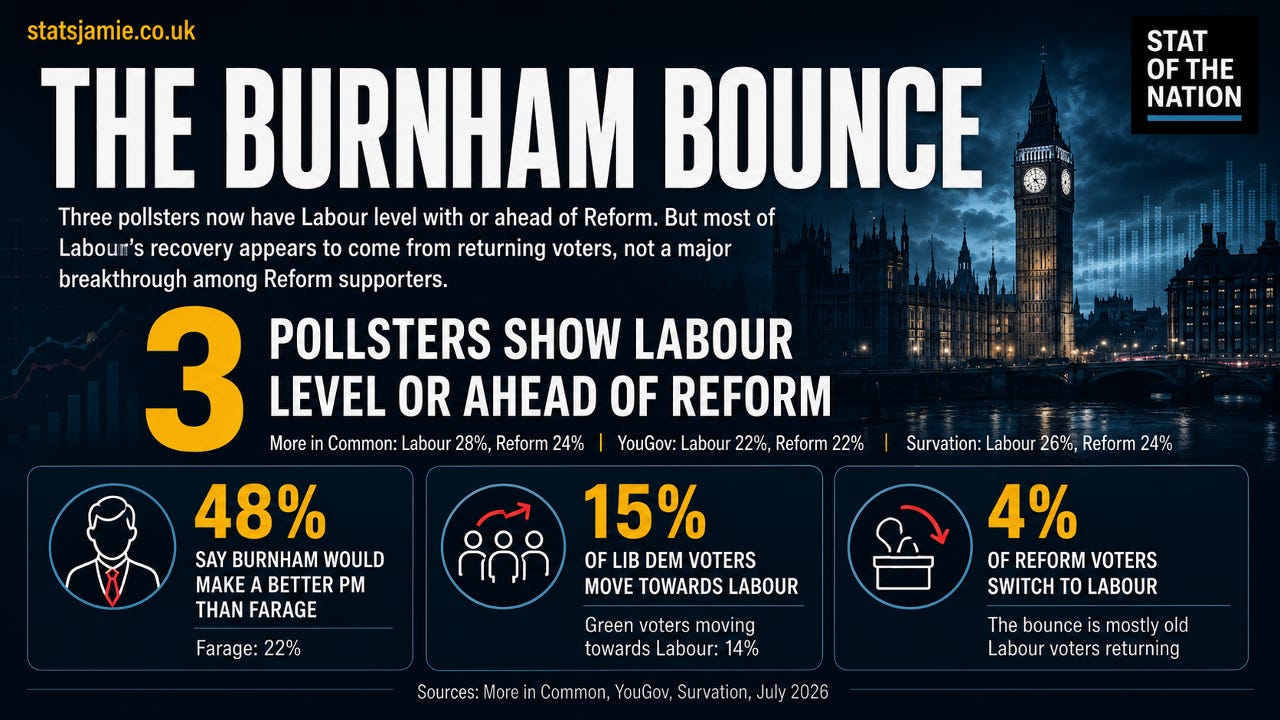
More in Common has Labour on 28%, four points ahead of Reform on 24%.
YouGov has the two parties tied on 22%, with the Conservatives close behind.
Survation has Labour on 26%, two points ahead of Reform. Before Starmer announced his resignation, the same pollster had Labour trailing Reform by eight points.
The exact figures vary, as they always do between polling companies. But the direction is consistent.
Labour is rising. Reform’s clear lead has disappeared. The Greens have also lost ground.
This is no longer one unusual poll that can be dismissed as an outlier. Different pollsters, using different methods, are detecting the same movement.
Labour is back in the contest.
Who Is Paying for the Burnham Bounce?
The most interesting question is not simply whether Labour has gained support.
It is where that support could come from under Burnham.
More in Common tested a hypothetical election with Burnham leading Labour. In that scenario, Labour rose six points to 27%, narrowly ahead of Reform on 26%.
The report found that Burnham’s strongest gains came from rebuilding Labour’s support among voters on the centre left:
• 15% of current Liberal Democrat voters said they would switch to Labour
• 14% of current Green voters said they would switch
• A quarter of those who did not know how they would vote chose Labour
• 4% of current Reform voters said they would switch
• 4% of current Conservative voters also moved to Labour
These are not confirmed movements in the latest voting intention polls. They are responses to a hypothetical question about how people would vote with Burnham leading Labour.
But the pattern is still revealing.
Burnham’s greatest strength appears to be among voters who had drifted towards the Greens, Liberal Democrats or indecision. His appeal reaches across the political spectrum, but the evidence suggests only limited movement from Reform and the Conservatives.
This looks less like Burnham constructing a completely new Labour coalition and more like him rebuilding the one Labour has lost.
That is still significant. Labour’s decline under Starmer involved voters moving in several directions. Some went to Reform, some to the Greens and Liberal Democrats, while others became undecided.
Burnham appears capable of bringing parts of that fragmented coalition back together.
But recovering former Labour voters is only the first stage. To build a lasting election winning coalition, he will also need to persuade more of the voters who have moved firmly to Reform or the Conservatives.
He may be repairing Labour’s foundations.
The harder task is building beyond them.
Burnham Is Bigger Than Labour
Burnham’s personal polling is currently much stronger than his party’s.
Asked who would make the better prime minister, 48% choose Burnham, compared with 22% choosing Nigel Farage.
That gives Labour an advantage it did not possess during Starmer’s final months. Burnham can reach voters who had stopped listening to the party.
But it also exposes a potential weakness.
Burnham is significantly more popular than a Labour Party still polling in the twenties.
Voters may like him, prefer him to the alternatives and be prepared to give him a chance without yet being ready to vote Labour.
Personal popularity can lift a party.
It cannot permanently protect that party from unpopular decisions, weak public services or a struggling economy.
For now, Burnham is being judged against an unpopular predecessor and against what voters hope he might become.
Soon he will be judged against his own results.
Every Honeymoon Ends
Burnham is enjoying the easiest period of his premiership.
He is new. He communicates differently from Starmer. Voters are judging his tone and intentions rather than the consequences of his decisions.
That will change.
Announcements are popular. Funding them is harder.
Promising reform is popular. Deciding who pays is harder.
Burnham will eventually face the same pressures that damaged Starmer: weak economic growth, strained public services and voters who demand improvement but resist higher taxes.
For now, the public is giving him a hearing.
But a honeymoon measures hope.
Governing measures delivery.
The Election Gamble
Burnham has ruled out an early general election, and Labour already possesses a working Commons majority of 166.
That majority allows the government to pass legislation, survive rebellions and govern without relying on smaller parties.
An election would put that advantage at risk.
Even after the bounce, Labour remains in the twenties. That may be enough to finish first in a fragmented political system, but it is unlikely to reproduce the overwhelming majority secured in 2024.
Yet if Labour continues rising, the pressure to seek a personal mandate will grow.
Burnham inherited the premiership. He did not lead Labour into government at the last election.
Going to the country would allow him to campaign on his own programme while his personal popularity remains high and before difficult decisions begin eroding the goodwill he currently enjoys.
But it would be an extraordinary gamble.
Burnham could strengthen his personal authority while weakening his government’s position in Parliament. A commanding majority could become a narrow one, a minority administration or a hung parliament.
Go early and risk surrendering a majority most prime ministers could only dream of.
Wait and risk watching the honeymoon fade before asking voters for their verdict.
A Bounce, Not a Verdict
Andy Burnham has already achieved something significant.
Labour is back in contention. Reform’s clear polling lead has disappeared. Voters who had moved towards the Greens, Liberal Democrats or indecision are taking another look.
But Burnham is mainly recovering people Labour had already lost.
The evidence does not yet show that he is winning large numbers of committed Reform voters or constructing a broader electoral coalition.
That is the next test.
For now, voters are judging the promise of his premiership rather than its consequences.
The difficult decisions are still to come.
The Burnham bounce is real.
But it is a honeymoon, not a verdict.
What do you think? Should Burnham use his early popularity to seek his own mandate, or would an early election be a reckless gamble?
Stats Jamie | Stats, Facts & Opinions
If you found this analysis useful, please share it and subscribe for more.
📚 You might also want to read:
Britain Is Cancelling the BBC — Another 539,000 Licences Disappear

Another 539,000 television licences disappeared last year, following a fall of more than 300,000 the year before. The decline is not merely continuing; it is accelerating.
📲 Follow me here for more daily updates:
You can't govern by Tik Tok and appearing to be nice to everyone except Reform for ever, it will come back to bite you hard but by then our country will be close to ruin !