

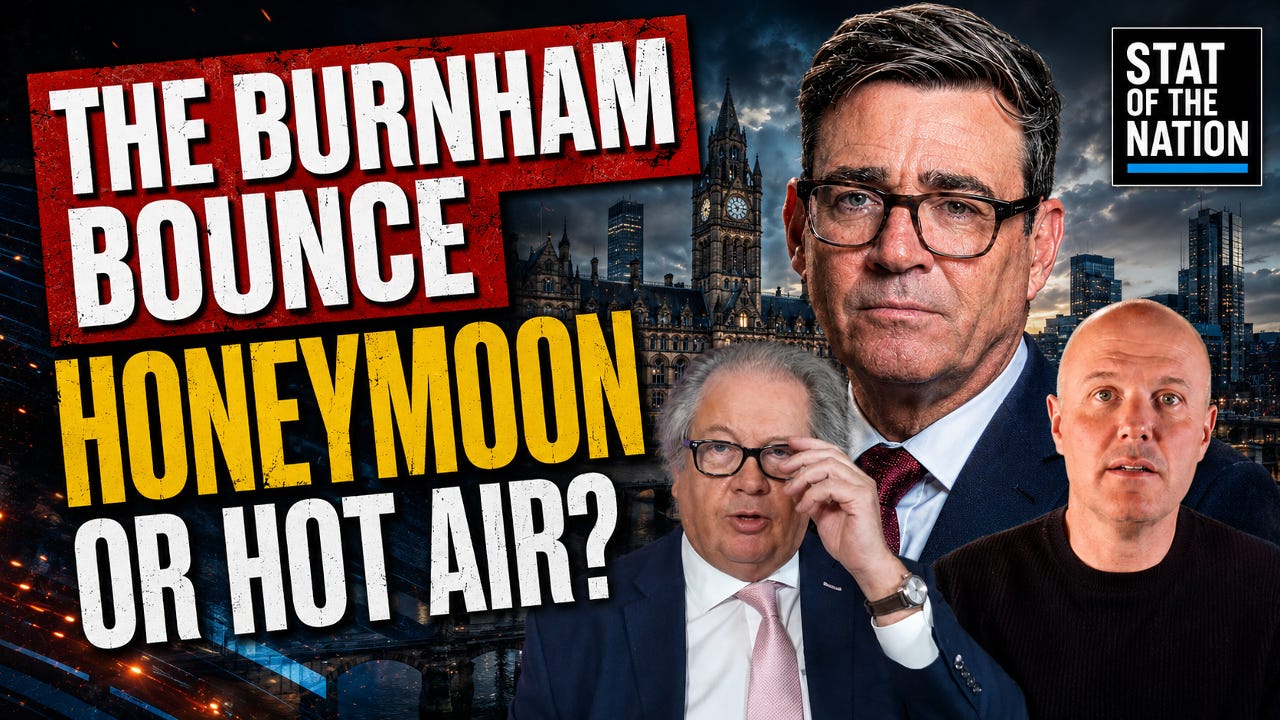
This week, I joined Mike Graham on The Mike Graham Show from the Netherlands to discuss the stories behind the headlines and what the numbers tell us about the state of Britain.
From drought after months of flooding to another review of social care, the same pattern keeps appearing. Britain does not lack political announcements. It lacks delivery.
Watch the Full Discussion
Watch my latest Stat of the Nation conversation with Mike Graham below:
This Week We Discussed
• Why Britain faces water shortages after months of flooding
• Whether the Burnham bounce is real
• Britain’s 22nd social care review in around 30 years
• The falling number of UK millionaires
• Whether Burnham could call an early general election
• Why illegal Channel crossings remain his biggest political test
The Burnham Honeymoon
Andy Burnham has improved Labour’s polling position, but that should not be surprising.
After Keir Starmer’s collapse in popularity, almost any replacement was likely to receive an immediate political honeymoon.
The more important question is where Labour’s support is coming from.
Burnham appears to be winning back people who had moved towards the Greens, Liberal Democrats or the undecided column. There is far less evidence that large numbers of Reform voters are returning to Labour.
For now, much of the media are focused on Burnham’s style, speeches and promises.
The real test will begin when Parliament returns and those promises face proper scrutiny.
Political honeymoons are enjoyable. Then the bill arrives.

Britain Reviews Problems Instead of Fixing Them
Burnham has announced another review of social care.
Britain has already held 22 reviews into the issue over roughly 30 years. Politicians understand the problem, but repeatedly avoid the difficult question of how care should be organised and funded.
A more national system may make sense. Leaving local councils to manage widely different levels of demand has created an inconsistent service.
But a National Care Service would cost billions.
People are also living longer while spending more years in poor health and needing support. There is now a gap of around 20 years between life expectancy and healthy life expectancy.
That places increasing pressure on families, councils, hospitals and care providers.
Another review can describe the crisis. It cannot pay for it.
The same failure can be seen in water infrastructure.
Britain experienced widespread flooding only months ago. Now large parts of the country are facing drought conditions.
We have not completed a major new reservoir for around 30 years, despite substantial population growth and increasing demand.
When it rains, we fail to control the water. When the rain stops, we discover that we did not store enough of it.
That is not simply a weather problem.
It is an infrastructure failure.
Is Britain Reducing Inequality by Becoming Poorer?
Mike and I also discussed estimates suggesting that the number of UK millionaires has fallen by around 7% over the past year.
After adjusting for inflation, the total is reportedly at its lowest level since the financial crisis in 2008.
The figures measure net wealth. Assets such as property and investments are included, but debts such as mortgages are deducted.
Some may welcome fewer millionaires as evidence of reduced inequality.
But Britain does not become more prosperous by losing wealth, investment and successful taxpayers.
Labour may have discovered a quick way to reduce the wealth gap: make everyone poorer.
That is not growth. It is managed decline.

The Border Test
Illegal Channel crossings may ultimately determine whether Burnham can win back voters who have moved to Reform.
People have heard repeated promises about smashing the gangs, improving cooperation with France and reforming the asylum system.
Yet when the weather improves, the boats continue to arrive.
That suggests the weather remains a more effective deterrent than government policy.
Burnham can improve Labour’s presentation. He can speak more naturally than Starmer and offer a more optimistic story about Britain.
But voters will eventually judge him on results.
Can he secure the border?
Can he establish who is entering the country?
Can he improve public services without increasing taxes again?
Can he generate economic growth rather than redistribute a shrinking pool of wealth?
Those are the tests that will determine whether the Burnham bounce becomes a lasting political recovery or another short lived Westminster honeymoon.
The Bottom Line
Andy Burnham has changed the mood around Labour.
He has not yet changed the underlying reality.
Britain still faces failing infrastructure, unresolved social care costs, declining wealth and a border that remains out of control.
The Burnham bounce will last until the promises meet the numbers.
And the numbers eventually win.
Do you think Andy Burnham can deliver real change, or is this just another political honeymoon?
Stats Jamie | Stats, Facts & Opinions
📢 Call to Action
If this helped cut through the noise, share it and subscribe free by entering your email in the box below and get the stats before the spin, straight to your inbox (no algorithms).
📲 Follow me here for more daily updates: