

In his speech this week, Keir Starmer listed falling small-boat crossings and closing asylum hotels among his Government’s achievements. He has also repeatedly promised to smash the criminal gangs behind the Channel crossings.
There is a fair point in both claims. The number of people in asylum hotels has fallen, and small-boat arrivals are down year-to-date on the same point last year.
But that is not the full story.
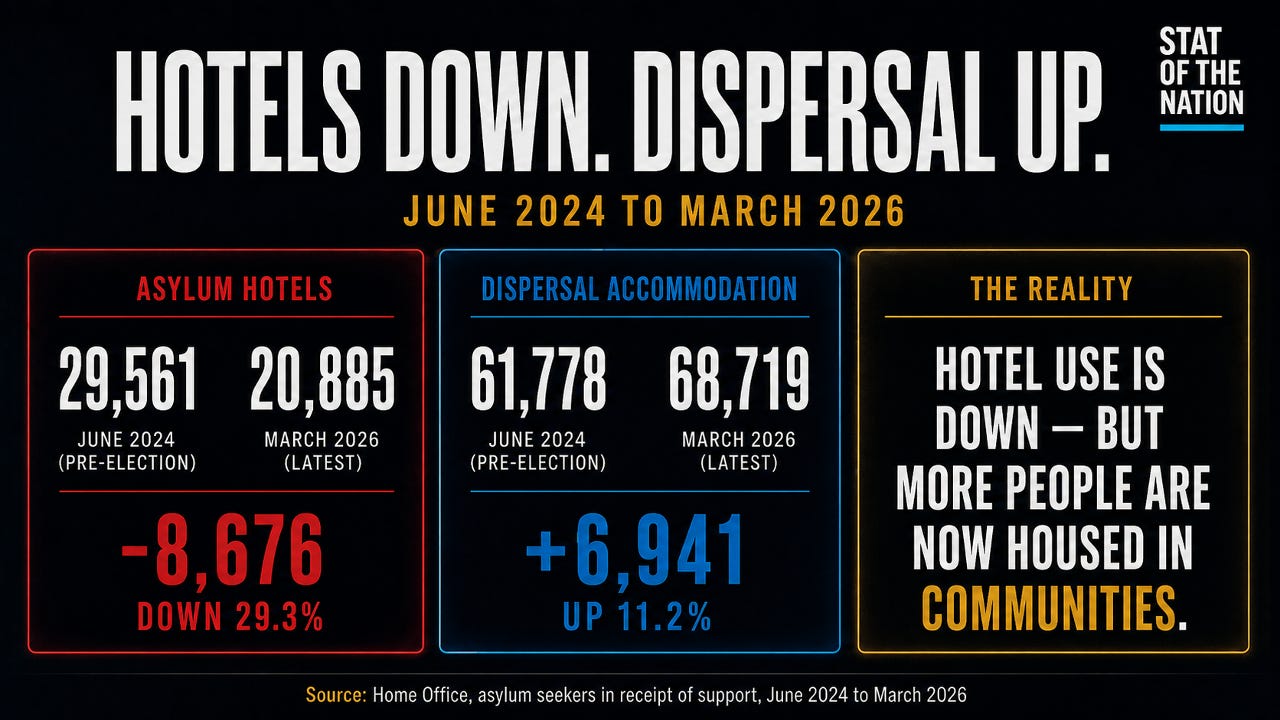
In June 2024, immediately before the general election, 29,561 people were in asylum hotels. By March 2026, that had fallen to 20,885.
Over the same period, however, the number in dispersal accommodation rose from 61,778 to 68,719.
So the hotels are closing. But more people are now being housed in communities across Britain.
And in the last 10 days alone, 1,891 people arrived in Britain by small boat.
If just one of those 1,891 people goes on to commit a serious crime against a child or young woman, that is one too many.
That is not necessarily the same thing as reducing the pressure created by the asylum system. It may simply mean moving it out of highly visible hotels and into towns, villages, shared homes and residential streets.
Lower Is Better. It Is Not The Same As Control.
The Government is entitled to say that small-boat arrivals are down compared with last year.
But by late June, more than 11,500 people had still crossed the Channel in small boats in 2026. The 1,891 arrivals in just 10 days show how quickly the numbers can rise again when conditions allow.
That is better than the alternative. It is not a secure border.
A serious border policy should not define success as simply beating last year’s number. The ambition should be to make illegal entry as difficult, unattractive and ultimately as close to zero as possible.
The Home Office exists to protect the border. It should not be judged mainly on how effectively it finds accommodation after people have arrived.
It should be judged on whether it can stop illegal entry in the first place.
The Biggest Immediate Deterrent Is Still The Weather
The most uncomfortable truth in this debate is that weather remains the strongest short-term deterrent.
When the Channel is rough, winds are high and visibility is poor, crossings fall. When conditions improve, the boats come.
The Home Office itself warns that small-boat numbers fluctuate with weather and seasonality. That is why a quieter period cannot simply be presented as proof that the gangs have been smashed.
The real test is what happens when the weather improves.
We saw that again in June. Conditions changed and 1,891 people arrived in just 10 days.
There are still people in northern France waiting for an opportunity to cross, while the smugglers’ business model remains intact.
A Government cannot claim victory because the Channel was rough for a fortnight.
Who Is Coming Across The Channel?
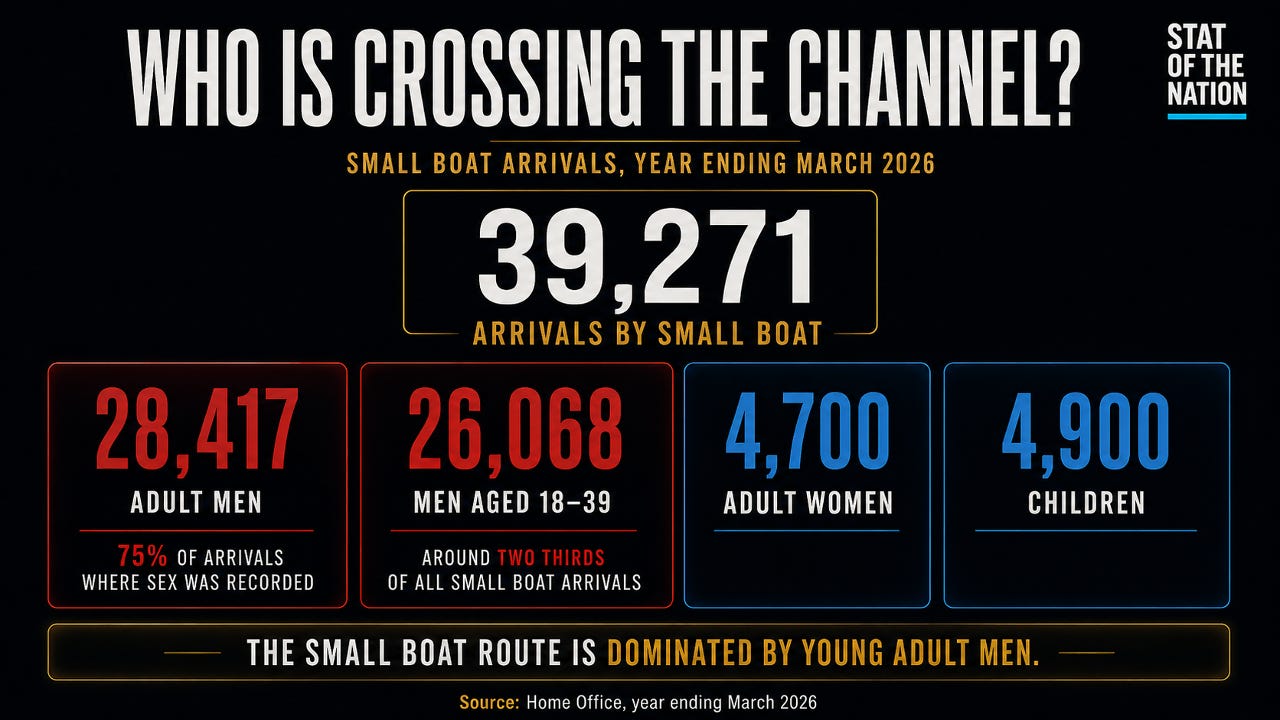
In the year ending March 2026, 39,271 people arrived in Britain by small boat.
The route is overwhelmingly male and heavily concentrated among younger adults:
28,417 were adult men — around 75% of arrivals where sex was recorded.
26,068 were men aged 18 to 39 — around two thirds of everyone arriving by small boat.
Around 4,700 were adult women.
Around 4,900 were children.
That does not mean every individual arriving is a danger. But it does mean the public is entitled to ask serious questions about identity, screening, safeguarding and whether Britain is genuinely in control of who enters the country.
These are not primarily people arriving through a managed resettlement scheme, where identity, eligibility and vulnerability checks happen before travel.
They are people who have travelled through France — a safe country with its own asylum system — before paying criminal gangs to enter Britain illegally.
That distinction matters.
What Can Britain Really Know At The Point Of Arrival?
The Government will say that people arriving by small boat are screened, fingerprinted, photographed and checked against available databases.
That is true.
But how robust can any check be when someone arrives without reliable documents, a verified identity or a traceable history?
Biometrics can establish whether somebody matches a record already held by Britain or an international partner. They cannot create a reliable history where no record exists.
They cannot independently verify every claimed name, nationality, address, work history or past association where the evidence simply is not available.
In a controlled system, checks happen before somebody is allowed to travel.
With small boats, the Home Office is often trying to establish identity, history and risk after somebody has already crossed the border.
That is border management after the event. It is not border control.
For the victim and their family, one serious failure is not an abstract argument about immigration policy. It can mean trauma and consequences that last for life.
The Criminal Networks Do Not Stop At The Water’s Edge
Small-boat crossings are not an accident. They are a business model.
The gangs organise routes, recruit customers, sell places on boats, move money across borders and adapt when enforcement changes.
Starmer promised to smash the gangs. Yet the gangs are plainly still operating.
BBC reporting has exposed alleged UK-linked payment networks used to facilitate Channel crossings. Separate investigations have shown how illegal labour, front businesses and informal networks can be used to exploit vulnerable migrants after arrival.
That is important because the people-smuggling trade does not stop when a boat reaches British waters.
Some people may arrive after paying cash up front. Others may be indebted, dependent or vulnerable to exploitation.
A system that allows illegal entry, leaves claims unresolved for long periods and disperses people into communities creates obvious opportunities for illegal work, cash-in-hand exploitation and criminal networks.
That is bad for those being exploited. It is bad for legitimate firms being undercut. And it is bad for communities left dealing with the consequences.
The Housing Pressure Is Not Abstract
It is not only the gangs who make money from a large, slow asylum system.
Private contractors are paid to source accommodation, manage sites, arrange transport, provide support and find rental properties for dispersal. Hotel operators, landlords, agents and accommodation providers all benefit from a system that requires tens of thousands of people to be housed for long periods.
That does not mean every contractor is doing anything improper. They are delivering services under contracts awarded by the state.
But the incentives are obvious.
The more people the system has to house, the bigger the taxpayer-funded market becomes.
Every property used for dispersal is also a property unavailable to local renters, families and workers already struggling with scarce housing and high rents.
In areas with tight rental markets, providers competing for homes can add to that pressure.
The public pays twice: once through asylum accommodation costs, then through the additional strain on housing, schools, GPs, councils and local services.
Closing Hotels Does Not Automatically Make Communities Safer
No one should argue that asylum hotels are a good long-term solution.
They were expensive, unsuitable and politically toxic. Reducing reliance on them is sensible.
But moving people out of hotels does not automatically remove the wider challenge.
A hotel is visible. Councils know where it is. Police know where it is. There is usually on-site management, a named location and a degree of public scrutiny.
Dispersal accommodation is different.
Communities deserve transparency about whether local capacity has been assessed, whether police and councils have the information they need, and whether schools, GPs and safeguarding services can cope.
They also deserve to know who is accountable if something goes wrong.
Closing a hotel may make the asylum system less visible.
It does not automatically make the public safer.
What A Serious Deterrent Would Look Like
Britain needs to change the calculation before people get into a boat.
First, it needs faster decisions. Claims cannot be allowed to drag on for years while people remain in publicly funded accommodation and criminal networks have time to exploit the gaps.
Second, people arriving illegally should be placed in clearly managed, secure and time-limited accommodation while their claims are decided — not simply dispersed into ordinary residential communities with little public visibility.
That is not about punishment. It is about control.
Third, the Government needs far tougher enforcement against illegal working and the UK-based financial infrastructure that enables people smuggling.
The gangs need to lose both the ability to move people and the ability to profit from doing so.
Fourth, Britain needs a credible third-country deterrent.
Australia understood a principle Britain has repeatedly failed to apply: arriving by boat without permission should not create a route to settlement in the country you have entered.
Its offshore-processing system was expensive and controversial. But it created certainty.
Britain needs its own lawful version of that principle. Whether through Rwanda or another safe third-country partner, the message must be clear: paying a smuggler to cross the Channel does not buy a place in Britain.
Genuine refugees can still be supported through safe, managed resettlement routes. But illegal entry cannot continue to look like a viable route to settlement.
Britain Does Not Need A Better Way To Hide The Consequences
The Government can fairly say crossings are down on last year.
It can fairly say hotel use has fallen.
But it cannot fairly say the problem is solved.
The weather remains the biggest immediate deterrent. The gangs are still operating. Contractors and landlords still profit from housing the consequences. And while hotels are closing, more people are being dispersed into communities.
Britain does not need a better way to hide the consequences of illegal entry.
It needs a system that stops it.
✍️ Jamie Jenkins
Stats Jamie | Stats, Facts & Opinions
📢 Call to Action
If this helped cut through the noise, share it and subscribe free by entering your email in the box below and get the stats before the spin, straight to your inbox (no algorithms).
📚 If you found this useful, you might also want to read:
To Ban Children From Social Media, Will Starmer Verify Every Adult?

Keir Starmer says his under-16 social-media ban will give children their childhood back. It may also require millions of adults to prove their age before they can participate online.
📲 Follow me here for more daily updates:
Yes, two within metres of my home.
One particular gentleman from the South has realised how cheap property is in South Tyneside, and is buying up several at auction. Despite suitability for the location, and despite a huge shortage of family homes, these developers are determined to make make profit, and there is little can be done.
Our newly elected councillors are making some progress, but I fear after appeals, we will be the losers.
Application turned down, in development nearest to me, so the owner has deferred to making it an Airbnb.
You say illegal migrants should be placed in “clearly managed, secure and time-limited accommodation while their claims are decided”. But do such places exist or do the public support building them? That’s the whole point, isn’t it?
Illegal Arrival = Detention = solves the problem. But detention where ?