

Keir Starmer stood up yesterday to save his premiership. What he delivered was a speech that showed exactly why it is collapsing.
After brutal election results, open questions about his leadership, and growing frustration across the country, Starmer had a chance to show he had listened. He could have used the moment to set out a serious domestic reset on living standards, housing, taxes, energy costs, immigration and public services.
He mentioned some of those pressures. He claimed NHS waiting lists, child poverty and immigration were coming down, and argued that the economy had been stabilised so living standards could improve after two decades of stagnation. But when it came to the big defining answer, he reached for something familiar: Europe.
Not serious reform at home. Not a proper reckoning with his own failures. Not a plan to cut costs, control borders, unleash growth or rebuild trust.
This was not a reset. It was a relapse.
A Prime Minister Running Out Of Road
Starmer began by admitting the election results were “tough, very tough”. He said he took responsibility. He admitted people are frustrated with politics, frustrated with the state of Britain, and frustrated with him. He also acknowledged that he has “doubters” and needs to prove them wrong.
But the speech quickly exposed the problem. He talked about responsibility, but much of the argument was still about why he should be allowed to carry on. He talked about change, but the substance was built around familiar Labour territory: state intervention, attacks on Reform, blame for Brexit, and a renewed push to pull Britain closer to the European Union.
To be fair, Europe was not the only policy announcement. Starmer also announced legislation to give the government powers, subject to a public interest test, to take full national ownership of British Steel. There may be specific arguments around steel, sovereign capability and national security. No serious country should be relaxed about losing strategic industrial capacity.
But that only reinforced the broader picture. This was not a growth reset built around lower costs, cheaper energy, tax competitiveness, housebuilding or private-sector dynamism. It was state control at home and closer EU alignment abroad.
That may reassure Labour activists. It is less likely to reassure voters looking at their mortgage, rent, council tax, energy bill, food shop and local high street. The country does not need slogans about hope. It needs proof that government can make life better.
Power Without Popularity
This is the problem I wrote about in February in Power Without Popularity.
Starmer entered Downing Street with a huge Commons majority, but not a huge popular mandate. Labour won fewer votes in 2024 under Starmer than it did under Jeremy Corbyn in 2019. Labour took 9.71 million votes in 2024, compared with 10.27 million in 2019 — around 560,000 fewer votes. Turnout also fell sharply, from 67.3% in 2019 to 59.7% in 2024. In absolute terms, around 3.2 million fewer votes were cast, despite a larger electorate.

That matters because this was never a great popular realignment behind Starmer. It was a landslide of seats, not a landslide of support. Labour did not surge. The Conservatives collapsed, Reform split the right, the Greens peeled away voters on Labour’s left, and First Past the Post did the rest.
A majority built on thin enthusiasm can look powerful from Westminster, but it is brittle when voters turn. That is what we are now seeing. The results have not created Starmer’s authority problem. They have exposed it.
Starmer’s Big Answer: Britain Back At The Heart Of Europe
The most revealing part of the speech came when Starmer turned to Europe.
He said the next EU summit would “set a new direction for Britain”. He said the last government was defined by breaking Britain’s relationship with Europe, but his Labour government would be defined by “rebuilding our relationship with Europe” and putting “Britain at the heart of Europe”.
There it was, right in the middle of his supposed reset.
Not Britain at the heart of an industrial revival. Not Britain at the heart of cheaper energy. Not Britain at the heart of domestic reform. Not Britain at the heart of border control.
Europe.
That matters because this is not just a diplomatic preference. It reveals Starmer’s political instinct. For him, the great emotional wound in British politics is still Brexit. The central task is not primarily to rebuild trust between voters and Westminster. It is to rebuild the relationship with Brussels.
That is why this speech matters. When the country sent him a warning, he answered with Europe.
Europe Is Not Exactly Booming
There is also a basic economic problem with Starmer’s argument.
He talks about Europe as if Britain is desperate to move closer to an economic powerhouse. But the recent GDP record does not support that simple story.
Since the Brexit vote, comparing real GDP in Q4 2025 with Q2 2016, the UK economy has grown by 12.1%. That is not spectacular. Nobody should pretend Britain is booming.
But compare it with the major European economies Starmer seems so keen to move closer to. France is slightly ahead, up 12.5%. Italy is up 10.1%. Germany — supposedly the industrial engine of Europe — is up just 6.0%.
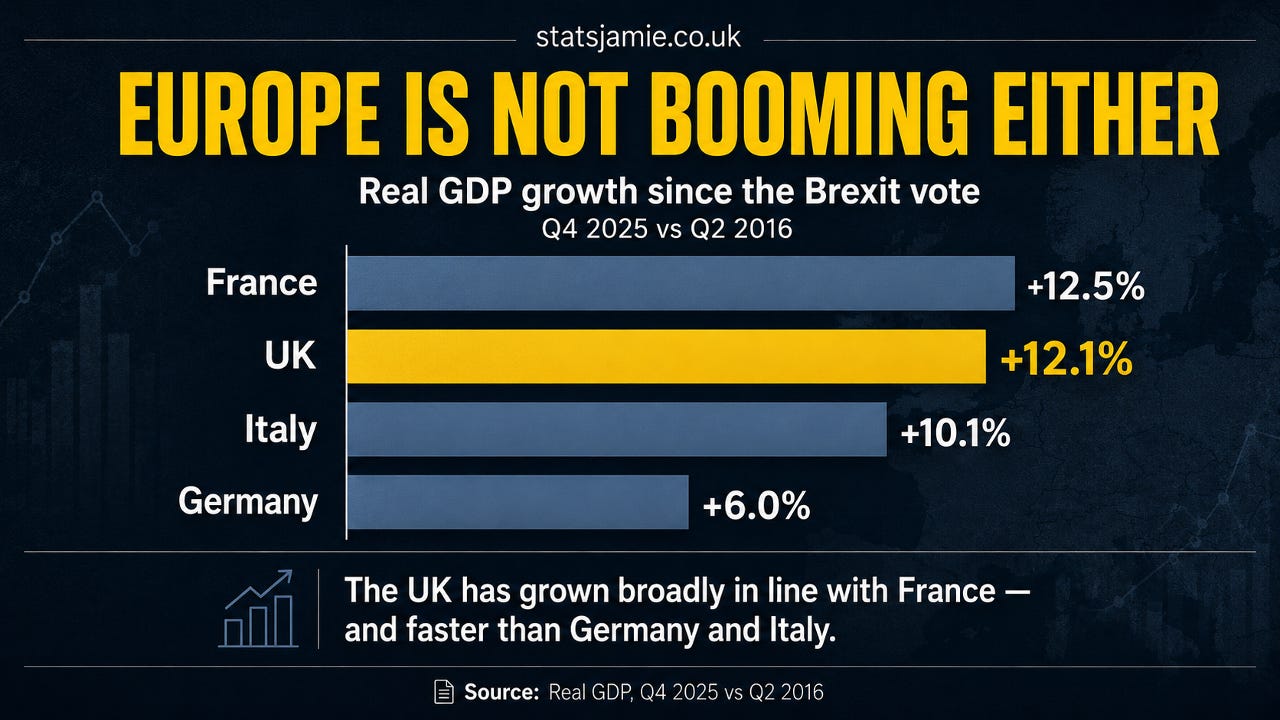
So the honest picture is this: Britain has grown broadly in line with France, faster than Italy, and roughly twice as fast as Germany since the Brexit vote.
That does not prove Brexit was an economic triumph. It clearly was not. But it does puncture the lazy political story that Britain’s problems are simply the result of Brexit, and that closer alignment with Brussels is some obvious economic cure.
Britain has serious economic problems: weak productivity, expensive energy, high taxes, poor infrastructure, unaffordable housing, and too many people out of the labour market. Those problems are real.
But they will not be fixed by pretending the EU is some economic rocket ship. Germany is stagnating. Italy remains sluggish. France is only slightly ahead of Britain over this period.
So when Starmer says Britain must be put back “at the heart of Europe”, the question is obvious:
Why is he trying to tie Britain more closely to a bloc whose own economic engine is spluttering?
Britain needs growth. It needs investment. It needs cheaper energy. It needs planning reform. It needs lower burdens on business. It needs better infrastructure. It needs a tax system that rewards work, risk and enterprise.
It does not need a Prime Minister treating Brussels as a comfort blanket.
The Working-Class Disconnect
The sharpest question of the day came from Katherine Forster of GB News.
She pointed out that Labour was founded to represent the working class, many of whom voted for Brexit because they felt left behind. She then put the problem directly to Starmer: after losing core votes in the Red Wall, Wales and Scotland, why was he standing in London promising “more Europe”?
It cut to the heart of the speech. Starmer’s response was to go straight back to Brexit.
He talked about Nigel Farage. He said Brexit had not made Britain richer, had not reduced migration, and had not made the country more secure. He said Britain needed stronger economic, defence and security arrangements, and that was why he wanted Britain closer to Europe.
That exchange tells you everything. The question was about whether Labour had abandoned working-class voters. The answer was about Brexit.
Starmer did not really address the deeper issue: that many voters feel ignored, overtaxed, priced out, talked down to, and taken for granted by a political class that keeps asking for their trust while delivering less and less in return.
When working-class voters asked to be heard, Starmer heard Nigel Farage.
The Chaos Is Already Here
Starmer’s defence is that changing leader would plunge the country into chaos. But that argument is wearing thin, because the chaos is already here.
According to reports, Cabinet ministers are now pushing him to quit, with sources claiming senior ministers went into No 10 to tell him his time is up. Dozens of Labour MPs have reportedly told him to resign after his fightback speech failed to stop the mutiny, and at the time of writing, 72 MPs are said to have publicly demanded a timetable for his departure.
The line from one Labour source is devastating: “The PM has had his say, people have heard him out, but it has not changed minds. The herd is moving.”
That is the danger for Starmer. Once a Prime Minister becomes the issue, every speech becomes a survival test. Every press conference becomes a leadership story. Every policy announcement gets swallowed by the same question: how long has he got?
There are also signs the party is no longer united around what comes next. Wes Streeting and Andy Burnham are reportedly canvassing supporters, Angela Rayner has called for Burnham to be allowed back into Westminster, and Labour MPs are split between those who want a swift contest and those who want a delay.
Starmer says replacing him would create chaos. But if Cabinet ministers are briefing, aides are resigning, MPs are organising, and markets are getting nervous, the more brutal question is this:
What if keeping him is the chaos?
That is not stability. It is drift.
Conclusion: Time To Go
Keir Starmer’s speech was meant to reset his premiership. Instead, it confirmed why it is failing.
The country wanted evidence that he had listened. What it got was a Prime Minister still trapped in the old arguments: Europe, Brexit, Reform, and the claim that any alternative would mean chaos.
Britain should not be complacent. But nor should it be conned into thinking Brussels is the answer to problems made in Westminster. Britain’s future will not be saved by moving closer to a low-growth European bloc. It will be saved by fixing Britain.
That is why yesterday’s speech matters. Not because it was dramatic, but because it was revealing.
Starmer has had his reset. It failed. Now the rebellion appears to be widening, the Cabinet is wavering, and Labour MPs are openly asking whether he can carry on.
Britain does not need another Starmer reset. It needs a Prime Minister who has actually heard the country.
✍️ Jamie Jenkins
Stats Jamie | Stats, Facts & Opinions
📢 Call to Action
If this helped cut through the noise, share it and subscribe free by entering your email in the box below and get the stats before the spin, straight to your inbox (no algorithms).
📚 If you found this useful, you might also want to read:
The Cost Of Living Is Heating Up Again — And Labour Has No Real Buffer Left

In June 2024, the month before Labour took office, CPI inflation stood at 2.0%. It now stands at 3.3%. So before ministers start blaming wars, oil markets or events abroad, let’s start with the obvious: inflation is higher now than when Labour inherited office. The latest rise was driven above all by transport, with higher fuel costs pushing the headlin…
📲 Follow me here for more daily updates:
No strategy, no imagination, no intelligence, just a robot, spouting words in a robotic voice devoid of emotion.
The idea that Starmer could repair the damage of the local election drubbing by making the "Speech of his life" is laughable. It's long past the the time for making speeches. Action is required.
Both France and Germany are in economic trouble. The leaders of both countries have said that they can no longer afford the welfare bill. There have been headlines recently to the effect that France is even considering an IMF bailout. German industry is shrinking and its industrial leaders say the causes are too much regulation and too high energy costs.