

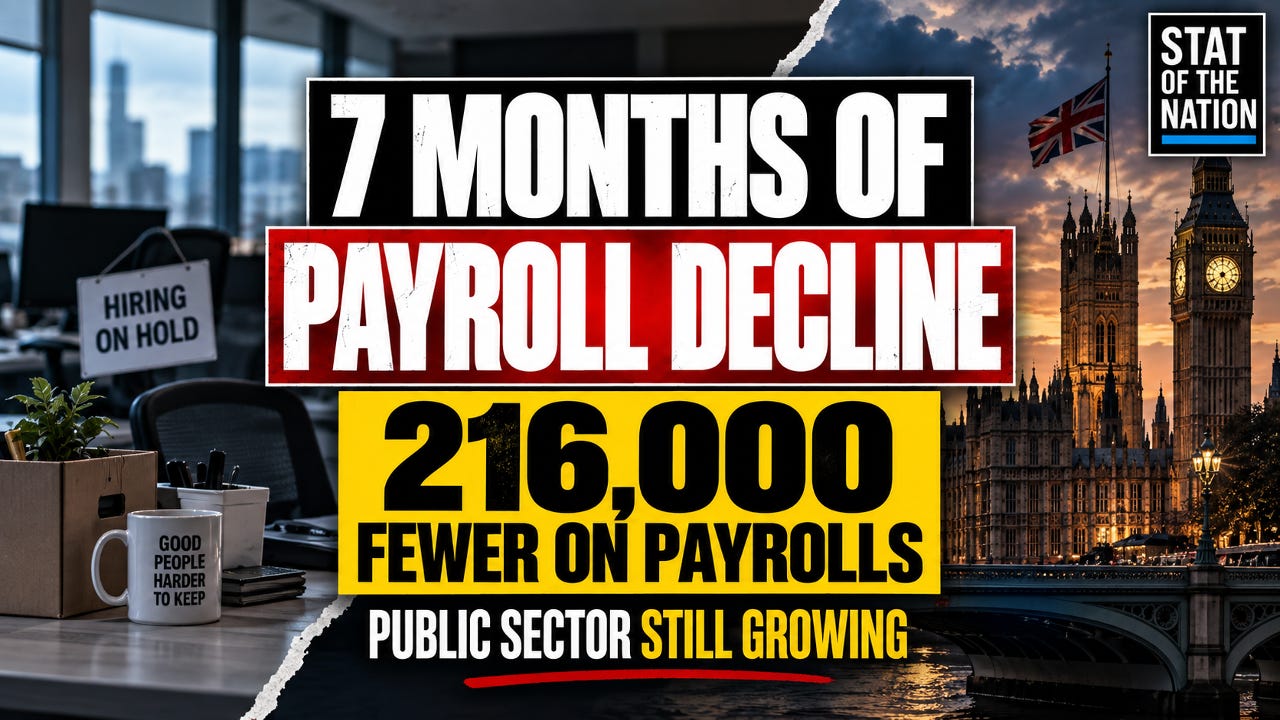
Britain has now recorded seven consecutive months of falling payroll employment.
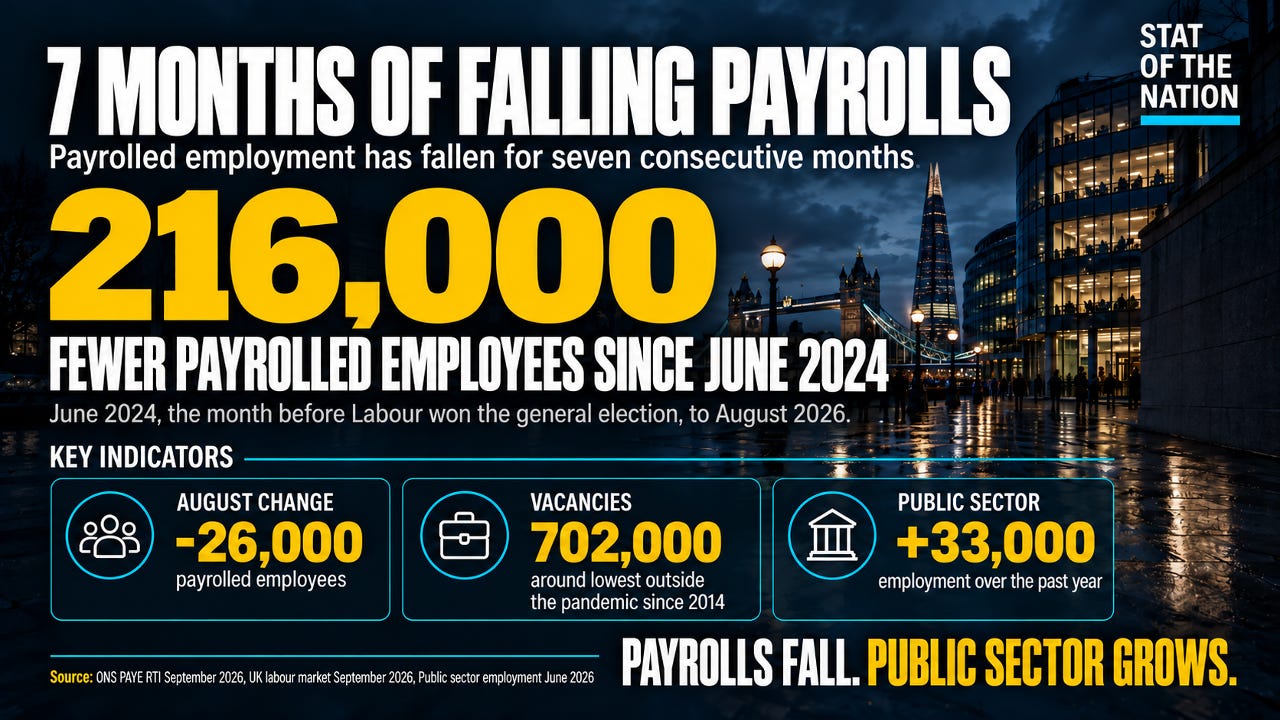
Another 26,000 employees disappeared from payrolls in August, taking the total down to 30.2 million. The latest ONS figures also show payrolled employment is 145,000 lower than a year ago.
But perhaps the more striking comparison is with the month before the general election.
In June 2024, Britain had 30,443,310 payrolled employees.
By August 2026, that had fallen to 30,227,243.
That is 216,067 fewer payrolled employees, around 216,000.
Vacancies have also fallen to 702,000 and smaller businesses are cutting back recruitment.
Meanwhile, public sector employment is still rising.
Britain is losing payroll employees, businesses are advertising fewer jobs, and the state is still getting bigger.
Seven Months of Falling Payroll Employment
August remains an early estimate and will be revised as more payroll information arrives.
But this is no longer about one provisional month.
Payroll employment has now fallen for seven consecutive months, and the ONS says the number of payrolled employees has generally been falling over the past two years.
Crucially, the ONS currently says PAYE Real Time Information provides its most reliable measure of employees.
That is why these numbers deserve attention.
Businesses Aren’t Just Cutting Jobs, They’re Hiring Less
Perhaps an even more revealing indicator is vacancies.
There were an estimated 702,000 vacancies across the UK in June to August 2026.
Outside the pandemic, the last time Britain had 702,000 or fewer vacancies was back in 2014.
The weakness among smaller employers is particularly striking.
Vacancies at businesses employing between one and nine people are down 23.5% in a year.
And the ONS makes an important observation.
Feedback from its Vacancy Survey suggests smaller firms may not be recruiting because of increases in labour costs.
That is important because this is no longer just theoretical.
Businesses themselves are telling the ONS that rising labour costs may be affecting recruitment.
A Reminder: What Did Labour’s “Jobs Tax” Do?
From April 2025, Labour increased employer National Insurance from 13.8% to 15% and cut the salary threshold at which employers start paying it from £9,100 to £5,000.
The Employment Allowance was also increased, cushioning the impact for some smaller employers.
But for many businesses, employing people became more expensive.
I have called this the jobs tax before because it increases the cost of employing someone.
That does not mean every payroll job lost since then was caused by National Insurance.
But what makes these latest figures interesting is that the ONS is now reporting feedback from smaller businesses that higher labour costs may be stopping them recruiting.
Increase the cost of employment and it should hardly be surprising if some businesses respond by employing fewer people.
Meanwhile, Public Sector Employment Is Rising
Now look at what is happening inside the state.
Public sector employment reached 6.21 million in June 2026, up 33,000 in a year.
Central government employment reached a record 4.08 million. The Civil Service employed 557,000 people, 6,000 more than a year earlier.
There is an important qualification.
Some schools becoming academies are statistically reclassified from local government into central government. Academy conversions accounted for around 21,000 of the annual movement between the two.
But total public sector employment itself was still 33,000 higher than a year ago.
So we have a striking contrast.
Overall payroll employment is falling, while public sector employment is rising.
And there is a basic economic reality here.
You cannot have a growing public sector without an economy capable of paying for it.
Public services and public sector salaries ultimately have to be financed through taxation, or through borrowing that taxpayers ultimately have to service.
That requires businesses employing people, paying wages, making profits and generating tax revenues.
The state cannot sustainably keep growing if the economy supporting it becomes weaker.
Then Look at Pay
The contrast becomes sharper again when we look at earnings.
Public sector regular pay growth: 6.3%
Private sector regular pay growth: 2.9%
Public sector regular earnings are currently growing at more than twice the rate in the private sector.
There is an important caveat. The ONS says public sector pay growth is being affected by variations in the timing of pay awards this year.
But the gap remains striking.
Private sector wage growth has slowed while businesses are simultaneously facing higher employment taxes and rising labour costs.
Fixing the Foundations?
Labour came into government promising to “fix the foundations”.
Since June 2024, Britain has lost around 216,000 payrolled employees.
Payroll employment has now fallen for seven consecutive months.
Businesses are advertising fewer vacancies.
Smaller employers are telling the ONS that rising labour costs may be stopping them recruiting.
Meanwhile, public sector employment is rising and public sector pay is currently growing at more than twice the private sector rate.
Government can spend more and employ more people.
But ultimately, those commitments have to be financed.
The state cannot keep growing unless the economy that pays for it grows too.
Britain needs businesses hiring, investing, creating profits and expanding the tax base that supports public services.
Right now, the payroll numbers are moving in the opposite direction.
✍️ Jamie Jenkins
Stats Jamie | Stats, Facts & Opinions
If you found this analysis useful, please share it and subscribe for more.
📲 Follow me here for more daily updates:
Great analysis Jamie, you along with colleagues on Substack are a breath of fresh air, bringing detailed data, that wound be otherwise covered up by the Blob that is trying to control us.
To some extent Public Sector employees are parasitic upon the larger economy, but they pay rents and buy food (etc) like the rest of us. So your stats look like good old Keynesianism in its, what, eighth decade by now? Buying voters on tick while too terrified to sell off US Treasury Bonds for fear of angering the insane extractive class.
Id guess the falling private sector payrolls reflect retrenchment but also a steady stream of SMEs that simply can't compete anymore?
Are NGOs/Charities accounted for separately out of curiosity?