

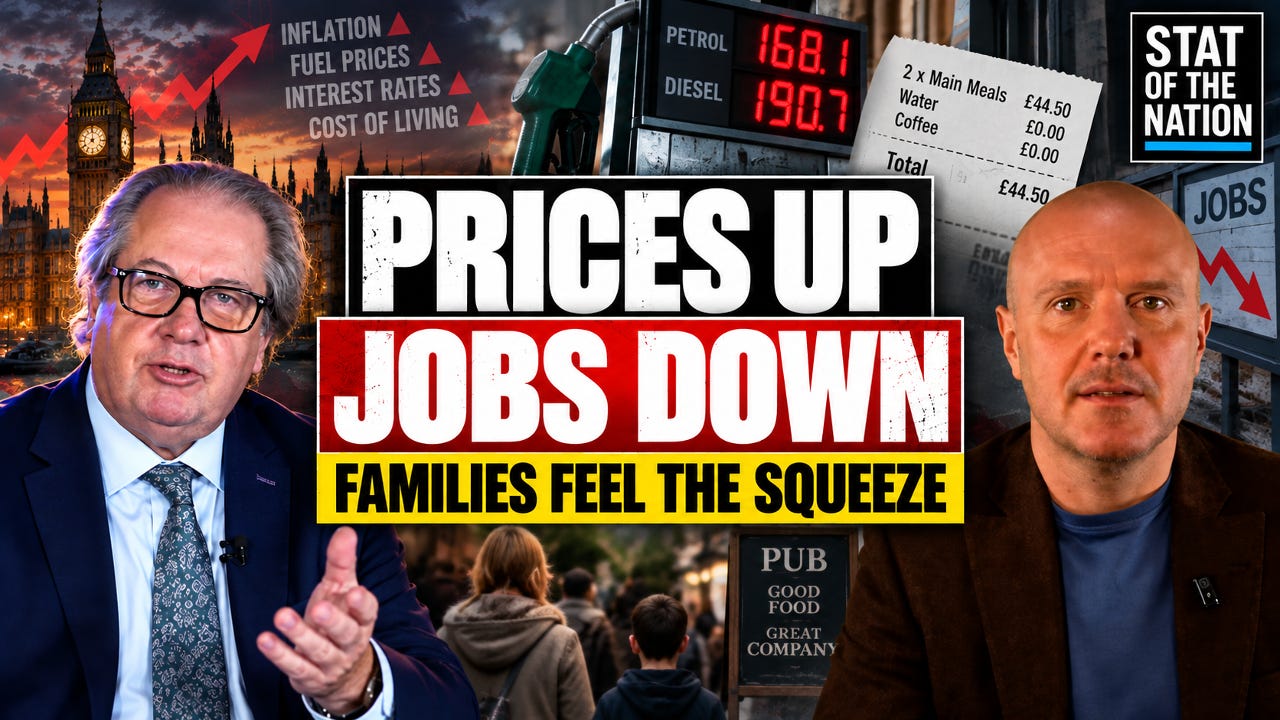
I joined Mike Graham this week to talk through the latest economic data, and there was plenty to get into: inflation back above 3%, sharply higher fuel prices, another fall in payroll employment and the growing squeeze on household budgets.
And sometimes a simple story tells you as much about the economy as the headline statistics.
Mike told me he had taken his son for lunch at a country pub near Bath. Two meals, water and a coffee came to £44.50.
He could afford it. But what about the family of four sitting behind him?
That became one of the themes of our conversation: after several years of rising prices, how much room do ordinary households actually have left to spend?
Watch the Full Conversation
Inflation Is Rising Again
The latest figures show inflation increased from 2.9% to 3.1% in August, with transport, particularly motor fuels, helping drive the increase.
Motor fuel prices were 23% higher than a year earlier.
There is an important point here that often gets misunderstood.
If inflation stays at 3%, prices have not stopped rising. They are still increasing by around 3% a year, on top of all the increases households have already absorbed.
That cumulative impact is what matters.
Inflation may be well below the levels reached during the worst of the cost-of-living crisis, but that does not mean prices have gone back down.
Higher Fuel Prices, Then Higher Interest Rates?
We also talked about the Bank of England and whether higher interest rates are really the answer to another bout of inflation driven by fuel and energy.
My concern is straightforward: putting UK interest rates up does not make global oil cheaper.
Higher rates can reduce demand elsewhere in the economy, but they also squeeze households through mortgages, borrowing costs and potentially rents.
That risks creating a double hit: higher fuel and energy costs, followed by higher borrowing costs in an attempt to tackle inflation partly being driven by those external pressures.
Seven Months of Job Losses
At the same time, the labour market is weakening.
The latest payroll figures showed another fall in August, leaving payroll employment 145,000 lower than a year earlier.
We have now seen seven consecutive months of year-on-year falls in payroll employment.
And some of the biggest losses have been in areas such as retail and hospitality, exactly the parts of the economy that feel it when households start cutting discretionary spending.
That brings us straight back to the pub.
When Families Stop Spending
£44.50 for two pub meals does not tell us everything about the British economy.
But it illustrates the pressure households are under.
When prices keep rising, people change their behaviour. They eat out less, postpone purchases, cut back on weekends away and look for cheaper alternatives.
Multiply those decisions across millions of households and businesses start feeling it.
Demand weakens. Recruitment slows. Hours get cut. Eventually, jobs can disappear.
That is why inflation and employment should not be viewed as completely separate stories.
The bigger question is becoming very simple: how much money do households actually have left after paying for the essentials?
And when fuel, food, housing and other everyday costs have all become more expensive, there is less left to spend elsewhere.
We covered all of this, plus public versus private-sector pay, energy policy and the outlook for interest rates, in my latest conversation with Mike Graham.
Watch the full discussion above.
✍️ Jamie Jenkins
Stats Jamie | Stats, Facts & Opinions
If you found this analysis useful, please share it and subscribe for more.
📲 Follow me here for more daily updates: