

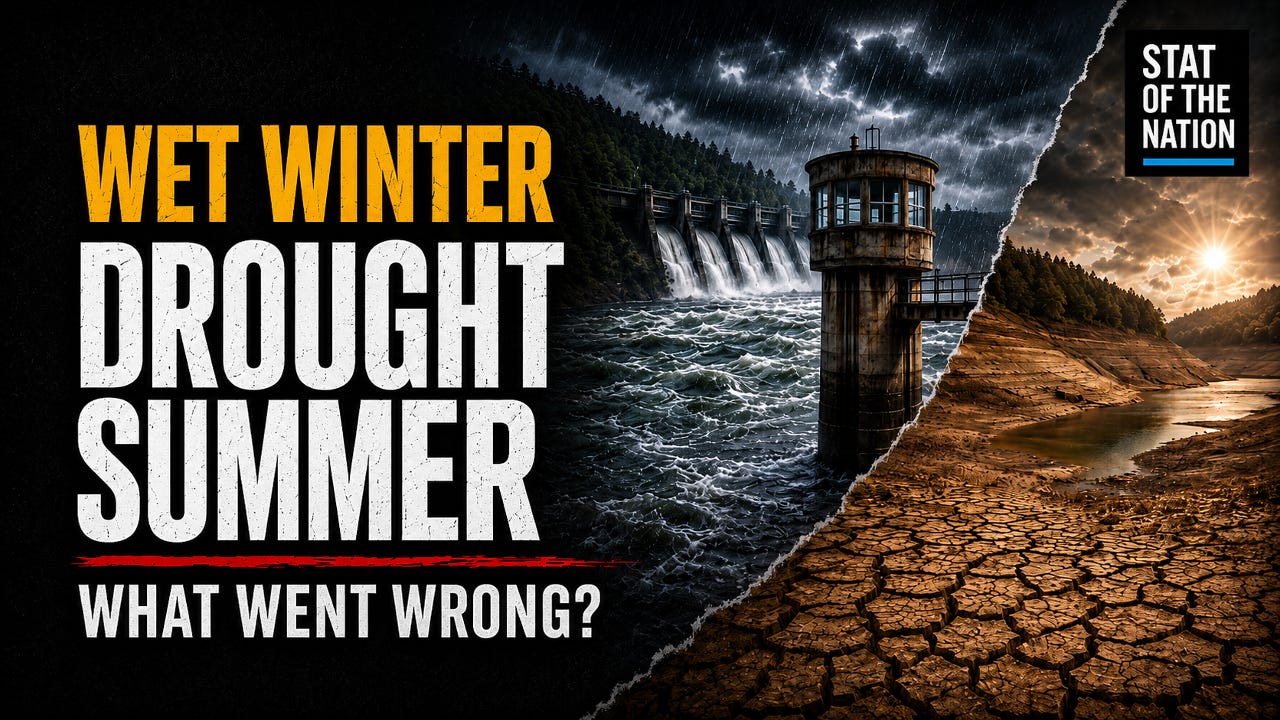
Britain has moved from an unusually wet winter to widespread drought in a matter of months.
Rainfall across the UK last winter was 13% above the long term average. England received 42% more rainfall than normal, while Wales received 20% more. England experienced its eighth wettest winter on record, with southern England recording its fourth wettest.
Yet half of England has now officially been declared in drought, while Natural Resources Wales has extended its environmental drought declaration across the whole of Wales. Scotland and Northern Ireland are not covered by those declarations, but the situation raises a wider UK question about whether essential infrastructure has kept pace with the country’s growth.
The immediate cause of the drought is clear. July brought exceptionally low rainfall, sustained high temperatures and soaring demand. But extreme weather does not remove the responsibility to prepare for it.
The bigger question is why a country that has added millions of people, built millions of homes and repeatedly warned of growing pressure on water supplies has taken so long to expand the infrastructure needed to support them.
From a Wet Winter to Drought
By the end of February, England’s reservoirs were 94% full, with twelve completely full. River flows were normal or higher at every monitored site, while groundwater levels had risen across most of the country. The winter rainfall provided an important buffer as Britain entered spring.
Then the rain stopped.
By late July, England had received just 7% of its long term average rainfall for the month, falling to only 1% across southern England. Wales had received just 8% of its normal July rainfall, putting the month on course to be the driest July in Wales since records began 190 years ago.
This is a genuine drought with serious consequences. Rivers are exceptionally low, groundwater levels are falling, wildlife is under pressure and farmers face worsening conditions. In England, seven water companies have introduced temporary restrictions covering 23 million customers, around 40% of the population.
However, drought is not only a test of the weather. It is also a test of how much resilience a country has built into its water system.
The Population Grew. Infrastructure Did Not Keep Pace
In 1995, the UK population was just over 58 million. The provisional estimate for 2025 is almost 69.5 million.
That is an increase of approximately 11.5 million people, or nearly 20%, in 30 years.
Every additional household requires a reliable supply of clean water. Every new housing development needs pipes, treatment capacity, local storage and connections to the wider network. Growing towns and cities also place greater pressure on reservoirs, rivers and groundwater.
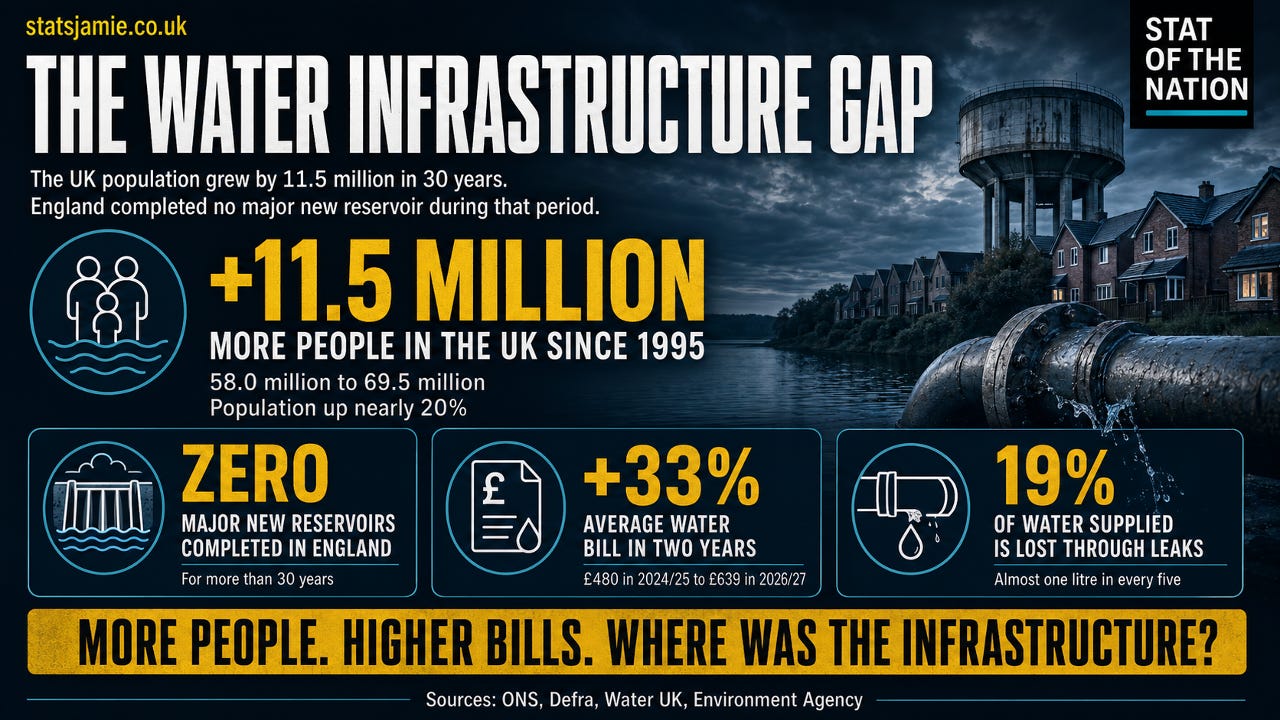
Yet England has not completed a new major reservoir for more than 30 years. Havant Thicket is expected to become the first around 2030, while water companies have committed to bringing nine new reservoirs into operation by 2050.
The issue is not that nobody knew demand would rise. Population growth was measurable, housing development was planned and concerns about future shortages were repeatedly documented.
Britain increased the number of people relying on the system without expanding strategic capacity at anything close to the same rate. That is not long term planning. It is decades of delayed catch up.
Reservoirs Matter
England’s reservoir storage fell from 94% at the end of February to 75.3% by late July, leaving it around 7.4 percentage points below the seasonal average. Almost half of monitored reservoirs were below normal levels.
The fact that reservoirs were almost full in February does not prove that Britain has sufficient storage. It proves that the wet winter provided a buffer, while the speed at which that buffer was depleted demonstrates why additional capacity matters.
Reservoirs allow a country to capture water during wet periods and use it when rainfall collapses. Not every drop can or should be stored, because rivers, wetlands and groundwater also need replenishing. But after adding more than 11 million people to the population, it is extraordinary that England went more than three decades without completing a major new reservoir.
It is about reservoirs, but it is not only about reservoirs. Britain also needs sufficient treatment capacity, local storage tanks, stronger connections between regions and the ability to move water from areas with greater supplies to those experiencing pressure.
The restrictions affecting around 33,000 properties in west Wales illustrate this wider problem. Dŵr Cymru said its treatment works were operating at maximum capacity, with additional water being moved around the network wherever possible.
That does not make reservoirs less important. It shows that the entire chain matters, from capturing raw water to treating, storing and delivering it.
Bills Have Risen by a Third in Two Years
This lack of resilience would be frustrating enough if households were paying less. They are not.
The national average water bill across England and Wales was £480 in 2024/25. Water UK forecast an average of £603 for 2025/26, followed by £639 for 2026/27. That is an increase of £159 in two years, or around 33%.
The water industry says these increases are helping to fund a £104 billion investment programme between 2025 and 2030. The money is intended to improve supplies, replace ageing infrastructure, reduce pollution and provide greater resilience.
Investment is clearly needed. The question is why households are only now being presented with the bill for decades of insufficient infrastructure.
Why were major reservoirs not built earlier? Why were treatment works not expanded as the population grew? Why were connections between water supply areas not strengthened before shortages and restrictions returned?
Households paid water bills throughout the entire period in which the population increased and infrastructure failed to keep pace. They are now being asked to pay substantially more while also being told to consume less.
Nearly One Litre in Five Is Still Lost
The questions become even harder when leakage is considered.
Nearly 19% of the water supplied in England is lost through leaks. The Environment Agency describes that level as unacceptably high and warns that delays to new supply projects could undermine future resilience.
Leakage can never be eliminated completely. Britain has a vast network of ageing pipes, many buried beneath roads and difficult to inspect or repair. But losing almost one fifth of the supply remains difficult to defend when millions of households face higher bills and restrictions.
Consumers are told to take shorter showers, avoid watering their gardens and stop washing their cars. At the same time, a substantial amount of treated water is lost before reaching anyone’s tap.
Households have a responsibility not to waste water. Water companies have a responsibility not to lose it.
What Are We Paying For?
That is the central question.
The UK population has increased by 11.5 million people in 30 years. England completed no major new reservoir during that period. Nearly 19% of the water supplied in England is still lost through leakage, while average bills across England and Wales have risen by around a third in two years.
Customers are now being asked to finance a vast programme of catch up investment after infrastructure failed to expand alongside the population it was meant to serve.
Some responsibility belongs to the water companies. Some belongs to regulators that approved investment plans and price settlements. Some belongs to successive governments that allowed strategic projects to remain trapped in planning and consultation.
But the failure does not primarily belong to the household using a garden hose.
The public has paid water bills for decades. It is now paying substantially higher bills and being asked to accept restrictions when the system comes under pressure. It is reasonable to ask what level of resilience that money has purchased.
The Bottom Line
The current drought has been caused by exceptionally low rainfall, sustained high temperatures and rising demand. That is not in dispute.
But its consequences have been made worse by a country whose population grew rapidly while essential infrastructure failed to keep pace.
Britain needs more reservoirs, greater treatment capacity, stronger regional connections and faster progress on repairing leaking pipes. These investments should have been delivered alongside population and housing growth, rather than decades later through catch up programmes funded by sharply rising bills.
The weather caused the drought. Population growth increased the pressure. Decades of weak infrastructure planning left the system exposed.
Until that changes, Britain will continue moving from wet winters to summer restrictions while customers are left asking a perfectly reasonable question:
What exactly have we been paying for?
✍️ Jamie Jenkins
Stats Jamie | Stats, Facts & Opinions
If you found this analysis useful, please share it and subscribe for more.
📚 You might also want to read:
Britain Is Broke — So Why Are MPs Demanding More Foreign Aid?

Before Andy Burnham has even become prime minister, another major spending demand has arrived. Labour MPs want the Government to begin a return to spending 0.7% of gross national income on overseas aid.
📲 Follow me here for more daily updates:
We've had something like half a million more people in Net Immigration per year since about 2010. As I understand it the Home Office is still working on the basis of 400 thousand per year in the future. That's a city about the size of Bristol, not just once but every year. Just think of the resources needed for a City that size, in housing, schools, doctors, water and sewage treatment, waste handling, electricity, everything.
Problems with the planning system have a lot to do with lack of reservoirs. I think Thames Water has been trying to get one built near Oxford since the 90's and it's not just the so called nimbys it's also bodies like Natural England, Environment Agency, the Minister and the regulator himself who are objecting. And by the way I count myself as a fully paid up nimby. Everyone is a nimby when it comes to the crunch.