

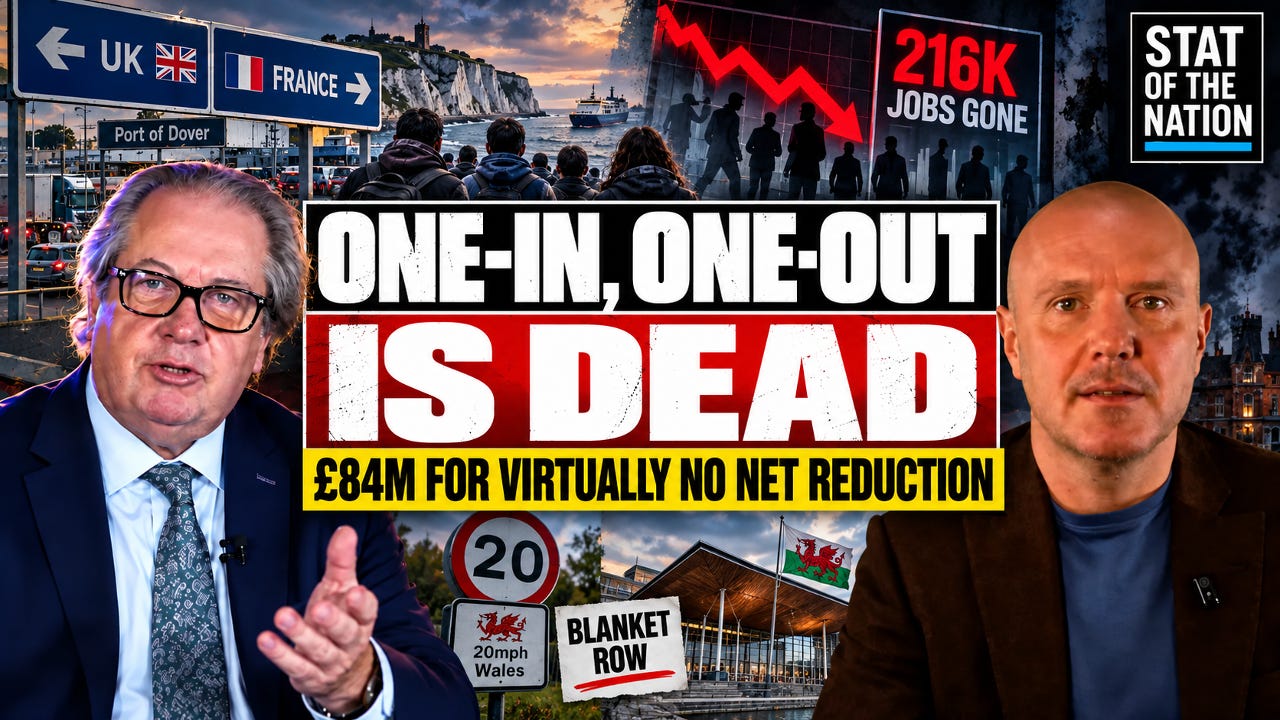
I joined Mike Graham again this week, and we started with a policy we were talking about on the show more than a year ago.
One-in, one-out is dead.
We also got into Andy Burnham’s spending plans, the state of the jobs market and the extraordinary row in the Senedd over whether politicians should use the word “blanket”.
Watch my full interview with Mike below.
£84 Million for Virtually No Net Reduction
The principle behind one-in, one-out sounded straightforward.
Someone arriving across the Channel could be returned to France. In exchange, Britain would take an asylum seeker from France through the legal route.
The problem with the numbers was obvious from the beginning. If you send roughly one person out and bring roughly one person in, you are not substantially reducing the number of people in Britain.
Home Secretary Shabana Mahmood told MPs in September that the numbers going in each direction had tracked “fairly evenly”. She also revealed that returning people to France was costing around £56,000 per person.
Around 1,500 people were ultimately returned.
So the implied calculation is straightforward:
1,500 × £56,000 = around £84 million.
That £84 million is an estimate based on the Home Secretary’s average cost per return, rather than a published final bill for the entire scheme.
But the value-for-money question remains.
We spent tens of millions returning people to France while taking broadly the same number back through the other side of the agreement. And all of this was happening on a tiny scale compared with the overall number of people crossing the Channel.
As I said to Mike, it was a drop in the ocean.
A year after the policy was being talked up as part of the answer to Channel crossings, it is gone.
Another Big Spending Promise
We then moved onto Andy Burnham’s proposed National Care Service.
The government says it wants to introduce free personal care for older people in the next Parliament, with changes to the state pension triple lock from April 2030 helping to fund it.
Social care undoubtedly needs reform.
But my point to Mike was about the bigger picture: where is the plan to get existing spending under control?
Britain borrowed £77.3 billion in the first five months of this financial year, £8.1 billion more than forecast. Over those same five months, central government spent £50 billion on debt interest alone.
Yet so much of our political debate still seems to revolve around finding the next thing government can spend money on.
Social care, health, welfare and defence all require funding. But eventually somebody has to confront the other side of the equation.
How much government can sustainably spend, and who pays for it?
Cardiff Bay and the Word “Blanket”
Then came perhaps the most bizarre part of the interview.
During a Senedd debate on Wales’s default 20mph speed limit, Janet Finch-Saunders used the word “blanket”.
She was pulled up on it and apologised.
Later, Russell George used the same word, was interrupted and corrected himself to “default”.
This really happened.
The Llywydd reminded Members that the Standards Commissioner and others had previously ruled that “blanket” was not appropriate when describing the policy. The earlier ruling described the term as imprecise and inaccurate.
There is a factual distinction here. The policy changed the default limit on restricted roads rather than making every road in Wales 20mph, and exceptions can be made.
But the spectacle of elected politicians being pulled up in the Welsh Parliament for saying the word “blanket” is, in my view, bonkers.
Wales has enormous challenges.
NHS waiting lists remain a serious problem. We have economic challenges and stretched public services. Yet this is the calibre of debate we are seeing in Cardiff Bay, from politicians whose wages we all pay.
For me, it is another example of why I remain deeply sceptical about calls for further devolution or Welsh independence.
Before demanding substantially more powers for Cardiff Bay, perhaps we should be asking how well the powers Wales already has are being used.
Giving an institution more power does not automatically mean better government.
216,000 Payroll Jobs Down, 130,000 Promised
We finished with perhaps the strongest numerical comparison of the interview.
The latest ONS figures estimate there were 30.2 million payrolled employees in August, down 145,000 compared with a year earlier.
The ONS says payrolled employment has generally been falling from its 2024 peak.
Using the underlying ONS series, there are now around:
216,000 fewer people on UK payrolls than in June 2024.
Then look at what Chancellor John Healey announced this week.
The government says it will use the National Wealth Fund’s existing capitalisation to create and support 130,000 jobs across the UK by 2030.
Put those figures next to each other.
216,000 payroll jobs down since June 2024.
130,000 jobs promised by 2030.
Even if all 130,000 are additional jobs, that is equivalent to only around 60% of the payroll employment decline we have already seen.
That was my point to Mike.
Labour increased employer National Insurance, increasing the cost of employing people. I have consistently called it a jobs tax.
Of course, you cannot attribute every lost payroll job to one tax change. Employment is affected by growth, wages, business confidence and plenty of other factors.
But my argument has always been that making it more expensive to employ people when the jobs market is already weakening is hardly going to help.
So we have increased the cost of employment, payroll numbers have fallen, and government is now using public policy and the National Wealth Fund to create or support 130,000 jobs by 2030.
That would fix only just over half of the payroll decline we have already seen.
And they have until 2030 to do it.
The Same Question Keeps Appearing
Immigration. Social care. Devolution. Jobs.
They look like separate stories, but the same question keeps appearing:
What are the actual outcomes?
One-in, one-out operated at tiny scale and came with an implied return cost of around £84 million.
Government continues to unveil new spending commitments while borrowing remains above forecast and debt interest swallows tens of billions.
Payroll employment has fallen by around 216,000 since June 2024, while the government promises to create or support 130,000 jobs by 2030.
And in Wales, politicians are being pulled up in the Senedd for saying the word “blanket”.
You can agree or disagree with the arguments I made to Mike.
But this is why I keep coming back to the numbers.
Political announcements are easy.
Outcomes are what matter.
✍️ Jamie Jenkins
Stats Jamie | Stats, Facts & Opinions
If you found this analysis useful, please share it and subscribe for more.
📲 Follow me here for more daily updates:
Can Starmer give our money back? Sieve and sell his assets