

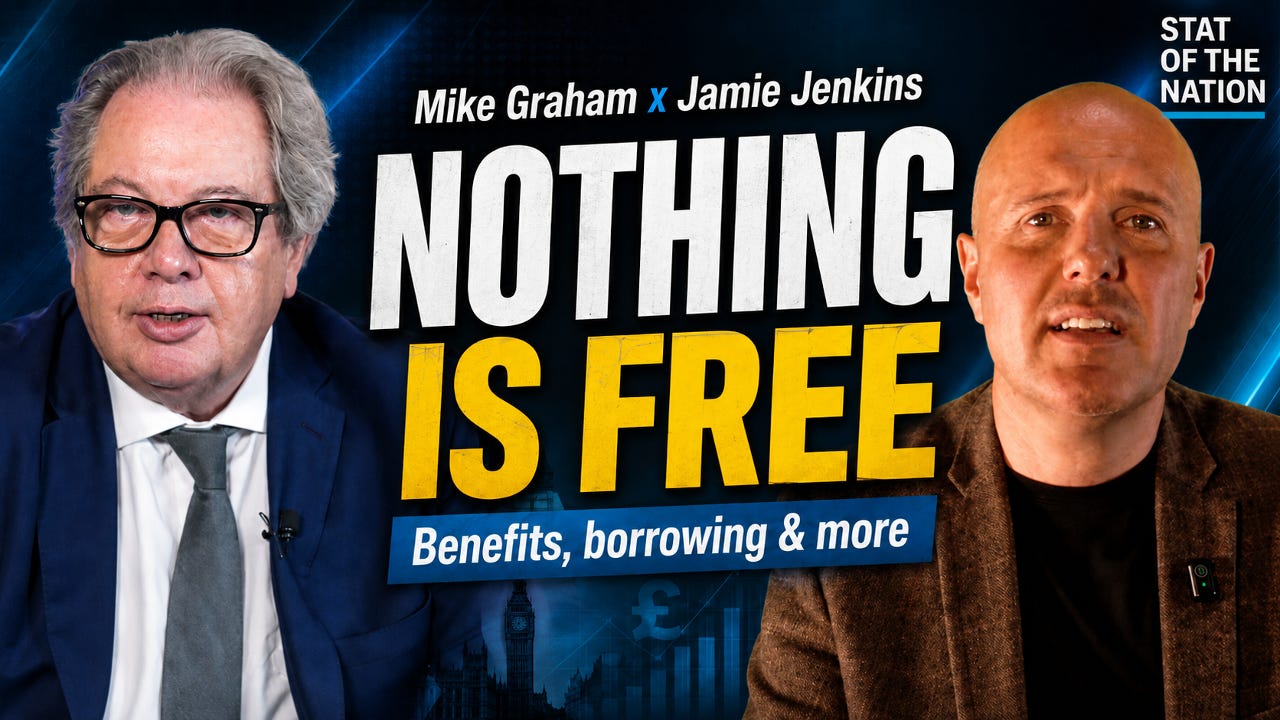
This week on The Mike Graham Show, we discussed the two-child benefit cap, rising disability claims, Labour’s growing list of “free” promises and why Britain must restore the principle that work should pay.
The welfare state was created as a safety net for people who fell on hard times or genuinely could not support themselves. Increasingly, however, it risks becoming a permanent way of life, while taxpayers and businesses are expected to carry an ever-heavier burden.
Watch the full discussion below.
Free Food, Free Childcare, More Benefits
One of the more extraordinary ideas discussed was a proposed national food service.
A senior adviser linked to Andy Burnham has reportedly floated the creation of around 9,500 state-supported restaurants, providing free meals to families.
We also discussed proposals for more free childcare for people receiving benefits, alongside the removal of the two-child benefit limit.
Close to 450,000 households could receive additional support if the limit is removed, at a cost approaching £3 billion by the end of the Parliament.
Each policy is presented as compassionate and affordable. But taken together, they reveal the same political instinct: identify a problem, create another government programme and send the bill to taxpayers.
Nothing provided by government is actually free. It is funded through higher taxes, more borrowing or less spending elsewhere.
Britain Is Already Borrowing Heavily
This matters because Britain is not starting from a healthy financial position.
Since Rachel Reeves entered the Treasury, the government has borrowed around £274.3 billion. In May alone, approximately £11.7 billion was spent on debt interest.
That is the real backdrop to every new spending promise.
The government is not choosing between spare cash and another benefit. It is choosing whether to tax more, borrow more or squeeze another service.
The Office for Budget Responsibility has already warned that, without reform, Britain’s debt burden could rise dramatically over the coming decades.
That makes the endless language of “free” increasingly detached from reality.

Benefits Must Remain a Safety Net
We also discussed the sharp rise in sickness and disability claims, including claims linked to anxiety, ADHD and other mental-health conditions among younger people.
Those who genuinely cannot work deserve proper support. But the system should not write off people who could work with treatment, training or appropriate help.
A successful welfare system should move people towards independence wherever possible.
That may mean stronger conditions, proper assessments and, where appropriate, requiring people capable of contributing to undertake training, job-search activity or useful community work.
The principle should be simple: work must always pay.
The Taxpayer Cannot Fund Everything
Working people are already being pulled into higher tax bands through frozen thresholds, while businesses face rising employment costs and weaker incentives to invest.
At the same time, Britain’s ageing population will bring higher spending on pensions, healthcare and social care.
That makes it even more important to control working-age welfare spending rather than continuously expanding eligibility.
The state depends on the private economy to fund it. If taxpayers, employers and investors are squeezed too hard, the money eventually runs out.
The Bottom Line
Britain should protect the vulnerable. But compassion cannot mean unlimited spending with no conditions, no reform and no consideration of who pays.
Free food. Free childcare. More benefits. Bigger government.
Politicians can call it free. Taxpayers know better.
Watch my full discussion with Mike Graham above.
✍️ Jamie Jenkins
Stats Jamie | Stats, Facts & Opinions
📢 Call to Action
If this helped cut through the noise, share it and subscribe free by entering your email in the box below and get the stats before the spin, straight to your inbox (no algorithms).
📚 If you found this useful, you might also want to read:
The Snowflake Generation, One Million Children Referred For Mental Health Support

More than one million children in England had an active referral to mental-health services in 2024–25.
📲 Follow me here for more daily updates:
I wish more people understood that "free" is not really free, it is pre paid, by the tax payer!