

As regular readers of Stat of the Nation will know, I was calling out the one-in, one-out scheme before it was even launched.
It was sold as a simple, rational fix. A clean deterrent. A policy that would finally bring control. It never passed the basic logic test.
And now, months in — with no regular data releases, no transparent reporting, and no published performance metrics — the truth has finally emerged. Not through an official Home Office statement, but via an on-air admission from the Home Secretary herself.
📻 The admission that cut through the spin
Speaking on Nick Ferrari at Breakfast, Shabana Mahmood confirmed the latest figures for Labour’s flagship Channel policy.
They are damning.
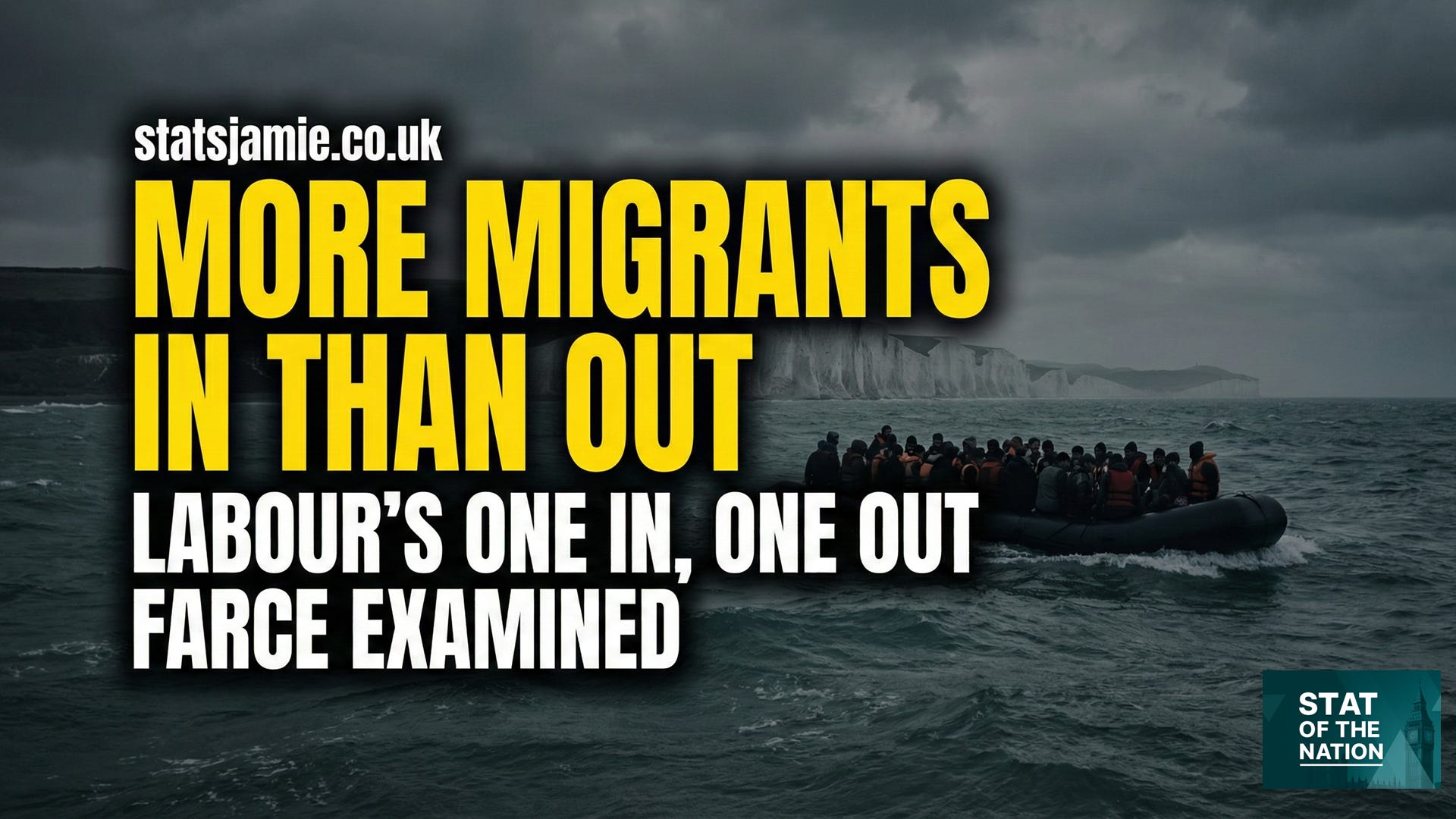
Since the scheme began, 350 migrants have been brought into the UK from France, while just 281 have been sent back. That leaves a net inflow of 69 people under a policy branded one in, one out.
We are not swapping people one-for-one. We are taking more people in than we are sending out.
That alone tells you everything you need to know about how this scheme is functioning in the real world.
📉 The scale of the problem this was meant to solve
It’s worth stepping back and remembering what this policy was supposed to tackle.
Last year alone, more than 41,000 people crossed the Channel in small boats — the second-highest total on record. That is the backdrop against which one-in, one-out was unveiled with such confidence.
Against flows of that magnitude, a scheme that quietly returns a few hundred people — while admitting even more — isn’t serious policy.
It’s theatre.
🌊 2026 so far: when weather beats government policy
Now look at what’s happened this year.
So far in 2026, 933 people have already crossed the Channel. And on 17 January alone, 317 people arrived in just five boats.
That single day — driven entirely by calm weather — brought more people into the UK than have been sent back to France under the one-in, one-out scheme since it began.
That comparison is fatal to the policy.
It shows that weather conditions, not government action, still determine outcomes. One calm day wipes out months of removals. If that’s the case, this is not a deterrent — it’s a speed bump.
🔁 Why this scheme doesn’t deter — by design
The Home Secretary herself explained the structural weakness.
Migrants returned to France are not detained. Some have already made their way back to Britain. And there are now more people in France waiting to come over under the scheme.
This isn’t stopping crossings. It’s recycling people through the system.
A deterrent changes incentives. This model simply manages flow — slowly — while crossings continue whenever the sea allows.
✈️ Rwanda: the deterrent Labour killed
That failure matters even more when set against what came before.
The previous government’s Rwanda relocation scheme was controversial and legally contested — but it was at least designed as a deterrent. After a record year for crossings, numbers did come down. We’ll never know how much of that was due to the threat of removal — because Keir Starmer scrapped the policy immediately on taking office, before it had any real chance to operate.
Now comes the sting in the tail.
Rwanda has launched legal action against the UK, arguing it’s still owed money under the scrapped treaty. The dispute has been filed with the Permanent Court of Arbitration in The Hague, and the case could drag on for years.
📊 Strip away the slogans, and the arithmetic is unforgiving
Strip away the slogans, and the picture is now unmistakable.
A policy sold as control has delivered confusion. A scheme branded one in, one out is bringing more people into the country than it sends away. One calm day in January can outpace months of removals. And while the government insists this is still a “pilot”, the forces actually driving Channel crossings remain unchanged — weather, not policy.
At the same time, the previous deterrent has been scrapped, Rwanda is now pursuing the UK through international arbitration, and taxpayers may yet face the bill for a strategy that was abandoned before it was tested.
You don’t need ideology to judge this. You don’t even need politics.
You just need to look at the numbers.
And the numbers tell a simple story: this isn’t a deterrent, it isn’t working, and it was never going to.
✍️ Jamie Jenkins
Stats Jamie | Stats, Facts & Opinions
📢 Call to Action
If this helped cut through the noise, share it and subscribe free at statsjamie.co.uk — get the stats before the spin, straight to your inbox (no algorithms).
📚 If you found this useful, you might also want to read:
41,472 illegal boat crossings in 2025, the total now up to 192,610

When Keir Starmer came into office, he promised a reset. No more slogans. No more chaos. Just results. The phrase was blunt: “smash the gangs.”
📲 Follow me here for more daily updates: