

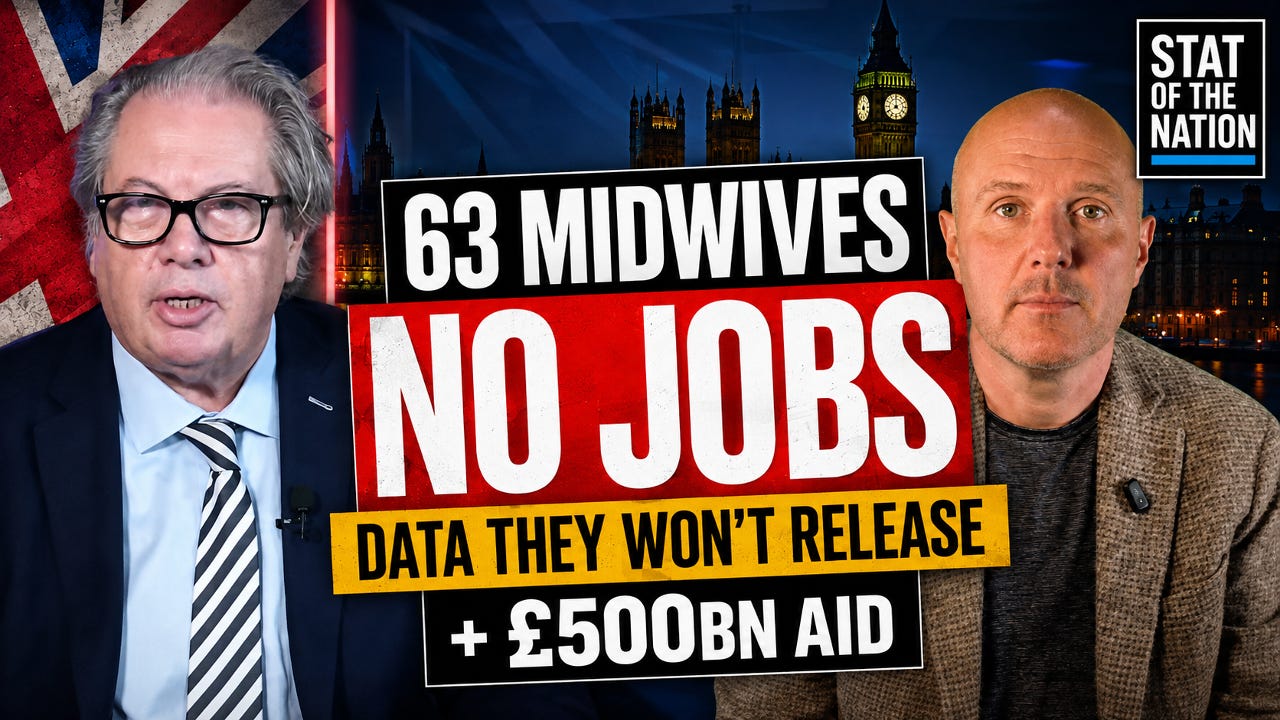
This week’s conversation with Mike Graham on the The Mike Graham Show kept coming back to one word: priorities.
Governments tell us money is tight, public services are stretched and taxes are already high. But when you look at some of the choices being made, the numbers raise some fairly obvious questions.
63 Qualified Midwives — But No Jobs
Let’s start in Wales, where around 63 newly qualified midwives remain without NHS jobs, despite completing the education and clinical training needed to work in maternity services.
Earlier this year, 68 graduates were reportedly left without posts through the NHS Wales recruitment process. Two months later, only five had secured jobs. These are people who have trained for a frontline NHS profession in a health service that regularly talks about workforce pressures, yet there are no funded jobs for them.
At the same time, the Welsh Government has funded a £350,000 Wales and Africa programme, which included its long-running tree-planting work in Mbale, Uganda. Wales also maintains a network of overseas offices, including locations in China.
The question is not whether every pound spent overseas is automatically wasted. It is about priorities.
If Wales can afford to train midwives, surely employing those midwives to deliver babies should be somewhere near the top of the spending list.
Britain Has Spent Almost £500bn on Foreign Aid
That brought us onto an even bigger spending question: how much has Britain actually spent on foreign aid since 1960?
I went back through OECD data and added up the annual figures. In cash terms, the total comes to around £285 billion. But a pound spent in 1960 was worth considerably more than a pound today, so I also adjusted the historic spending for inflation.
My calculation using the OECD data puts the total at around £500 billion in today’s money.
Half a trillion pounds.
Now put that alongside Britain’s public finances. UK public sector net debt is approaching £3 trillion, while the Government continues to borrow tens of billions of pounds because spending exceeds the money coming in. Britain has not recorded an annual budget surplus for more than two decades.
That does not mean foreign aid caused one-sixth of Britain’s national debt. Government finances do not work like that. But £500 billion is equivalent in scale to roughly one-sixth of today’s entire net debt, which puts the sums involved into perspective.
It also leads to a simple question about how we set the foreign aid budget. Rather than choosing an arbitrary percentage of national income to spend overseas, why not link it to what Britain can actually afford?
My preference would be simple: run a surplus first, then decide how much of that surplus Britain wants to spend overseas.
If government is borrowing money every year just to fund its existing commitments, taxpayers are entitled to ask whether sending billions of pounds abroad should remain a priority.

Why Is Government Fighting to Keep Crime Data Secret?
The third issue should concern people regardless of where they stand on immigration.
The Government holds information about criminal convictions. A Freedom of Information request sought conviction data for England and Wales broken down by nationality and offence, but the Ministry of Justice refused to release it.
The Information Commissioner subsequently ruled that the information should be disclosed. The Government is now appealing that decision.
So we have a fairly extraordinary position: the data exists, there is substantial public interest in seeing it, the Information Commissioner says it should be released, and the Government is fighting that decision. Taxpayers are ultimately paying for that fight.
Having spent years working in government statistics, this is where I have a real problem.
Official statistics exist to inform public debate. If government holds information that can shed light on an issue of significant public interest, then — unless there is a compelling legal, privacy or ethical reason to withhold it — transparency should be the default.
The data isn’t the Government’s. It’s the public’s.
Importantly, none of us should prejudge what the complete dataset will show. Perhaps it will reveal substantial differences between nationalities. Perhaps it will show that some of the claims circulating online are exaggerated.
That is precisely why it needs to be published.
Release the figures, provide proper population comparisons where robust data exist, break the numbers down by age and sex where appropriate, and explain the limitations. Then let people debate the evidence.
Keeping information hidden simply fuels suspicion.

40,000 Heat Deaths. 139,000 Cold Deaths.
Finally, we discussed new Office for National Statistics analysis of temperature-related mortality.
There has understandably been enormous discussion about heatwaves and the health risks associated with rising temperatures. Those risks are real, but the historical comparison is striking.
Between 1988 and 2025, the ONS estimates that in England there were approximately 40,000 deaths associated with the hottest temperatures compared with 139,000 associated with the coldest temperatures.
That means mortality associated with the coldest temperatures was more than three times higher over the period.
There is an important caveat. These are statistical estimates based on the relationship between temperatures and mortality; they are not simply counts of death certificates listing “heat” or “cold” as the cause. Heat-related mortality has also been increasing in recent years.
But the historical numbers still matter. When we debate climate and energy policy, keeping people warm and able to afford their heating remains an important public-health issue too.
Get the Priorities Right
These are four very different stories, but the same question runs through each of them: are government priorities matching the problems the country actually faces?
If we spend public money training frontline NHS workers, we should be able to employ them. If Britain is approaching £3 trillion of debt, major areas of spending deserve scrutiny. If government holds statistics that could inform one of the biggest political debates in the country, transparency should be the starting point. And when we discuss climate risks, we should look at the complete evidence.
Politicians can announce targets, strategies and spending plans. The numbers tell us whether the priorities actually make sense.
That is what Stat of the Nation is here to do.
✍️ Jamie Jenkins
Stats Jamie | Stats, Facts & Opinions
If you found this analysis useful, please share it and subscribe for more.
📲 Follow me here for more daily updates:
Foreign aid is not what we are supposed to think it is. Very little of the money goes to the people it is supposed to help. It is managed by the Foreign Commonwealth and Development office. As far as I can tell the purpose is for UK development of 'our' interests in the countries they target. Presumably someone high up thinks we get more back than we spend or we wouldn't be sending it.
This is one of the top substacks that I follow. It allows us to assess the priorities that the governments will not discuss with us and leaves us to make up our own minds.