

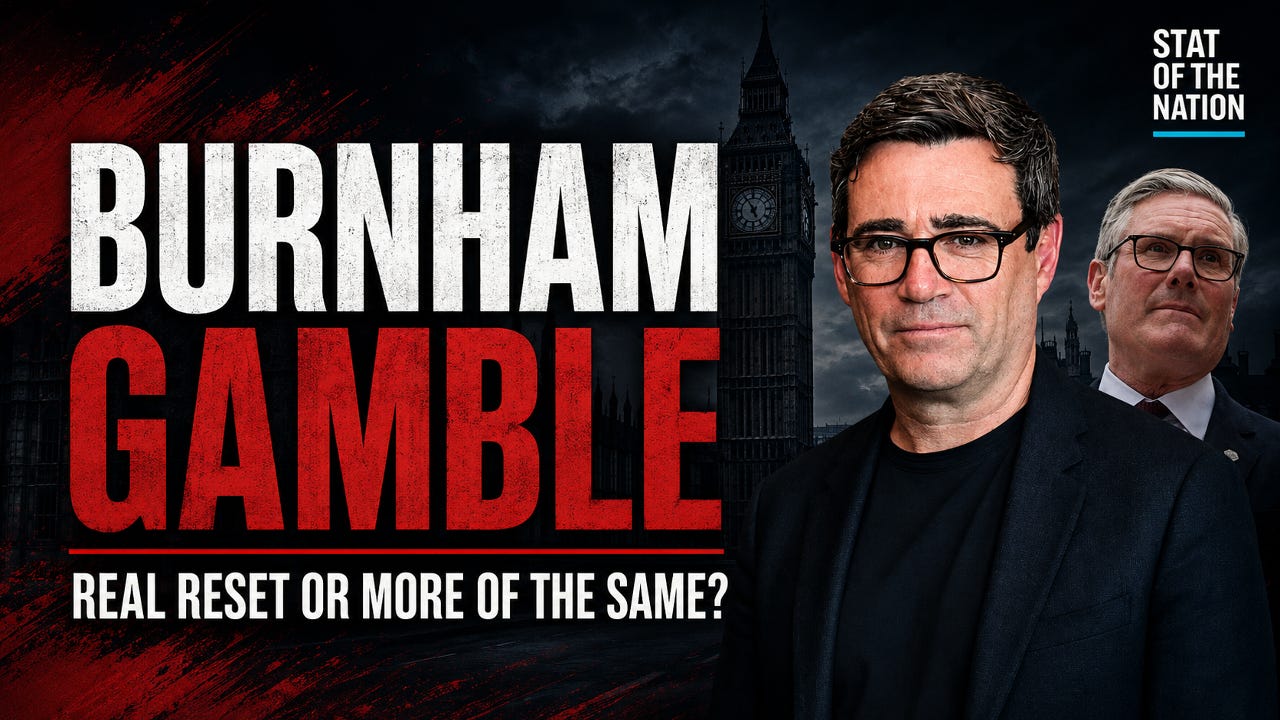
Keir Starmer’s resignation is not just the end of a failed premiership.
It is an admission that Labour’s electoral coalition was coming apart.
The party has been haemorrhaging votes in different directions. Reform has taken support from people who want tougher borders, lower taxes and a more fundamental break from Westminster politics. At the same time, the Greens have shown that Labour can now be beaten from its own left in seats it once regarded as safe.
That is why Andy Burnham is now being treated as Labour’s likely saviour.
He is not simply a replacement for Starmer. He is Labour’s roll of the dice: a more recognisable, more emotional, more traditional Labour figure who might reconnect with voters Starmer pushed away.
But there is a problem.
Trying to win back Green voters could pull Labour further left at precisely the moment it is already losing people to Reform for the opposite reason.
Gorton And Denton Was The Warning Shot
The Gorton and Denton by-election was not just an embarrassing defeat for Labour.
It was a warning about what is happening to the party’s voter base.
The Greens won with 14,980 votes, or 40.7% of the total. Reform came second on 10,578 votes. Labour fell to third with just 9,364.
That is a remarkable collapse in an area Labour had held for generations.
It showed that Labour is now vulnerable in two directions at once. It can lose voters to Reform where people want tougher action on immigration, crime, tax and the wider direction of the country. But it can also lose voters to the Greens where people think Labour has become too managerial, too cautious or too disconnected from its own activist base.
That is the political calculation behind Burnham.
He may be able to appeal to voters who think Starmer stripped the emotion, ambition and identity out of Labour. He may be able to compete with the Greens for younger, urban and progressive voters. And he may be able to challenge Zack Polanski’s appeal by sounding more radical on public services, local power and the environment.
But every move in that direction carries a cost.
The more Labour moves left to win back Green support, the harder it may become to win back voters who have drifted to Reform because they believe Labour is already too high-tax, too controlling and too detached from everyday concerns.
Burnham Is Labour’s Attempt To Rebuild A Broken Coalition
Burnham’s appeal is obvious.
He is more comfortable than Starmer talking about communities, public services and the impact of political decisions on ordinary people. He has a regional base, a public profile and a more natural political style.
That matters because Starmer’s problem was never just his personal popularity.
It was that Labour increasingly looked as though it had no instinct for where the country was heading.
The Government promised growth, but businesses were hit with higher employment costs. It promised control of the border, but the small boats crisis continued. It promised stability, but the public got U-turns, internal chaos and a government that often appeared to be reacting rather than leading.
The result was predictable: voters started looking elsewhere.
Burnham may be able to change the mood. He may restore some energy. He may make Labour feel less like a managerial project and more like a political movement.
But a warmer tone is not the same as a new direction.
The voters who left Labour for Reform are not necessarily waiting for a more charismatic Labour leader.
Many are waiting for something much more fundamental: lower taxes, firmer borders, less bureaucracy and a government willing to challenge the assumptions that have dominated Westminster for years.
Wales Is Starmer’s Defining Legacy
For Labour, the loss of Wales is especially damaging.
This was not simply another poor result or a difficult night at the polls. It was historic.
For the first time since devolution, Labour did not win the most seats in the Senedd. Plaid Cymru emerged as the largest party, Reform came second, and Welsh Labour was reduced to just nine of the 96 seats.
That is a brutal verdict on a party which had long treated Wales as one of its safest political territories.
Starmer will have to live with that legacy.
Under his leadership, Labour did not just lose support in Westminster polling. It lost its grip on one of its historic heartlands. It showed that voters who had backed Labour for decades were no longer prepared to do so automatically.
Burnham may be able to reset the mood inside the party.
But he inherits a Labour movement that has already lost trust in Wales, lost ground to Reform, and been humiliated by the Greens in a seat it once took for granted.
That is not a routine leadership transition.
It is a rescue mission.
A Burnham Coronation Would Not Be A Mandate
Burnham is now the clear frontrunner to replace Starmer. He has declared his intention to run and has already received support from senior Labour figures including Wes Streeting.
He may face little meaningful opposition.
That may suit Labour MPs who want a quick, orderly transfer of power and a chance to stop the bleeding.
But it should not be confused with a public mandate.
The electorate did not vote for Andy Burnham to become Prime Minister. Nor did they vote for Labour to replace its leader less than two years after a general election because its first choice had become untenable.
That matters because Burnham will face an immediate question.
Is he offering a genuine change of direction?
Or is he simply a more polished version of the same Labour model: more spending, more intervention, more tax and more state control?
That may be enough to win back some voters on the left.
It is unlikely to be enough for everyone else.
The Real Question Is What Labour Does Next
Starmer’s resignation may bring Labour a brief period of relief.
A new leader often creates a burst of attention, goodwill and internal unity. Burnham may slow the Green surge. He may win back some voters who found Starmer cold, distant or politically exhausted.
But Labour’s deeper problem remains.
The party is being squeezed by voters who want entirely different things.
Some want Labour to move left, become greener and spend more. Others want a sharper break from high tax, weak borders and an increasingly controlling state.
Burnham cannot satisfy both groups indefinitely.
That is why this is a gamble.
Labour may believe Burnham is the man who can rebuild its coalition.
But he may instead reveal how impossible that coalition has become to hold together.
Starmer is gone.
The real test now is whether Burnham offers change — or simply a more charismatic route to more of the same.
✍️ Jamie Jenkins
Stats Jamie | Stats, Facts & Opinions
📢 Call to Action
If this helped cut through the noise, share it and subscribe free by entering your email in the box below and get the stats before the spin, straight to your inbox (no algorithms).
📲 Follow me here for more daily updates:
Worse than Starmer
I'd be very surprised if the King of the North (aka My 2nd Favourite War Criminal After David Milliband) will be any more popular than old Kiki Stammer. Just because Burnham has been out of Westminster for some 10 years doesn't make him a clean pair of hands. He's one of Blair's Boys. He's a Labour Together man. A bloke who thinks all that old fashioned renationalisation, tax the rich, welcome the foreigners, target the toffs stuff is still what people want. He represents no one - maybe some Mancunians who got a few good contracts, a couple of old boys with flat caps and whippets and a few diehard old leftwing socialist middle-class fools (Hugh Grant?). So he's just Starmer Mk II with longer eyelashes. Nobody voted for him outside of Makerfield. Nobody knows what his manifesto would be. If he's got any cojones he would immediately call for a snap election. But he won't.