

Labour has won the Holborn and St Pancras by-election, defeating Green Party leader Zack Polanski and giving Prime Minister Andy Burnham a welcome political victory.
But before we get carried away, there is something worth remembering.
Labour has won every election in Holborn and St Pancras since the constituency was created in 1983.
This was not a Labour gain. It was the successful defence of a seat the party has held for 43 years, previously represented by Keir Starmer.
Nevertheless, there are some interesting numbers behind the result. Labour’s majority has narrowed, Polanski has failed to turn considerable Green support into a parliamentary victory, and national polling suggests Burnham is recovering support lost under his predecessor.
I joined GB News to discuss the by-election, the challenges facing the Greens and what the latest polling could mean for the next general election.
Labour Wins, But Its Majority Has Shrunk
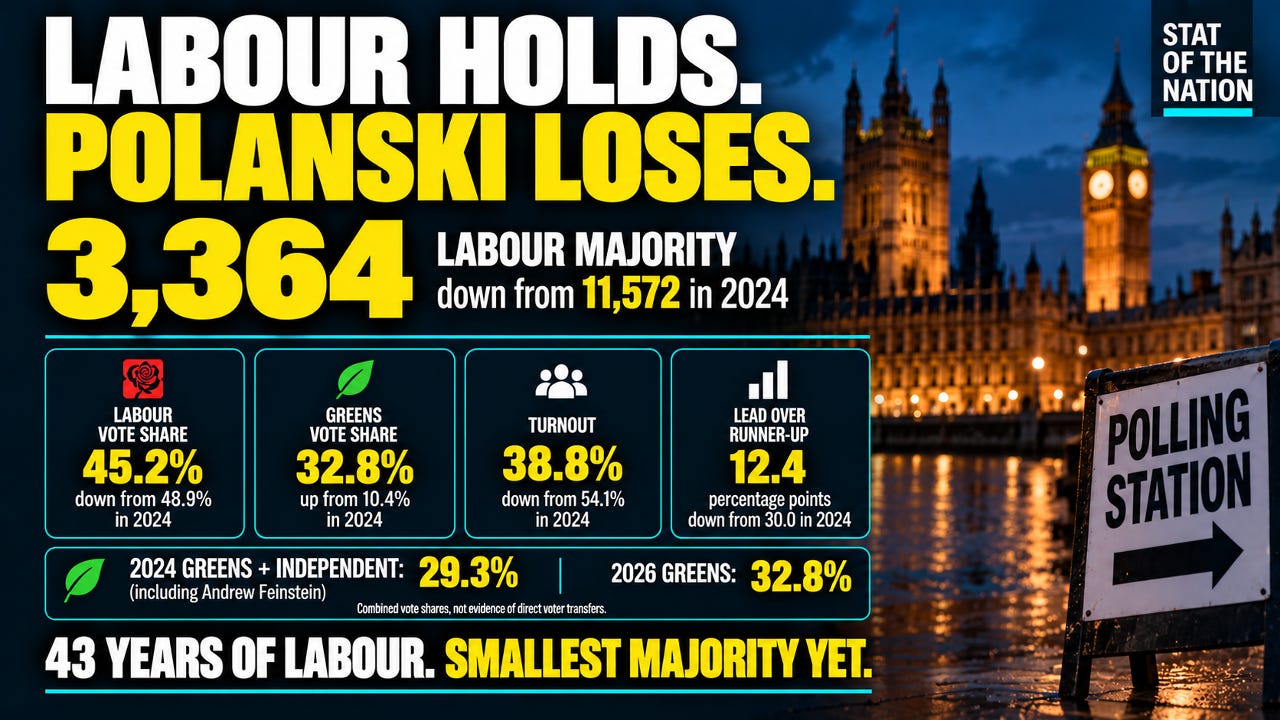
Labour’s Sagal Abdi-Wali secured 12,292 votes, equivalent to 45.2% of the total. Zack Polanski finished second with 8,928 votes, or 32.8%.
That gave Labour a majority of 3,364 votes.
Compare that with the 2024 general election, when Starmer won 48.9% of the vote and secured a majority of 11,572.
Labour’s vote share has fallen by 3.7 percentage points, while its majority has dropped by more than 8,000 votes.
But turnout matters.
In 2024, turnout was 54.1%. At the by-election, it fell to just 38.76%, a decline of more than 15 percentage points.
Fewer than four in ten eligible voters participated, so simply comparing the number of votes in Labour’s majority risks exaggerating the change.
The more revealing statistic is Labour’s lead over its nearest challenger. That narrowed from approximately 30 percentage points in 2024 to just 12.4 points in the by-election.
Of course, the identity of the runner-up also changed, and differences in turnout mean we cannot assume the same voters switched directly from Labour to the Greens.
Nevertheless, Labour’s share of the vote has declined, and its lead over the main challenger is considerably smaller than it was two years ago.
That is important context when assessing claims of a decisive electoral breakthrough.
Did the Greens Really Surge?
At first glance, the Green Party’s performance looks remarkable.
Its vote share increased from 10.4% at the 2024 general election to 32.8% in the by-election.
An increase of 22.4 percentage points sounds like an extraordinary surge.
But there is a crucial detail missing from that comparison.
In 2024, independent candidate Andrew Feinstein secured 18.9% of the vote, finishing second behind Starmer. Feinstein subsequently backed Polanski, while the Camden People’s Alliance, which had previously supported Feinstein, also endorsed the Green candidate.
Add the 2024 Green and Feinstein vote shares together and the total is 29.3%.
Compare that with Polanski’s 32.8% and the difference is just 3.5 percentage points.
This does not mean every Feinstein supporter voted Green, nor does it allow us to identify individual voting movements between the two elections.
But the figures are consistent with much of the apparent Green surge reflecting the consolidation of an existing left-of-Labour vote rather than an entirely new wave of support.
And after all that, Polanski still failed to win.
The defeat also comes amid controversy within the Green Party following its conference vote on Zionism, which attracted criticism from senior figures including former leader Caroline Lucas and Green MP Siân Berry.
We cannot know whether the controversy influenced enough voters to change the outcome, but it has added to the pressure on Polanski following his defeat.
The Greens have demonstrated that they can mount a substantial challenge in an established Labour constituency. What they have not demonstrated is an ability to convert that support into a Westminster seat in this contest.
The Burnham Bounce: Labour Is Recovering Nationally
While the by-election tells us about one London constituency, the national opinion polls provide a broader picture.
And there is evidence that Labour’s position has improved significantly since Andy Burnham replaced Keir Starmer.
In YouGov polling conducted around the leadership transition in July, Labour stood at 20%. By early October, that had increased to 27%, a rise of seven percentage points.
Survation tells a similar story. Labour has risen from 24% in its final pre-Burnham polling to 30% in its latest survey, conducted between 2 and 5 October.
That latest Survation poll also puts Reform UK on 24%, the Conservatives on 19%, the Liberal Democrats on 9% and the Greens on 8%.
Across recent national polls, Labour is averaging approximately 28%, compared with around 23% for Reform, 19% for the Conservatives and 10% each for the Greens and Liberal Democrats.
That represents a considerable improvement for Labour.
But there are two important qualifications.
First, Labour won 33.7% of the national vote at the 2024 general election. Even after its recovery, the party remains several points below the support that delivered its parliamentary landslide.
Second, the improvement is not simply the result of Reform losing large numbers of voters.
In the comparable YouGov polls, Labour has gained seven percentage points since July while Reform has fallen by just one.
The recovery therefore appears to involve Labour winning back former supporters and improving its position against other parties, rather than relying on a major collapse in Reform’s vote.
YouGov’s research also indicates that public attitudes towards Labour have improved under Burnham, although views of the party remain considerably less favourable than views of the Prime Minister personally.
And we should be careful about attributing the entire improvement to one politician. Survation has identified an upward trajectory for Labour beginning in June, before Burnham entered Downing Street.
Nevertheless, Labour’s national recovery is measurable, and the party is now in a much stronger polling position than it was during the final months of Starmer’s leadership.
The national polls provide more compelling evidence of that improvement than a by-election victory in a constituency Labour has held for more than four decades.
Could Labour Win Another Election With Less Than 30%?
The polling also raises a fascinating question about Britain’s electoral system.
Could Labour secure another parliamentary majority while winning less than 30% of the national vote?
Potentially, yes.
At the 2024 general election, Labour won 411 of the 650 parliamentary seats despite securing just 33.7% of the vote.
Reform UK, by comparison, received 14.3% but won only five seats.
The Liberal Democrats secured 12.2% and won 72 seats.
That is the extraordinary effect of first-past-the-post.
It is not simply how many votes a party receives nationally, but where those votes are concentrated.
With Reform UK and the Conservatives competing for many of the same voters, Labour could benefit from a divided opposition even if its own national vote share remains relatively modest.
At the same time, the Greens could continue threatening Labour in urban constituencies, while the Liberal Democrats remain competitive elsewhere.
This makes translating national voting intention into parliamentary seats particularly difficult. Small changes in the distribution of votes could produce very different election results.
Labour does not necessarily need to return to its 2024 vote share to remain competitive for another majority.
But a polling lead today is no guarantee of an election victory, particularly when the next general election could still be years away.
What Do the Numbers Really Tell Us?
Labour has held a constituency it has never lost, while Zack Polanski has failed to turn substantial Green support into a parliamentary victory.
The reduction in Labour’s majority is significant, although low turnout and the presence of a prominent independent candidate in 2024 complicate direct comparisons.
And the apparent Green surge looks much less dramatic once the previous independent vote is considered.
But the bigger political story may be emerging in the national polls.
Labour has recovered six or seven percentage points in comparable surveys around the leadership transition, even though its support remains below the level recorded at the 2024 general election.
With the opposition vote divided between Reform, the Conservatives, the Greens and Liberal Democrats, that recovery could have substantial consequences when Britain next goes to the polls.
Burnham has won the by-election. The question now is whether he can win back the country.
And on that question, the national polling is increasingly encouraging for Labour, but the verdict is far from settled.
✍️ Jamie Jenkins
Stats Jamie | Stats, Facts & Opinions
If you found this analysis useful, please share it and subscribe for more.
📲 Follow me here for more daily updates:
I was surprised that so many people would still vote green but I see that there is a sizeable Muslim population in the constituency.
Great analysis as always. The polls said we'd lose the Brexit vote too Jamie, I think we'll surprise them again once Labour actually DO something rather than kick it down the road. The budget will be interesting, let's see what the bond markets and polls say after that !