


For decades, Welsh politics was built around one assumption: Labour would always be the dominant force. That assumption has now collapsed.
Plaid Cymru has emerged as the largest party in the Senedd with 43 seats, just six short of a majority. Reform UK finished second with 34 seats, Labour fell to 9, the Conservatives held 7, the Greens won 2 and the Liberal Democrats took 1. This was the first time since devolution that Welsh Labour will not form the government, and turnout passed 50% for the first time in a Senedd election.
This is not just a poor result for Labour. It is political rock bottom in Wales under Keir Starmer. But it is also not quite the story some expected. Reform broke through in a major way, but the party that came out on top was Plaid Cymru — a nationalist-left party that managed to take the anti-Labour energy and turn it into a serious route to power.
The Polls Were Mixed — But the Direction Was Clear
Some polling and commentary suggested Plaid Cymru and Reform were locked in a much tighter contest. There were moments in the campaign where the story felt like Reform could finish ahead, or at least push Plaid much closer than the final result showed.
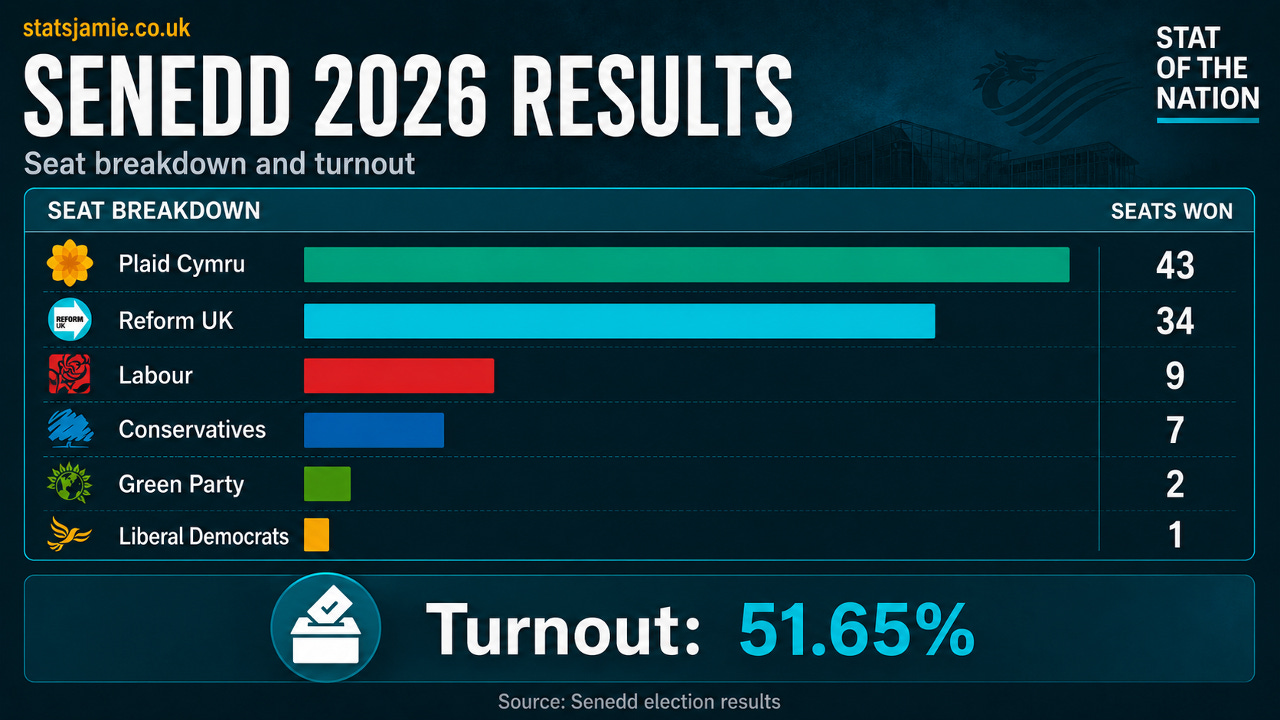
But it would be wrong to say all the polls missed it. They did not. The final YouGov MRP for ITV Cymru Wales and Cardiff University had Plaid Cymru on course to win 43 seats, with Reform UK on 34 — exactly where the election landed. The lesson is not that polling is useless. The lesson is that some polls and some campaign narratives captured the direction better than others.
The wider political point is that the mood on the ground was clearer than some of the campaign noise suggested. The Caerphilly by-election had already shown that Labour’s lost vote was not simply moving in one direction. Reform was clearly gaining support, but Plaid Cymru was also becoming the more natural destination for many former Labour voters, especially in parts of Wales where the party had built local credibility.
That is why this result should not be treated as a complete shock. The signs were there. Labour’s vote was breaking apart, and Plaid Cymru was better placed than many realised to benefit from that collapse.
Labour’s Fortress Has Fallen
Welsh Labour used to look immovable. It dominated the post-devolution era, controlled the Welsh Government for more than two decades, and treated large parts of Wales as safe territory. That old political machine has now broken.
Nine seats is not a difficult election result. It is a collapse. Labour has been pushed into third place, behind both Plaid Cymru and Reform UK, while First Minister Eluned Morgan lost her seat and resigned as Welsh Labour leader.
The challenge for Labour is that this happened while the party is in power at Westminster. Keir Starmer has not revived Labour’s fortunes in Wales; he has presided over one of its worst results. That creates a serious political problem because Labour can no longer claim to be the automatic governing party of Wales. It now has to earn that position back from near rock bottom.
There is a possible upside for Labour, but only in the long term. When Starmer eventually goes, Labour may be able to argue for a reset and say this was the low point. But voters do not return just because a party changes leader. Labour needs a reason for people to come back, and that is where the problem becomes much harder.
Labour’s Route Back Is Blocked by Plaid Cymru
Labour’s lost voters have not simply moved to Reform. Many have moved to Plaid Cymru, and that creates a much deeper strategic problem.
If Labour wants to recover in Wales, it needs to win back voters who now see Plaid Cymru as the main alternative. But if Labour helps Plaid govern too closely, it risks validating Plaid as the natural party of government. It could end up keeping Plaid in office while making it even harder to challenge them later.
That is Labour’s quandary. A formal deal with Plaid Cymru may look tempting in the short term. It could give Labour influence and keep Reform away from power. But in the long term, it could be disastrous. Labour would be tied to Plaid’s record, unable to fully oppose the government, and still unable to rebuild a distinct offer of its own.
Scotland should be the warning. Labour once dominated there too. Then the SNP became the main anti-Labour force, and Labour spent years trying to recover from a political realignment that it failed to understand quickly enough.
Wales is not Scotland. But the risk for Labour is obvious. If Plaid Cymru becomes the party that former Labour voters trust to run Wales, Labour could find itself locked out for a generation.
Reform Broke Through — But Plaid Blocked Them
Reform UK will rightly point to 34 seats as a major breakthrough. They now have a serious presence in Welsh politics, a platform inside the Senedd, and a base from which to build.
But this was not an uncomplicated success. The electoral map matters. In much of Wales, including parts of the Valleys where Reform may have expected to do especially well, Plaid Cymru came out ahead. That is crucial because Westminster elections are fought under first-past-the-post, where finishing second can mean finishing nowhere.
For Nigel Farage, the Welsh result is therefore a warning as well as an opportunity. Reform has proved it can win support. It has not yet proved it can dominate enough places to turn that support into Westminster seats.
In a proportional Senedd election, 34 seats is huge. In a Westminster election, coming second across large parts of Wales could leave Reform with far less to show for it. That is why this result matters beyond the Senedd. It suggests Reform is a major force in Welsh politics, but not necessarily the main anti-Labour vehicle everywhere. In many places, Plaid Cymru got there first.
The Greens Failed to Turn Polling Into Power
The Green Party also needs to be part of this story, because their result shows something important about where the left-wing anti-Labour vote actually went.
During the campaign, the Greens appeared to have some momentum. Under the new Senedd system, with Labour’s vote collapsing and voters looking for alternatives, there was a clear opportunity for them to break through. In the end, they won just 2 seats. That gets them into the Senedd, but it is not a major political breakthrough.
The problem for the Greens is that the left-wing protest vote in Wales did not mainly go to them. It went to Plaid Cymru. For voters who wanted to punish Labour but did not want to move right, Plaid looked like the more serious vehicle for change.
That matters because Plaid Cymru managed to occupy the space the Greens might have hoped to grow into: anti-Labour, left-of-centre, Welsh-focused and electorally credible. The Greens may have picked up representation, but they failed to turn favourable conditions into meaningful political power.
In a fragmented Senedd, 2 seats can still matter. But the bigger lesson is obvious. Labour’s collapse did not create a major Green surge. It created a Plaid Cymru landslide.
The Conservatives Survived — And That Matters
For the Conservatives, this was not a strong result in any traditional sense. Seven seats is still a small presence in the Senedd, and they remain well behind Plaid Cymru and Reform.
But survival matters. Before the election, there was talk of the Welsh Conservatives being wiped out entirely. That did not happen. In a political system this fragmented, simply remaining on the board gives the party something to build from.
The Conservatives now have a chance to reposition themselves. They are no longer the main challenger to Labour in Wales, and Reform has clearly taken much of the anti-establishment energy on the right. But if Reform struggles to convert Senedd success into Westminster seats, and if Labour remains weak, the Conservatives may see an opportunity to rebuild as a smaller, more disciplined force.
They are wounded. But they are not extinct.
What This Means for Wales
This result changes the political direction of Wales. Labour’s dominance has ended. Plaid Cymru is now the largest force in the Senedd and the party most likely to lead the next Welsh Government. Reform has broken through, but the map suggests Plaid may be better placed in many areas that matter for Westminster. The Conservatives have survived, while the Greens failed to turn favourable conditions into a meaningful breakthrough.
The immediate question is how Plaid Cymru governs. With 43 seats, they are six short of the 49 needed for a majority. They could try to govern as a minority, relying on support issue by issue. Labour could support them informally, but a formal deal would carry serious risks for Labour’s future.
The bigger question is whether this is the start of a long-term realignment. If Plaid Cymru governs competently, they could become the natural party of government in Wales. If Labour fails to rebuild, the old Labour vote may not come home. If Reform cannot turn its breakthrough into local dominance, it may find that the Welsh political map is much less helpful than the headline seat total suggests. And if the Greens cannot convert left-wing dissatisfaction with Labour into seats, they risk being squeezed by Plaid whenever Welsh voters want change without moving right.
That is the core story. Wales has not simply moved from Labour to Reform. It has rejected Labour’s old dominance and handed the initiative to Plaid Cymru.
For Wales, this is a new era.
Not Labour Wales.
Not Reform Wales.
Plaid Wales — at least for now.
And everyone else now has to work out how to respond.
✍️ Jamie Jenkins
Stats Jamie | Stats, Facts & Opinions
📢 Call to Action
If this helped cut through the noise, share it and subscribe free by entering your email in the box below and get the stats before the spin, straight to your inbox (no algorithms).
📚 If you found this useful, you might also want to read:
Britain Is Heading For 71 Million. Where Are They All Supposed To Go?

The latest ONS population projections should trigger a serious national debate.
📲 Follow me here for more daily updates:
Interesting but equally worrying and reference to what the
results would mean in Westminster via the first past the post system ie where Reform Wales would fail to gain so few seats only adds impetus to the idea that a Reform/ Tory pact in inevitable at some point