

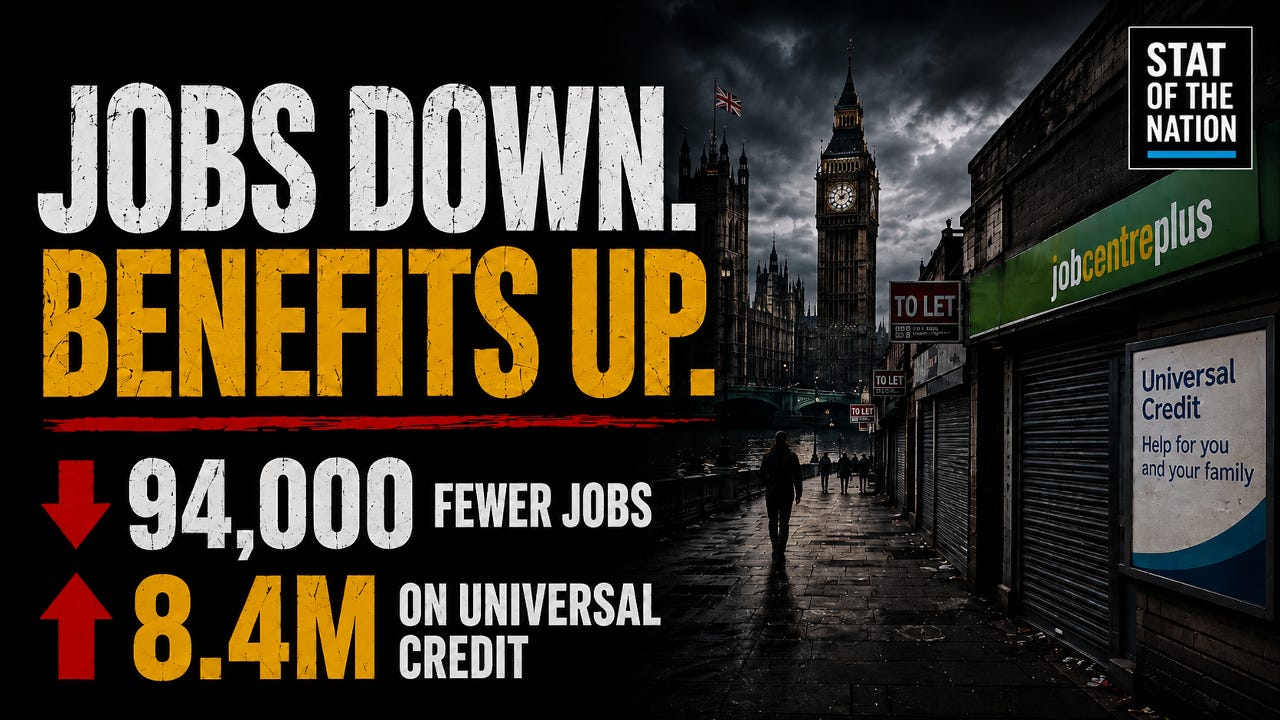
Two sets of official statistics released this week paint a worrying picture.
On one side, Britain is still losing payrolled jobs.
On the other, the number of people on Universal Credit has reached another record.
There are important caveats behind both sets of figures. But put them together and there is a warning Britain shouldn’t ignore.
We need more businesses creating jobs and more people able to move into work. Right now, the numbers are moving in the opposite direction.
Britain Is Still Losing Jobs
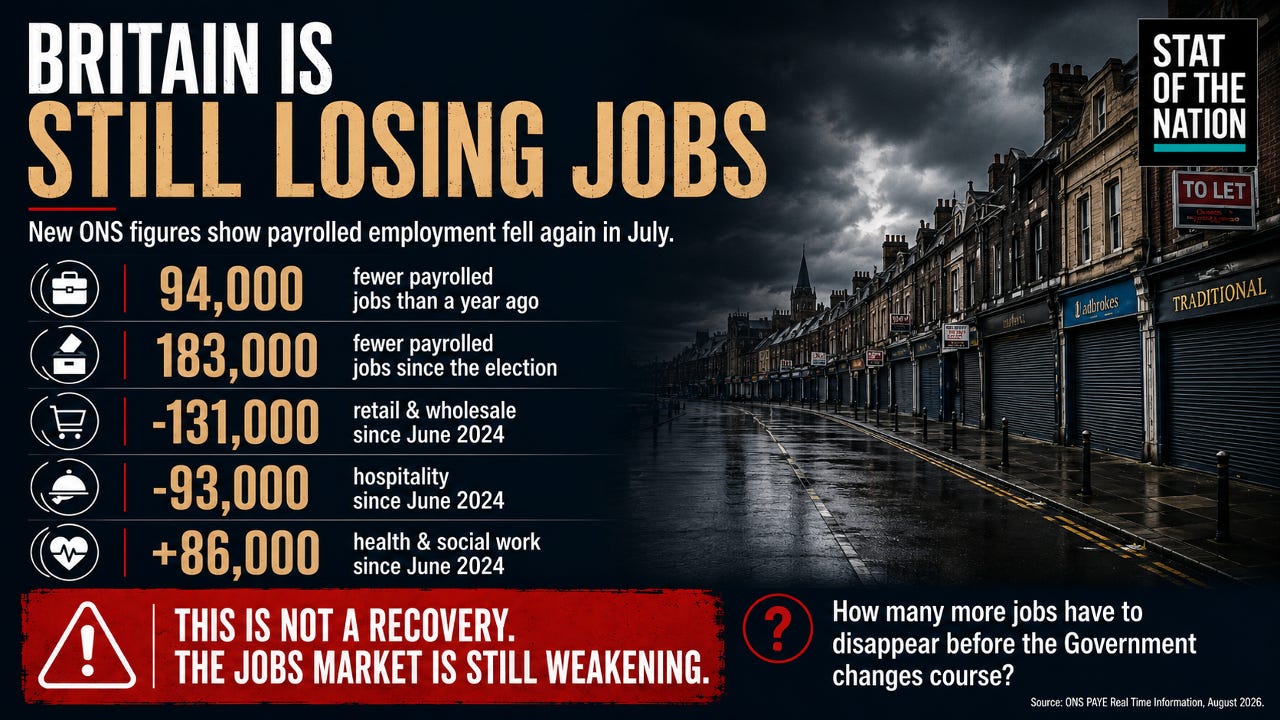
Latest HMRC payroll figures published by the Office for National Statistics show there were 30.3 million payrolled employees in July 2026.
That’s 94,000 fewer than a year ago.
Employee numbers were also down another 13,000 on June, although that latest monthly estimate is provisional and may be revised.
The bigger picture is clear enough: payroll employment peaked during 2024 and has subsequently fallen.
And some parts of the economy are being hit much harder than others.
Wholesale and retail employment has fallen by 75,000 in just one year, the largest fall of any major sector.
Hospitality is struggling too. Payrolled employment in accommodation and food services was 2.8% lower than a year earlier, the largest percentage fall among the major sectors.
These are sectors employing millions of people and providing many of the entry-level jobs that help people get into the labour market.
They are also operating against a backdrop of higher employment and operating costs.
And the ONS itself says:
“Feedback from our Vacancy Survey suggests that some firms may not be recruiting because of increases in labour costs and other operating expenses.”
That matters.
Businesses don’t create jobs simply because politicians want them to. If employing someone becomes more expensive while margins are being squeezed elsewhere, firms have an obvious incentive to recruit less, cut hours or reduce headcount.
The jobs machine isn’t firing as it should.
Meanwhile, Universal Credit Hits 8.4 Million
Alongside the latest labour-market figures, the Department for Work and Pensions published its latest Universal Credit statistics.
There are now:
8.4 MILLION people on Universal Credit.
That’s the highest number since the benefit was introduced.
It’s up from 7.7 million a year ago and dramatically higher than the 5.5 million recorded in early 2022.
But this needs some important context.
Simply looking at that increase and concluding that millions more people have suddenly become dependent on benefits would be wrong.
Much of the Rise Has Been People Moving From Old Benefits
Universal Credit has been replacing a range of older benefits.
That process, known as Move to Universal Credit, or managed migration, has transferred large numbers of existing benefit recipients onto UC.
And it explains most of the spectacular increase we’ve seen over the past couple of years.
Between December 2023 and December 2025, the Universal Credit caseload increased by around 2 million people.
Around 1.6 million, roughly 78% of that increase, were people moved onto Universal Credit through managed migration.
That’s an important distinction.
They weren’t 1.6 million completely new people entering the welfare system. Many were already receiving support through Employment and Support Allowance, tax credits, Housing Benefit and other legacy benefits.
But this is where the latest figures get more interesting.
The managed-migration programme is now largely complete.
And since the beginning of this year, the underlying picture has started to change.
Between January and May:
the total UC caseload increased by around 37,000
managed-migration claimants actually fell by around 16,000
other UC claimants increased by around 52,000
In other words, the latest increase is no longer being driven by managed migration.
That’s what we need to watch now.
4.3 Million Have No Work Requirements
Perhaps the most striking number in the latest release is this:
4.3 MILLION Universal Credit claimants are now in the “no work requirements” group.
That’s more than half of everybody on Universal Credit.
By comparison, only around 1.6 million are in the “searching for work” group.
Again, context matters.
“No work requirements” does not mean millions of people simply choosing not to work.
It includes people whom the system does not currently require to look for or prepare for work, including many people with serious health conditions or disabilities and people with caring responsibilities.
And managed migration from health-related legacy benefits explains much of the historic increase.
But once again, look at what’s happening now.
Between January and May 2026, the no-work-requirements group increased by 87,000.
Only 10,000 of that increase came from managed migration.
The remaining 77,000, around 88% of the increase, came from other Universal Credit claimants.
That’s significant.
For years, one of the obvious explanations for the rapidly expanding no-work-requirements population was the transfer of existing ESA recipients.
That explanation is becoming much less relevant to the latest growth.
Fewer Universal Credit Claimants Are Working
Universal Credit is not simply an unemployment benefit.
Millions of people receive it while working because their earnings or household circumstances still make them eligible for support.
But the employment numbers have also weakened.
In April 2025, around 3.2 million Universal Credit claimants were in some form of employment, representing 41.9% of the caseload.
By April 2026 that had fallen to around 3.1 million — 37.7%.
Part of the fall in the percentage is explained by the changing composition of UC as people migrate from health-related benefits.
But the absolute number in employment has fallen too.
And that is happening at exactly the same time as the wider payroll figures show Britain losing employees.
How Has the Nationality Mix Changed?
There is another part of the Universal Credit data worth examining.
DWP nationality statistics show that in April 2026 there were approximately:
574,000 European Economic Area (EEA) nationals, excluding Ireland
526,000 non-EEA nationals
receiving Universal Credit.
The European Economic Area includes EU countries plus Norway, Iceland and Liechtenstein.
Combined, that’s around 1.1 million identifiable EEA or non-EEA nationals on Universal Credit.
A further roughly 188,000 people had no nationality recorded on DWP’s digital systems. We shouldn’t assume those people are foreign nationals, their nationality is simply unknown in this dataset.
The longer-term change among non-EEA nationals is particularly striking.
In April 2022, around 212,000 non-EEA nationals were recorded on Universal Credit.
By April 2026 that had increased to approximately 526,000.
That’s a rise of around 314,000, or 148% in four years.
For comparison, the overall Universal Credit caseload increased by around 50% over roughly the same period.
Nationality is recorded administratively and people’s circumstances can change. Eligibility for Universal Credit also depends on immigration and residency rules, being a foreign national does not automatically give somebody an entitlement to benefits.
But the scale and pace of that increase are still worth examining.
Jobs Down. Benefits Up.
None of these figures in isolation tells us everything about Britain’s economy.
There are legitimate reasons why people receive Universal Credit.
Millions of claimants work.
Much of the huge increase in UC over recent years was an administrative transfer from older benefits rather than new welfare dependency.
And many of those with no work requirements have health conditions, disabilities or caring responsibilities that genuinely prevent them from working.
Those facts matter.
But so does the direction of travel.
The latest data show that:
Britain has 94,000 fewer payrolled employees than a year ago
retail has lost 75,000 payrolled employees
hospitality employment is down 2.8%
a record 8.4 million people are on Universal Credit
4.3 million have no work requirements
the latest growth in that group is overwhelmingly not being driven by managed migration
Britain needs an economy that makes it easier for businesses to create jobs.
And we need a welfare system that supports people who genuinely cannot work, while doing everything reasonably possible to help those who can work into employment.
Jobs down and benefits up isn’t a direction Britain can afford to continue.
✍️ Jamie Jenkins
Stats Jamie | Stats, Facts & Opinions
If you found this analysis useful, please share it and subscribe for more.
📲 Follow me here for more daily updates:
I was in my local town yesterday. There were people who are always there. A good half a dozen of not elderly people with lots of dogs, tattoos, piercings, cigarettes, wacky-baccy and Red Bull. They clearly don't work and would be unemployable anyway. I know we are constantly told that not all disabilities are visible but...these are not sick people. They are the uneducated, unemployable underclass who the government facilitates in their lifestyles. They will have come from carehomes, broken homes, young offenders institutions. They will have been excluded from schools and have managed to get no education whatsoever. They will live on benefits in social housing in a world which is incredibly small and disfunctional. They have undoubtedly been diagnosed with all sorts of modern mental health issues such as ADHD and will be on a variety of Ritalin and anti-depressants. The government and the social care/charities world facilitate all this. These lost souls are being pushed even further down the list with the arrival of all the new universal credit seekers who will end up being the same but more dangerous (the new arrivals don't know the community rules that come with being a native - these sad people don't rape, murder or rob because they know it's wrong). I don't believe this is some Marxist government plan to get everyone unemployed and dependent on government handouts - that is a really dumb conspiracy theory - because the government has no money unless people work and pay tax. I think this is decades of government incompetence and mismanagement and ignorance. A decent government would be taking away benefits and entitlements and handouts which would force people to work or starve.
"Between January and May 2026, the no-work-requirements group increased by 87,000.
Only 10,000 of that increase came from managed migration.
The remaining 77,000, around 88% of the increase, came from other Universal Credit claimants.
That’s significant."
I can help explain this too. A simple query tells us the following;
1. The April 2026 Health Element Deadline (Rush to Apply)
A massive policy shift occurred on 6 April 2026, which created a strong financial incentive for claimants to report health conditions before that date. The Policy Change: Under the Universal Credit Act 2025, the monthly top-up for the Limited Capability for Work and Work-Related Activity (LCWRA) group was slashed roughly in half—from about £430 a month down to £217 a month—for new health claims. The Protection Rule: Anyone who was already receiving the health top-up or had reported their health condition before 6 April 2026 was legally "grandfathered" in, protecting their right to the higher payment amount. The Result: This created a huge surge in existing UC claimants rushing to formally submit medical evidence and start their Work Capability Assessments (WCA) in early 2026 to beat the cut-off date. As those assessments processed through the spring, thousands of claimants officially transitioned into the "no-work-requirements" group.🧠
2. Surging Mental Health and Complex Health Conditions
Beyond the policy deadline, the UK has seen a steady, underlying increase in claimants suffering from long-term illnesses, heavily driven by mental health conditions like severe anxiety, depression, and neurodevelopmental conditions like ADHD. Existing claimants who may have initially been in the "searching for work" category have increasingly transitioned into the health-exempt category as their conditions worsened or as they secured formal medical diagnoses.🛑
3. Backlogs and Paused Health Reviews
Once a claimant is placed into the LCWRA health category, they are exempt from looking for work. Historically, the DWP routinely reassessed these claimants to see if their health had improved. However, due to lingering administrative backlogs and pauses on regular health reviews within the Jobcentre system, people are entering the "no work requirements" group but rarely being transitioned out of it. This creates a "one-way valve" effect where the category grows continually.👶
4. The Removal of the Two-Child Limit
On 6 April 2026, the government also scrapped the two-child limit on Universal Credit, allowing families to claim additional child elements for a third child or more. Under UC rules, a lead caregiver of a child under the age of one is automatically placed in the "no-work-requirements" group. The removal of the cap made it financially viable and necessary for larger low-income families to update their UC structures, shifting more existing parent-claimants into temporary work exemptions based on their childcare responsibilities.💼
5. In-Work Earnings Threshold Crossings
The "no-work-requirements" group doesn't just include sick or disabled individuals; it also applies to people who earn above a certain financial threshold. If you work and your monthly wages cross the Conditionality Earnings Threshold (CET), the DWP considers that you are working enough and automatically removes your requirements to look for more work. In April 2026, the National Living Wage increased to £12.71 per hour. This automatic pay rise pushed a significant number of existing, low-earning part-time workers over their administrative thresholds, automatically reclassifying them into the "no-work-requirements" group without them changing their hours.
HTH!